Question: answer in would be #1,# 3, and then # 5. Finally, after the 5-question list, you will find a case entitled Meyer Mobile Homes Corporation.
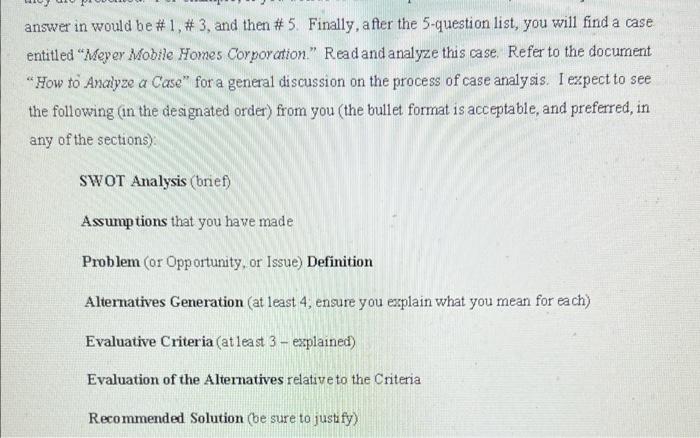
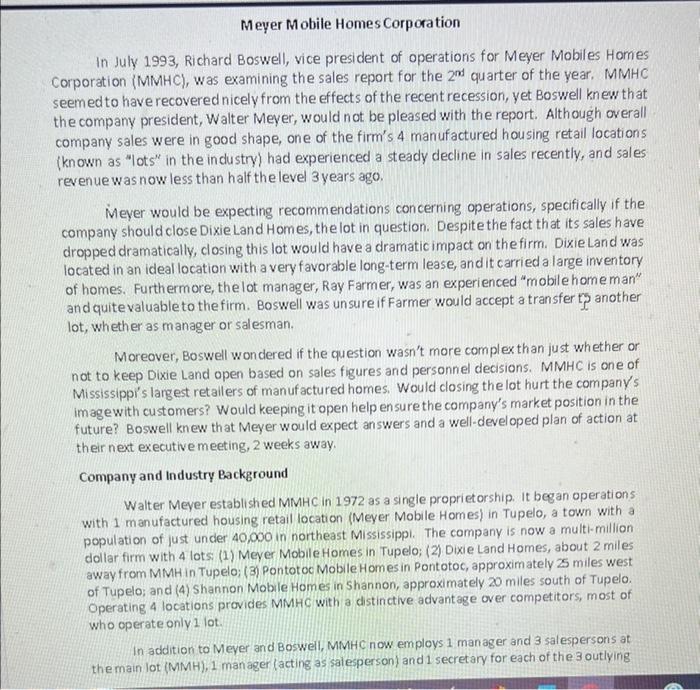
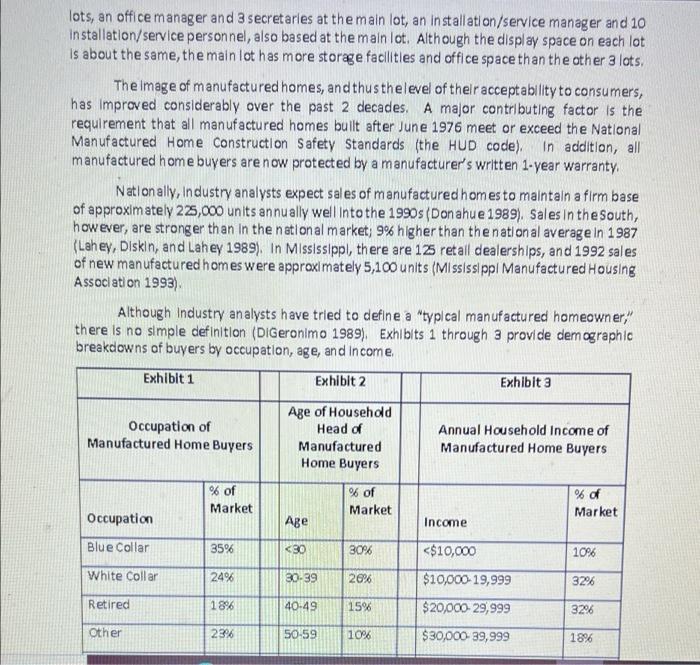
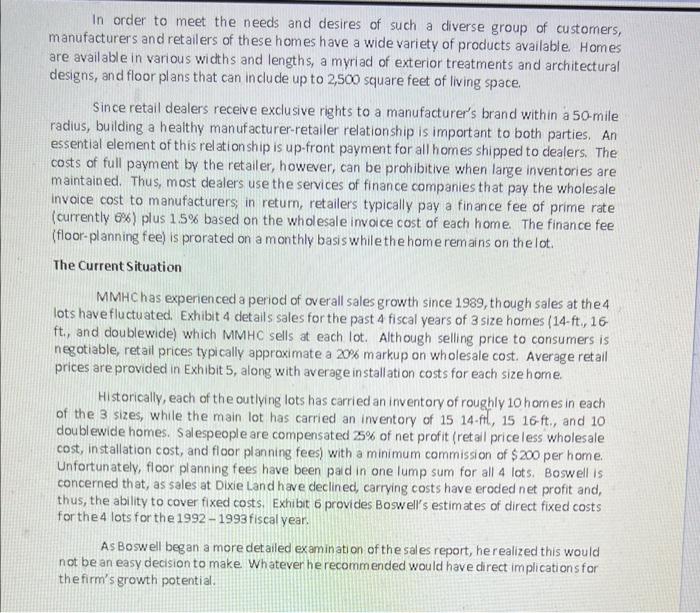
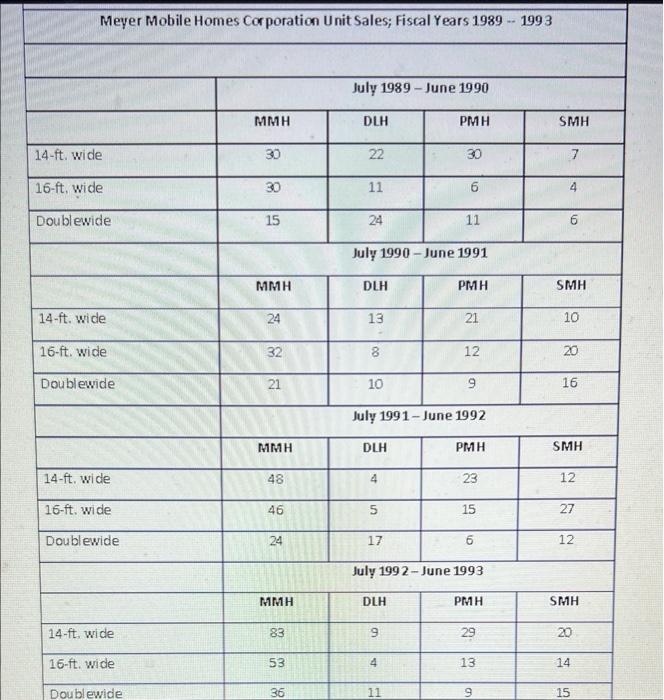
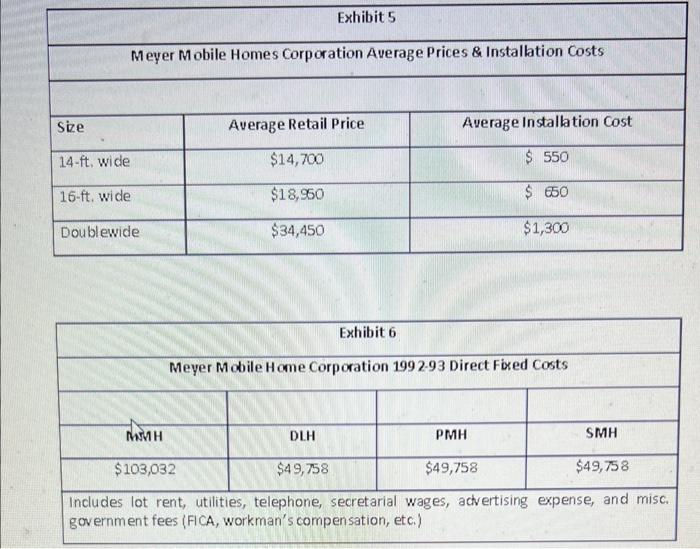
answer in would be #1,# 3, and then # 5. Finally, after the 5-question list, you will find a case entitled "Meyer Mobile Homes Corporation." Read and analyze this case. Refer to the document "How to Analyze a Case" for a general discussion on the process of case analysis. I expect to see the following (in the designated order) from you the bullet format is acceptable, and preferred, in any of the sections) SWOT Analysis (brief) Assumptions that you have made Problem (or Opportunity, or Issue) Definition Alternatives Generation (at least 4, ensure you explain what you mean for each) Evaluative Criteria (at least 3 - explained) Evaluation of the Alternatives relative to the Criteria Recommended Solution (be sure to justify) Meyer Mobile Homes Corporation in July 1993, Richard Boswell, vice president of operations for Meyer Mobiles Homes Corporation (MMHC), was examining the sales report for the 20 quarter of the year. MMHC seemed to have recovered nicely from the effects of the recent recession, yet Boswell knew that the company president, Walter Meyer, would not be pleased with the report. Although overall company sales were in good shape, one of the firm's 4 manufactured housing retail locations (known as "lots" in the industry) had experienced a steady decline in sales recently, and sales revenue was now less than half the level 3 years ago Meyer would be expecting recommendations concerning operations, specifically if the company should close Dixie Land Homes, the lot in question. Despite the fact that its sales have dropped dramatically, closing this lot would have a dramatic impact on the firm. Dixie Land was located in an ideal location with a very favorable long-term lease, and it carried a large inventory of homes. Furthermore, the lot manager, Ray Farmer, was an experienced "mobile home man" and quite valuable to the firm. Boswell was unsure if Farmer would accept a transferts another lot, whether as manager or salesman. Moreover, Boswell wondered if the question wasn't more complex than just whether or not to keep Dixie Land open based on sales figures and personnel decisions. MMHC is one of Mississippi's largest retailers of manufactured homes. Would closing the lot hurt the company's image with customers? Would keeping it open help ensure the company's market position in the future? Boswell knew that Meyer would expect answers and a well-developed plan of action at their next executive meeting, 2 weeks away, Company and Industry Background Walter Meyer established MMHC in 1972 as a single proprietorship. It began operations with 1 manufactured housing retail location (Meyer Mobile Homes) in Tupelo, a town with a population of just under 40,000 in northeast Mississippi. The company is now a multi-million dollar firm with 4 lots (1) Meyer Mobile Homes in Tupelo; (2) Dixie Land Homes, about 2 miles away from MMH in Tupelo; (3) Pontotoo Mobile Homes in Pontotoo, approximately 25 miles west of Tupelo; and (4) Shannon Mobile Homes in Shannon, approximately 20 miles south of Tupelo. Operating 4 locations provides MMHC with a distinctive advantage over competitors, most of who operate only 1 lot In addition to Meyer and Boswell, MIHC now employs 1 manager and 3 salespersons at the main lot (MMH), 1 manager (acting as salesperson) and 1 secretary for each of the 3 outlying lots, an office manager and 3 secretaries at the main lot, an installation/service manager and 10 Installation/service personnel, also based at the main lot. Although the display space on each lot is about the same, the main lot has more storage facilities and office space than the other 3 lots, The image of manufactured homes, and thus the level of their acceptability to consumers, has improved considerably over the past 2 decades. A major contributing factor is the requirement that all manufactured homes built after June 1976 meet or exceed the National Manufactured Home Construction Safety Standards (the HUD code). In addition, all manufactured home buyers are now protected by a manufacturer's written 1-year warranty Nationally, Industry analysts expect sales of manufactured homes to maintain a firm base of approximately 225,000 units annually well into the 1990s (Donahue 1989). Sales in the South, however, are stronger than in the national market; 9% higher than the national average in 1987 (Lahey, Diskin, and Lahey 1989). In Mississippl, there are 12 retall dealerships, and 1992 sales of new manufactured homes were approximately 5,100 units (Mississippi Manufactured Housing Association 1993) Although Industry analysts have tried to define a typical manufactured homeowner," there is no simple definition (DIGeronimo 1989)Exhibits 1 through a provide demographic breakdowns of buyers by occupation, age, and income Exhibit 1 Exhibit 2 Exhibit 3 Occupation of Manufactured Home Buyers Age of Household Head of Manufactured Home Buyers Annual Household Income of Manufactured Home Buyers % of Market % of Market % of Market Occupation Age Income Blue Collar 35%









 Study Help