







Question: Answer it in an Excel sheet please. You are a very powerful institutional investor that holds 1 million shares of Cisco System, Inc., purchased on
Answer it in an Excel sheet please.
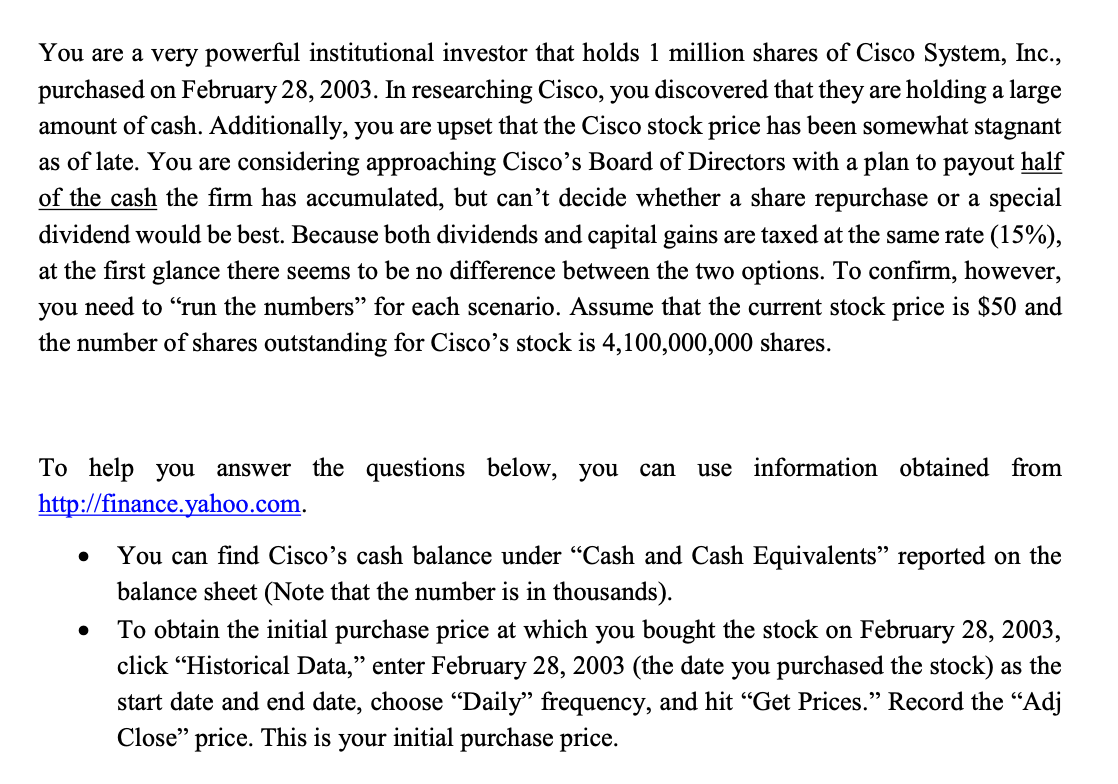
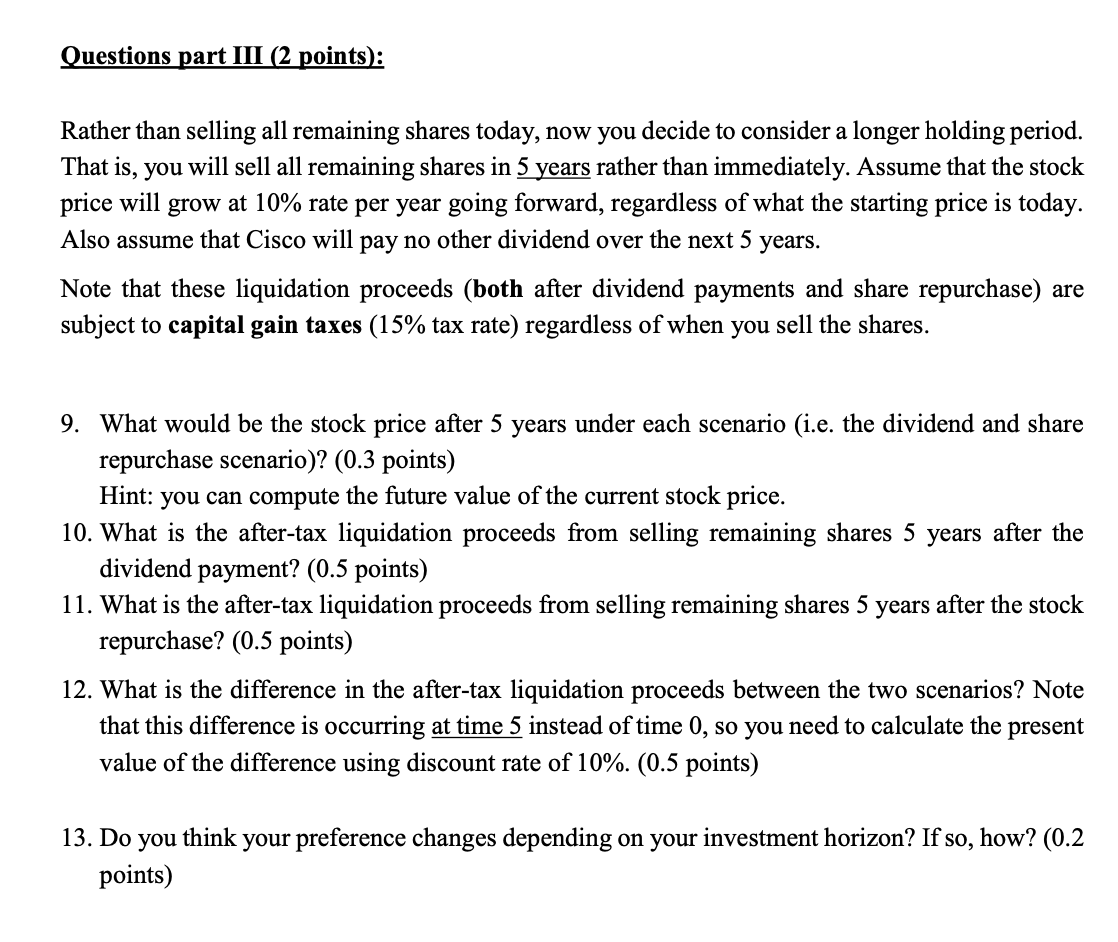
You are a very powerful institutional investor that holds 1 million shares of Cisco System, Inc., purchased on February 28, 2003. In researching Cisco, you discovered that they are holding a large amount of cash. Additionally, you are upset that the Cisco stock price has been somewhat stagnant as of late. You are considering approaching Cisco's Board of Directors with a plan to payout half of the cash the firm has accumulated, but can't decide whether a share repurchase or a special dividend would be best. Because both dividends and capital gains are taxed at the same rate (15\%), at the first glance there seems to be no difference between the two options. To confirm, however, you need to "run the numbers" for each scenario. Assume that the current stock price is $50 and the number of shares outstanding for Cisco's stock is 4,100,000,000 shares. To help you answer the questions below, you can use information obtained from http://finance.yahoo.com. - You can find Cisco's cash balance under "Cash and Cash Equivalents" reported on the balance sheet (Note that the number is in thousands). - To obtain the initial purchase price at which you bought the stock on February 28, 2003, click "Historical Data," enter February 28, 2003 (the date you purchased the stock) as the start date and end date, choose "Daily" frequency, and hit "Get Prices." Record the "Adj Close" price. This is your initial purchase price. Questions part III (2 points): Rather than selling all remaining shares today, now you decide to consider a longer holding period. That is, you will sell all remaining shares in 5 years rather than immediately. Assume that the stock price will grow at 10% rate per year going forward, regardless of what the starting price is today. Also assume that Cisco will pay no other dividend over the next 5 years. Note that these liquidation proceeds (both after dividend payments and share repurchase) are subject to capital gain taxes (15% tax rate) regardless of when you sell the shares. 9. What would be the stock price after 5 years under each scenario (i.e. the dividend and share repurchase scenario)? (0.3 points) Hint: you can compute the future value of the current stock price. 10. What is the after-tax liquidation proceeds from selling remaining shares 5 years after the dividend payment? (0.5 points) 11. What is the after-tax liquidation proceeds from selling remaining shares 5 years after the stock repurchase? (0.5 points) 12. What is the difference in the after-tax liquidation proceeds between the two scenarios? Note that this difference is occurring at time 5 instead of time 0 , so you need to calculate the present value of the difference using discount rate of 10%. (0.5 points) 13. Do you think your preference changes depending on your investment horizon? If so, how? (0.2 points) You are a very powerful institutional investor that holds 1 million shares of Cisco System, Inc., purchased on February 28, 2003. In researching Cisco, you discovered that they are holding a large amount of cash. Additionally, you are upset that the Cisco stock price has been somewhat stagnant as of late. You are considering approaching Cisco's Board of Directors with a plan to payout half of the cash the firm has accumulated, but can't decide whether a share repurchase or a special dividend would be best. Because both dividends and capital gains are taxed at the same rate (15\%), at the first glance there seems to be no difference between the two options. To confirm, however, you need to "run the numbers" for each scenario. Assume that the current stock price is $50 and the number of shares outstanding for Cisco's stock is 4,100,000,000 shares. To help you answer the questions below, you can use information obtained from http://finance.yahoo.com. - You can find Cisco's cash balance under "Cash and Cash Equivalents" reported on the balance sheet (Note that the number is in thousands). - To obtain the initial purchase price at which you bought the stock on February 28, 2003, click "Historical Data," enter February 28, 2003 (the date you purchased the stock) as the start date and end date, choose "Daily" frequency, and hit "Get Prices." Record the "Adj Close" price. This is your initial purchase price. Questions part III (2 points): Rather than selling all remaining shares today, now you decide to consider a longer holding period. That is, you will sell all remaining shares in 5 years rather than immediately. Assume that the stock price will grow at 10% rate per year going forward, regardless of what the starting price is today. Also assume that Cisco will pay no other dividend over the next 5 years. Note that these liquidation proceeds (both after dividend payments and share repurchase) are subject to capital gain taxes (15% tax rate) regardless of when you sell the shares. 9. What would be the stock price after 5 years under each scenario (i.e. the dividend and share repurchase scenario)? (0.3 points) Hint: you can compute the future value of the current stock price. 10. What is the after-tax liquidation proceeds from selling remaining shares 5 years after the dividend payment? (0.5 points) 11. What is the after-tax liquidation proceeds from selling remaining shares 5 years after the stock repurchase? (0.5 points) 12. What is the difference in the after-tax liquidation proceeds between the two scenarios? Note that this difference is occurring at time 5 instead of time 0 , so you need to calculate the present value of the difference using discount rate of 10%. (0.5 points) 13. Do you think your preference changes depending on your investment horizon? If so, how? (0.2 points)
Step by Step Solution
There are 3 Steps involved in it

Get step-by-step solutions from verified subject matter experts
 Study Help