







Question: Answer just this question: Why did google restructure itself and create Alphabet? What is it hoping to accomplish? Will Alphabets new structure with independent business
Answer just this question: Why did google restructure itself and create Alphabet? What is it hoping to accomplish? Will Alphabets new structure with independent business units enable it to innovate more?
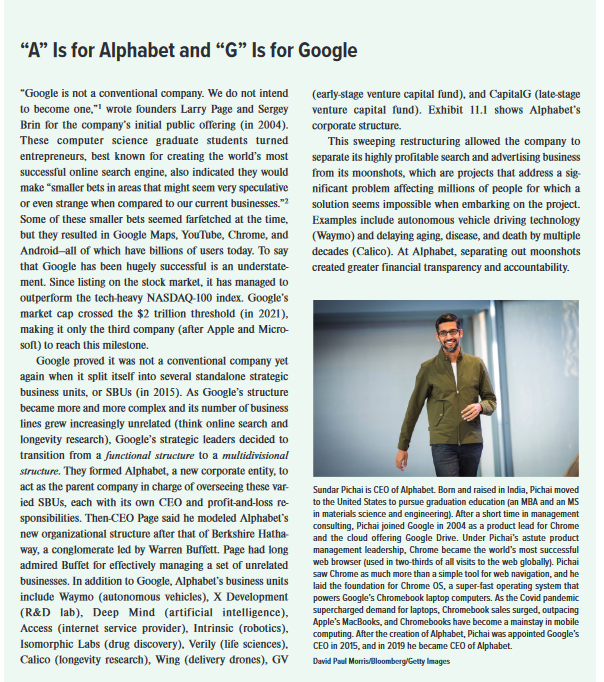
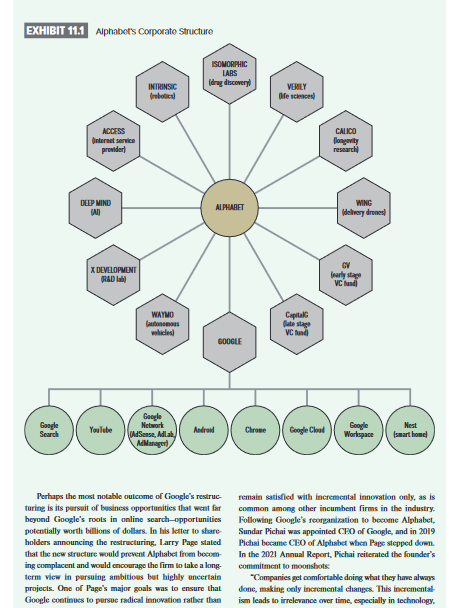
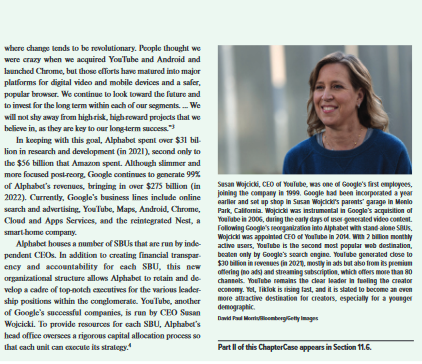
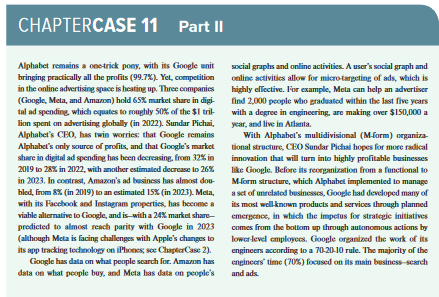
"A" Is for Alphabet and "G" Is for Google "Google is not a conventional company. We do not intend to become one,"1 wrote founders Larry Page and Sergey Brin for the company's initial public offering (in 2004). These computer science graduate students turned entrepreneurs, best known for creating the world's most successful online search engine, also indicated they would make "smaller bets in areas that might seem very speculative or even strange when compared to our current businesses." Some of these smaller bets seemed farfetched at the time, but they resulted in Google Maps, YouTube, Chrome, and Android-all of which have billions of users today. To say that Google has been hugely successful is an understatement. Since listing on the stock market, it has managed to outperform the tech-heavy NASDAQ-100 index. Google's market cap crossed the $2 trillion threshold (in 2021), making it only the third company (after Apple and Microsoft) to reach this milestone. Google proved it was not a conventional company yet again when it split itself into several standalone strategic business units, or SBUs (in 2015). As Google's structure became more and more complex and its number of business lines grew increasingly unrelated (think online search and longevity research), Google's strategic leaders decided to transition from a functional structure to a multidivisional structure. They formed Alphabet, a new corporate entity, to act as the parent company in charge of overseeing these varied SBUs, each with its own CEO and profit-and-loss responsibilities. Then-CEO Page said he modeled Alphabet's new organizational structure after that of Berkshire Hathaway, a conglomerate led by Warren Buffett. Page had long admired Buffet for effectively managing a set of unrelated businesses. In addition to Google, Alphabet's business units include Waymo (autonomous vehicles), X Development (R\&D lab), Deep Mind (artificial intelligence), Access (internet service provider), Intrinsic (robotics), Isomorphic Labs (drug discovery). Verily (life sciences). Calico (longevity research), Wing (delivery drones), GV (early-stage venture capital fund), and CapitalG (late-stage venture capital fund). Exhibit 11.1 shows Alphabet's corporate structure. This sweeping restructuring allowed the company to separate its highly profitable search and advertising business from its moonshots, which are projects that address a significant problem affecting millions of people for which a solution seems impossible when embarking on the project. Examples include autonomous vehicle driving technology (Waymo) and delaying aging, disease, and death by multiple decades (Calico). At Alphabet, separating out moonshots created greater financial transparency and accountability. Sundar Pichai is CEO of Alphabet. Born and raised in India, Pichai moved to the United States to pursue graduation education (an MBA and an MS in materials science and engineering). After a short time in management consulting. Pichai joined Google in 2004 as a product lead for Chrome and the cloud offering Google Drive. Under Pichai's astute product management leadership. Chrome became the world's most successful web browser (used in two-thirds of all visits to the web globally). Pichai saw Chrome as much more than a simple tool for web navigation, and he laid the foundation for Chrome OS, a super-fast operating system that powers Google's Chromebook laptop computers. As the Covid pandemic supercharged demand for laptops, Chromebook sales surged, outpacing Apple's MacBooks, and Chromebooks have become a mainstay in mobile computing. After the creation of Alphabet, Pichai was appointed Google's CEO in 2015, and in 2019 he became CEO of Alphabet. David Paul Morris/Dloomberg/Getty Images Howover, engincers dedicated one day a wock (20%) to developing ideas of their own choosing, and they spent the remainder (10\%) on total wild cards such as Project Loon, an envisioned network of high-altitude halloons that travel on the edge of space to provide wircless internet services to the people who do not have internet access-primarily those in rural and remole areas. An estimated 33% of the world's population ( 2.6 billion people) has never used the internet. Lovn appeared to be promisine, and as such it "graduated" from X Development (Alphahet's R\&D lab) and became a standalone unit with its own CliO in 2018. Yet, just three years later, Alphabet decided to shut Loon down. Loon CEOO Alastair Westyarth explained that despite years of heavy R\&D spending and engineering resources, the inability to drive down costs low crough to create "a long-term, sustainable business" led to Loon's termination. 10 Despite Looe's failure, Google has reported that half of its new products came from the 20% rula. These products include Gmail, Google Maps, Google News, Orkut, and AdSensa. AdSense started as an experiment by two Google eneineers: They attempted to match Gmail content with targeted ads based on that content. Today, AdSense enables content ereators such as bloezers to serve online ads that are targeled to the sillo's conlent. Although Google has a stellar track reeond for strategy process as planned emergence, it has fumbled its social networking endemors multiple times. These missteps left the space open to Meta, now Google's fieroest competitor in the digital ad space with its Facebook and Instheram properties. Google's first altempt at social networking goes back to 2002, two years (eons in internet time) before Facebook was founded. Google enginoer Orkut Buyukkokten had doveloped a social network, called Orkut, using his 20% discretionary timn. Marissa Mayer, then Google's vice president in charge of the project, liked what she saw and provided initial support. More engineers were eventually added to further Orkut's development. Google was astonished at Orkut's early success: Within the first month after its release, hundreds of thousands of people had siened up, By 2014, Orkut had 30 million users, mostly in Bravil and India. But this number paled in comparison to Facebook's moec than I bitlion users worldwide at the time. Why did Gooele fumble its early lead over Facebook? Google had a huge opportunity to become the leader in social networking because Myspace imploded after it was acquired by News Corp. Despite initial support, Google's top executives felt that social networking did not fit its visioe to onganize the wowld's information and make af uniwersally acossible and useful Google relied oe highly complex and proprietary sleorithms to organize the knowlodec available on the internet and serve up targeted scarch ads. Social networking software, in comparison, is fairly pedestrian. Additionally, Page and Brin, both excoptional computer scientists, felt their Page-Rank algorithm, which accounts for hundreds of variables and considers all available web. sites, was far superior because it provides objective recommendations to users' search queries rather than swbeclive endorsements by someone's online friends. As a consequence, they snubbed social networking. Moroover, given the many different projocts Google was pursuing at that time, the company's lop executives ranked Orkut as a low priority. Starved of further resources, the social netwodking sile wilhered and was evenlually shut down in 2014, making Meta the undisputed leader. In yot another effort to catch up with Meta, Google launched Google Plus in 2011. This social networking site integrated all of Google's services-Gimail, YouTube, Chrome, and others-into one user interface, It required users to sign into its portal, even if they were uxing just one Google product. After a data breach, Gooele Plus was shut down unceremoniously in 2019. Mearmhile, Meta has 3 billion active users on its platforms (Facebook and Instsgram)-and Cooglo is unable to access any of the information tied to these users. Not being able to access Meta users' activities on its social networks limits Google's ability to serve targeted ads, which in ture cuts directly into its main line of business. Mearwhile, Alphabet's CTOO Sundar Pichai is still hopine for anocher major breakthrough that will open up a new line of business beyond what Google does. Questions 1. Why did Google restructure itself and creale Alphaber? What is it hoping to accomplish? For additional insights, see Larry Page's post announcing the restructuring at hllps//abc:xyzl. 2. Do you think the reorganization is heneficial for Alphabet's moonshots, now housed in their own business unit with profit-and loss responsihility? Why or why not? lisplain. 3. Why has Google "failed" to develop other profitahle businesses? Is Goofle's stratcay proecss of planned emergence to blame? Why or why not? Will Alphahet's new structure with independent SBUs enable the company to innovate more and find the next highly profitable business beyond celline scarch snd advertis ing? [Hint: Take a look at Alphabet's most recent annusal report.] Alphabet remains a oootrick poey. with its Goople unit bringing practically all the profits (99.7\%). Yet, competition in the online advertising space is heating up. Three companies (Googlo, Meta, and Amaron) hold 65\% market share in digjtal ad spendine. which equates to moughly 50% of the $1 trillion spent on advertising globally (in 2022). Sundar Pichai, Alphabet's CEO, has twin worries; that Google remains Alphabet's anly source of profits, and that Google's market share in dieital ad spending has been decreasine, from 32% in 2019 to 28% in 2022 , with another estimated decrease to 26% in 2023, In coetrest, Amaxon's ad besiness has alnest doubled, from 8\% (in 2019) to an estimated 15\% (in 2023). Meta, with its Facebook and Instagram propertics, has become a viahle aliernative to Google, and is-with a 24% market shareprodicted to almost reach parity with Google in 2023 (although Meta is facing challenges, with Apple's changes to its app trackine, tedinolory on (Phoes, sce Chaptcare 2). Google has data on what people search for. Amarnn has data on what people buy, and Meta has data on people's social graphs and online activities. A user's social graph and celine sctivities allow for microtsreting of ads, which is highly eflective. For example, Meta can help an advertixer find 2,000 poople who graduatiod within the list five years with a degree in engineering, are making over $150,000 a year, and live in Adkenta. With Alphabet's multidivisional (M-form) organizational strocture, CEO Sundar Pictai hopes for more radical innovation that will turn into highly profitable businesses like Goople. Before its reorganization from a functional to Mform structure, which Alphabet implemented to manage a set of unrelated businesses, Goople had developed many of its most wellknown products and services through planned emerpence, in which the impetus for stratceie initiatives comes from the bottom up through autonomous actions by lowertevel employees. Goople organized the wotk of its engineers according to a 70-20-10 rule. The majority of the enpinecrs' time (70%) focused on its main business-sestch and ads. Perhaps the most notable outcome of Google's restructuring is its pursuit of besiness opportunities that wat far beyond Google's roots in online search-opportunities potentially worth billions of dollars. In his ketter to shareholders announcing the restructuring, Iarry Page stated that the new structure mould prevent Alphabet from bexoming complacent and would encourage the firm to take a longterm vicw in pursuing ambitious bet hiphly uncertain projects. One of Page's major goals was to ensure that Goople continues to pursuc radieal innovation rather than remain satisfled with incremental innoration only, as is common among other incumbent firms in the industry. Following Goople's reorganization to become Alphabet, Sundar Pichai was appointed CFO of Google, and in 2019 Pichsi became CEO of Alphsbet when Pags stepped dom. In the 2021 Annual Report, Pichai reiterated the founder's commitment to moonshots: "Companies get comfortable doing what they have always done, making celly incremental chaness. This incrementalism leads to irrelevance over time, especially in technology. where change tends to be revolutionary. Poople thought we were craxy when we acquired YouTube and Android and launchad Chrume, but those eflorts haro matured inlo major platforms for digital video and mobile devices and a safer, popular beuwser. We continue to look toward the fulure and to irvest for the long term within each of our segments. .. We will not shy away from highrisk, highroward projocts that we believe in, as they are bey to our long-term sacoess. y In kecping with this goal, Alphabet spent over $31 billion in research and development (in 2021), second only to the $56 billion that Amason spent. Although slimmer and more focused post-reorg. Google continues to generate 99% of Alphabet's revenues, bringing in over $275 bellion (in 2022). Currently, Google's business lines include online search and advertising. YouTube, Maps, Android, Chrome, Cloud and Apps Services, and the reintegrated Nest, a smart bome company. Alphabet houses a number of SBUts that are rue by independent CEOs. In addition to creating financial transparency and accomntability for each SBU, this new organizational structure allows Alphabet to retain and develop a cadre of top-notch executives for the various leadership positions within the conglomerate. YouTube, another of Goofle's successful companies, is rus by CEO Sesan Wojcicki. To provide resources for each SBU, Alphabd's head office oversees a rigorous capital allocation process so that each unit can erceute its strategy." Sasan Wojoick, cEO of Youlute, mas oae of Geogle's fist enpioyees, joining the conapary is 1969. Coogie had been incerpecated a year earlier and set up shop in Sursan Wojcldor's pareats' garage in Menib Park, Calfornia. Wajocke was instrumental in Cooglo's acquistion of Wojack Was appointed CFO of Youllite in 204 . Whe 2 billon nonttiy actiwe asers, Youlube is the second nost popalar wob destination, bealen oaly by Eoogle's sesech engine. Youlube generaled dose to otlerieg ino ads and streaning satrofiption, which effers mose thas 80 channok. Woutube remains the clear leader in fualing the creator ecenony. ket, likfok is rising last, and it is stated to become an erch more arouctive destitstion for creators, especially for a youtger denogreptic. Part II of this ChapterCase appears in Section 11.6
Step by Step Solution
There are 3 Steps involved in it
Google restructured itself to create Alphabet in order to improve management of its growing number o... View full answer

Get step-by-step solutions from verified subject matter experts
 Study Help