







Question: answer me 4 and 5 no. now 4. Consider the experiment of rolling a pair of dice. Suppose that we are interested in the sum
answer me 4 and 5 no. now
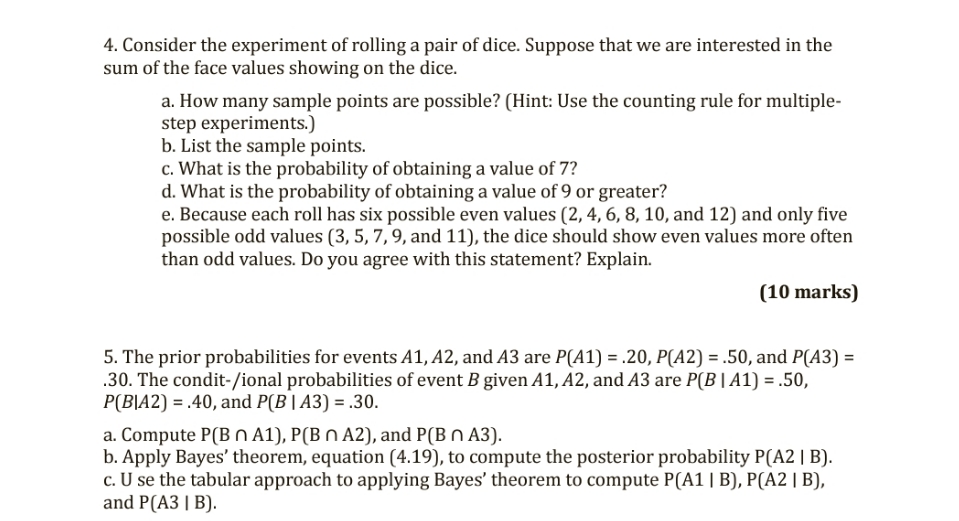
4. Consider the experiment of rolling a pair of dice. Suppose that we are interested in the sum of the face values showing on the dice. a. How many sample points are possible? (Hint: Use the counting rule for multiple- step experiments.) b. List the sample points. c. What is the probability of obtaining a value of 7? d. What is the probability of obtaining a value of 9 or greater? e. Because each roll has six possible even values (2, 4, 6, 8, 10, and 12) and only five possible odd values (3, 5, 7, 9, and 11), the dice should show even values more often than odd values. Do you agree with this statement? Explain. (10 marks) 5. The prior probabilities for events A1, A2, and A3 are P(A1) = .20, P(A2) = .50, and P(A3) = 30. The condit-/ional probabilities of event B given A1, A2, and A3 are P(B | A1) = .50, P(BIA2) = .40, and P(B | A3) = .30. a. Compute P(B n A1), P(B n A2), and P(B n A3). b. Apply Bayes' theorem, equation (4.19), to compute the posterior probability P(A2 | B). c. Use the tabular approach to applying Bayes' theorem to compute P(A1 | B), P(A2 | B), and P(A3 | B)
Step by Step Solution
There are 3 Steps involved in it

Get step-by-step solutions from verified subject matter experts
 Study Help