





Question: Answer NAME: NAME: (21) In a randomized trial, if pretest measures of the dependent variable for the treatment and control groups are close to identical

Answer
Answer NAME: NAME: (21) In a randomized trial, if
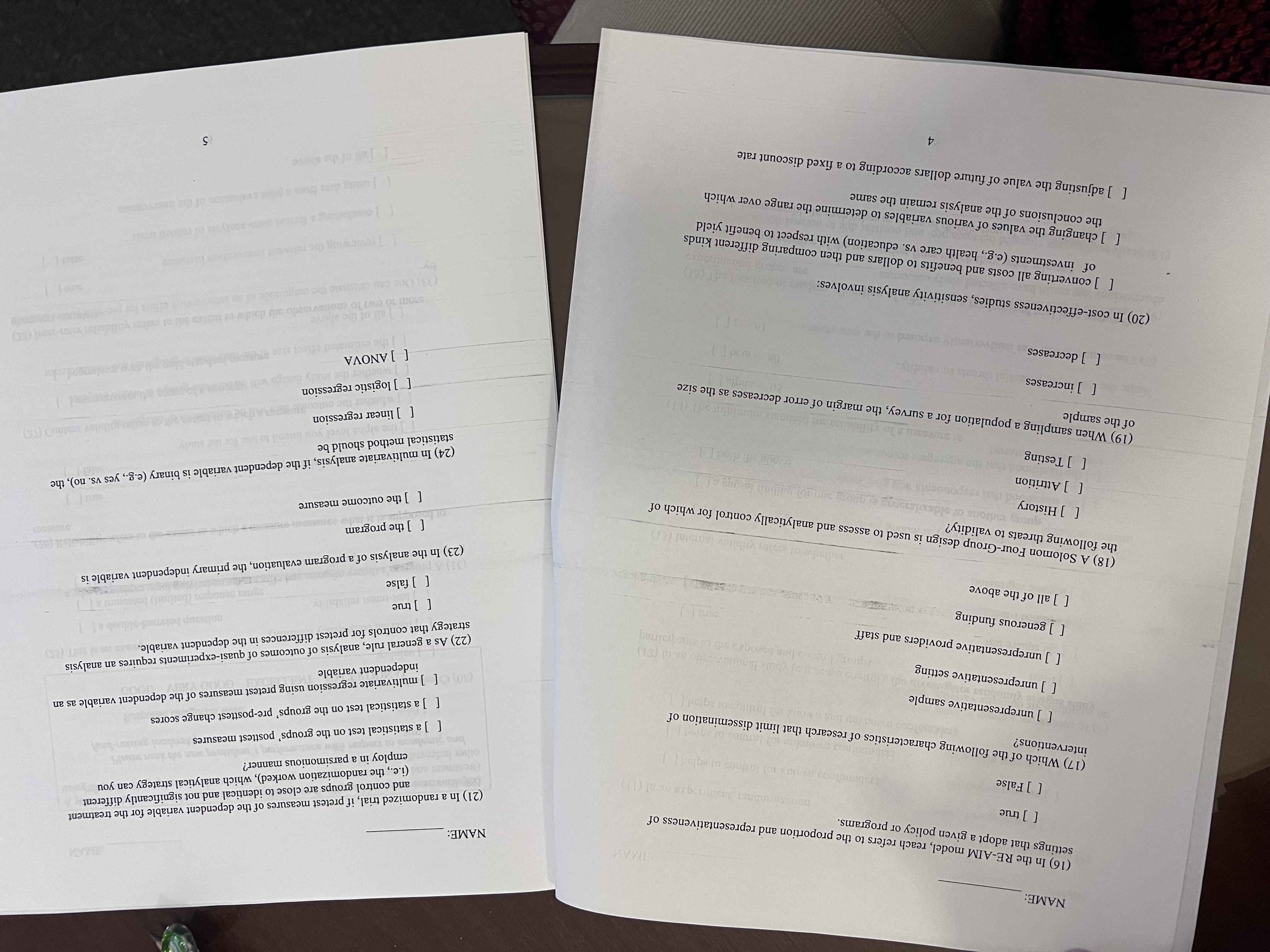
NAME: NAME: (21) In a randomized trial, if pretest measures of the dependent variable for the treatment and control groups are close to identical and not significantly different (16) In the RE-AIM model, reach refers to the proportion and representativeness of (i.e., the randomization worked), which analytical strategy can you settings that adopt a given policy or programs. employ in a parsimonious manner? [ ] true Ings recond and lounos of eqlord [ [ ] a statistical test on the groups' posttest measures [ ] False [ ] a statistical test on the groups' pre-posttest change scores 0[ ] multivariate regression using pretest measures of the dependent variable as an (17) Which of the following characteristics of research that limit dissemination of interventions? (25) independent variable (22) As a general rule, analysis of outcomes of quasi-experiments requires an analysis [ ] unrepresentative sample strategy that controls for pretest differences in the dependent variable. [ ] unrepresentative setting 5) Ybute lenoilersordo he tal (SP) [ ] true [ ] unrepresentative providers and staff [ ] false (23) In the analysis of a program evaluation, the primary independent variable is [ ] generous funding [ ] all of the above [ ] the program [ ] the outcome measure (18) A Solomon Four-Group design is used to assess and analytically control for which of the following threats to validity? (24) In multivariate analysis, if the dependent variable is binary (e.g., yes vs. no), the [ ] History statistical method should be [ ] Attrition [ ] linear regression [ ] Testing [ ] logistic regression (19) When sampling a population for a survey, the margin of error decreases as the size [ ] ANOVA of the sample [ ] increases stom 16 owl to anoilsy [ ] decreases One can (20) In cost-effectiveness studies, sensitivity analysis involves: [ ] converting all costs and benefits to dollars and then comparing different kinds of investments (e.g., health care vs. education) with respect to benefit yield [ ] changing the values of various variables to determine the range over which I Tull of the since in the conclusions of the analysis remain the same [ ] adjusting the value of future dollars according to a fixed discount rate

Step by Step Solution

There are 3 Steps involved in it

1 Expert Approved Answer
Step: 1 Unlock blur-text-image

Question Has Been Solved by an Expert!

Get step-by-step solutions from verified subject matter experts

Step: 2 Unlock
Step: 3 Unlock

Students Have Also Explored These Related Business Writing Questions!