







Question: Answer number 3 only! Show your complete solution. III. PROBLEM SOLVING Show your complete solution and state the necessary assumptions that are used in your
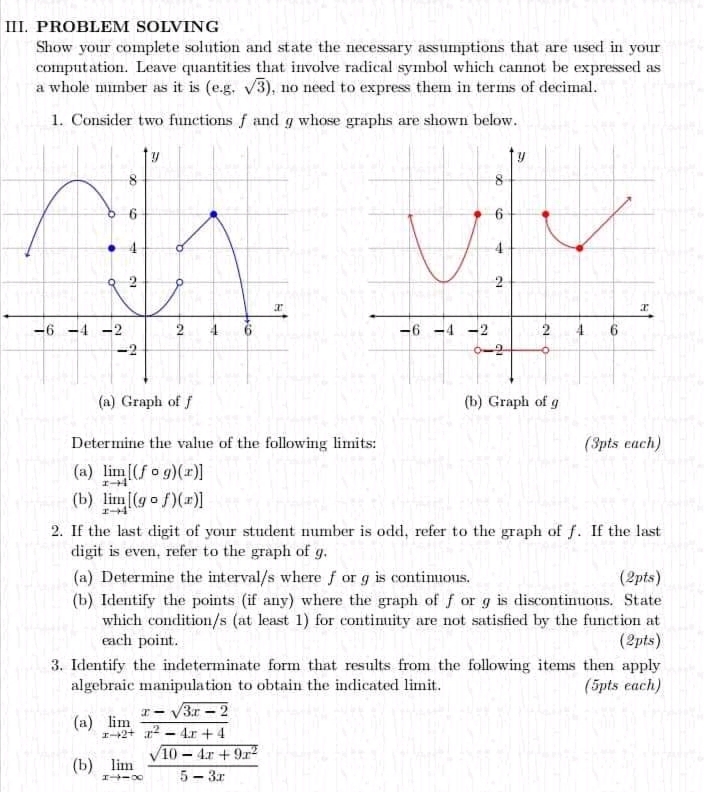
Answer number 3 only! Show your complete solution.
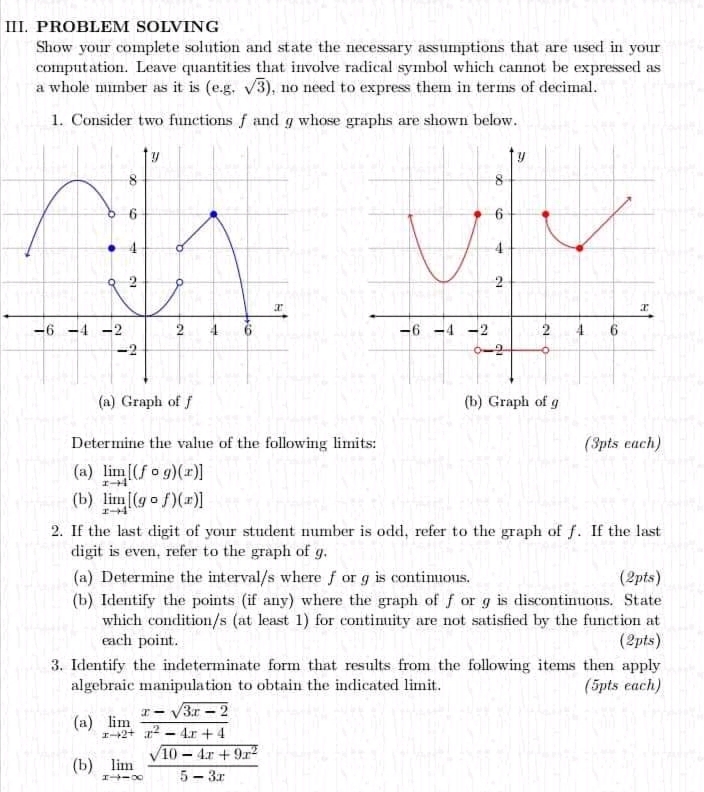
III. PROBLEM SOLVING Show your complete solution and state the necessary assumptions that are used in your computation. Leave quantities that involve radical symbol which cannot be expressed as a whole number as it is (e.g. v3), no need to express them in terms of decimal. 1. Consider two functions f and g whose graphs are shown below. 8 6 6 2 2 -6 -4 -2 2 -6 -4 -2 2 4 6 -2 0- 2 (a) Graph of f (b) Graph of g Determine the value of the following limits: (3pts each) (a) lim [(fog)(x)] (b) lim [(go f)(x)] 2. If the last digit of your student number is odd, refer to the graph of f. If the last digit is even, refer to the graph of g. (a) Determine the interval/s where f or g is continuous. (2pts) (b) Identify the points (if any) where the graph of f or g is discontinuous. State which condition/s (at least 1) for continuity are not satisfied by the function at each point. (2pts) 3. Identify the indeterminate form that results from the following items then apply algebraic manipulation to obtain the indicated limit. (5pts each) r- V3.r - 2 (a) lim V10 - 4r + 92 (b) lim 5 - 3r
Step by Step Solution
There are 3 Steps involved in it

Get step-by-step solutions from verified subject matter experts
 Study Help