







Question: ANSWER ONLY IN PYTHON LANGUAGE PLEASE. Just answer the highlighted part. Problem 1. (20%) Write a program and use it to compute the Harmonic sum,
ANSWER ONLY IN PYTHON LANGUAGE PLEASE.
Just answer the highlighted part.
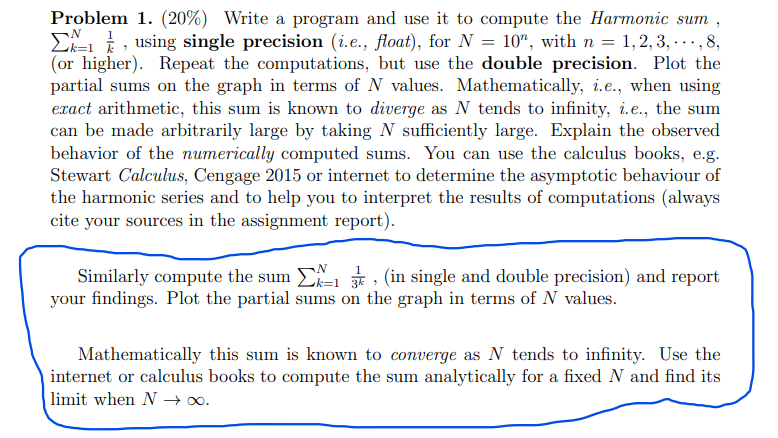
Problem 1. (20\%) Write a program and use it to compute the Harmonic sum, k=1Nk1, using single precision (i.e., float), for N=10n, with n=1,2,3,,8, (or higher). Repeat the computations, but use the double precision. Plot the partial sums on the graph in terms of N values. Mathematically, i.e., when using exact arithmetic, this sum is known to diverge as N tends to infinity, i.e., the sum can be made arbitrarily large by taking N sufficiently large. Explain the observed behavior of the numerically computed sums. You can use the calculus books, e.g. Stewart Calculus, Cengage 2015 or internet to determine the asymptotic behaviour of the harmonic series and to help you to interpret the results of computations (always cite your sources in the assignment report). Similarly compute the sum k=1N3k1, (in single and double precision) and report your findings. Plot the partial sums on the graph in terms of N values. Mathematically this sum is known to converge as N tends to infinity. Use the internet or calculus books to compute the sum analytically for a fixed N and find its limit when N
Step by Step Solution
There are 3 Steps involved in it

Get step-by-step solutions from verified subject matter experts
 Study Help