







Question: Answer only question D ,E ,F pLEASE SHOW WORKING 1. a) A closed-end investment company is currently selling for $10, and its NAV is $10.63.
 Answer only question D ,E ,F
pLEASE SHOW WORKING
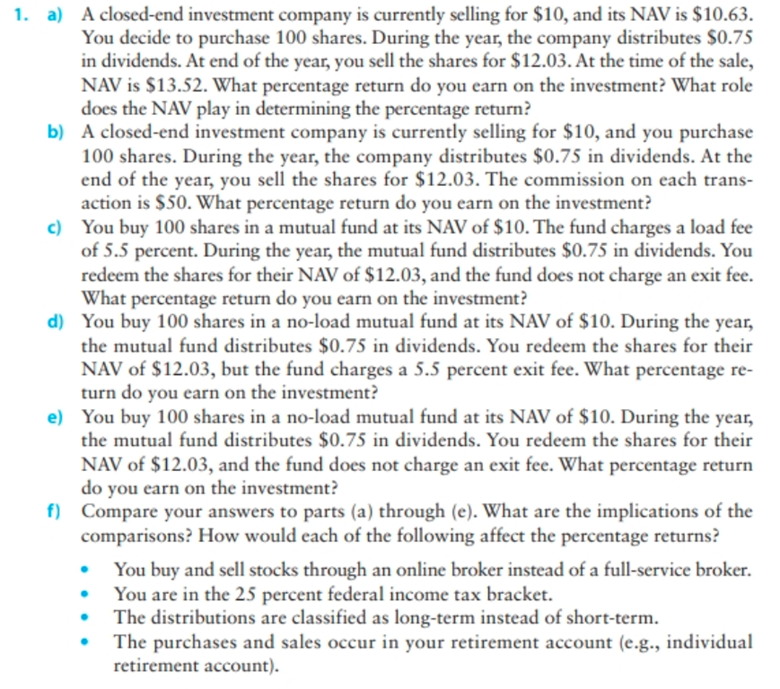
1. a) A closed-end investment company is currently selling for $10, and its NAV is $10.63. You decide to purchase 100 shares. During the year, the company distributes $0.75 in dividends. At end of the year, you sell the shares for $12.03. At the time of the sale, NAV is $13.52. What percentage return do you earn on the investment? What role does the NAV play in determining the percentage return? b) A closed-end investment company is currently selling for $10, and you purchase 100 shares. During the year, the company distributes $0.75 in dividends. At the end of the year, you sell the shares for $12.03. The commission on each trans- action is $50. What percentage return do you earn on the investment? c) You buy 100 shares in a mutual fund at its NAV of $10. The fund charges a load fee of 5.5 percent. During the year, the mutual fund distributes $0.75 in dividends. You redeem the shares for their NAV of $12.03, and the fund does not charge an exit fee. What percentage return do you earn on the investment? d) You buy 100 shares in a no-load mutual fund at its NAV of $10. During the year, the mutual fund distributes $0.75 in dividends. You redeem the shares for their NAV of $12.03, but the fund charges a 5.5 percent exit fee. What percentage re- turn do you earn on the investment? e) You buy 100 shares in a no-load mutual fund at its NAV of $10. During the year, the mutual fund distributes $0.75 in dividends. You redeem the shares for their NAV of $12.03, and the fund does not charge an exit fee. What percentage return do you earn on the investment? f) Compare your answers to parts (a) through (e). What are the implications of the comparisons? How would each of the following affect the percentage returns? You buy and sell stocks through an online broker instead of a full-service broker. You are in the 25 percent federal income tax bracket. The distributions are classified as long-term instead of short-term. The purchases and sales occur in your retirement account (e.g., individual retirement account)
Step by Step Solution
There are 3 Steps involved in it

Get step-by-step solutions from verified subject matter experts
 Study Help