





Question: Answer parts a, b, d, and e Decarbonizing the energy supply is desirable from a climate mitigation perspective, but alternative energy sources can also cause

Answer parts a, b, d, and e Decarbonizing theAnswer parts a, b, d, and e Decarbonizing the Answer parts a, b, d, and e

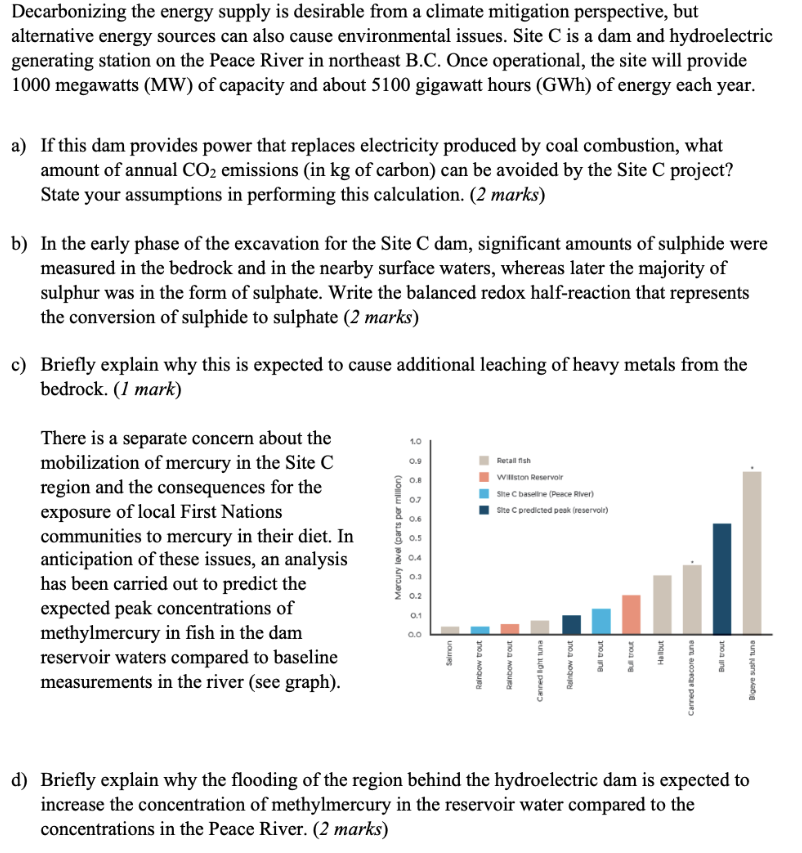
Decarbonizing the energy supply is desirable from a climate mitigation perspective, but alternative energy sources can also cause environmental issues. Site C is a dam and hydroelectric generating station on the Peace River in northeast B.C. Once operational, the site will provide 1000 megawatts (MW) of capacity and about 5100 gigawatt hours (GWh) of energy each year. a) If this dam provides power that replaces electricity produced by coal combustion, what amount of annual CO2 emissions (in kg of carbon) can be avoided by the Site C project? State your assumptions in performing this calculation. (2 marks) b) In the early phase of the excavation for the Site C dam, significant amounts of sulphide were measured in the bedrock and in the nearby surface waters, whereas later the majority of sulphur was in the form of sulphate. Write the balanced redox half-reaction that represents the conversion of sulphide to sulphate ( 2 marks) c) Briefly explain why this is expected to cause additional leaching of heavy metals from the bedrock. (1 mark) There is a separate concern about the mobilization of mercury in the Site C region and the consequences for the exposure of local First Nations communities to mercury in their diet. In anticipation of these issues, an analysis has been carried out to predict the expected peak concentrations of methylmercury in fish in the dam reservoir waters compared to baseline measurements in the river (see graph). d) Briefly explain why the flooding of the region behind the hydroelectric dam is expected to increase the concentration of methylmercury in the reservoir water compared to the concentrations in the Peace River. ( 2 marks) e) If a local community member typically eats three portions of 200g of Bull trout per week, how much more methylmercury will they be ingesting in their diet on an annual basis (in g ), at the time of peak impact compared to before the construction of the dam? ( 2 marks)

Step by Step Solution

There are 3 Steps involved in it

1 Expert Approved Answer
Step: 1 Unlock blur-text-image

Question Has Been Solved by an Expert!

Get step-by-step solutions from verified subject matter experts

Step: 2 Unlock
Step: 3 Unlock

Students Have Also Explored These Related General Management Questions!