







Question: Answer Q4. I already know the answer to Q3 is D. I want to understand how to derive the answer for Q4. T(n)=27T(n/3)+n3logn We use
Answer Q4. I already know the answer to Q3 is D. I want to understand how to derive the answer for Q4.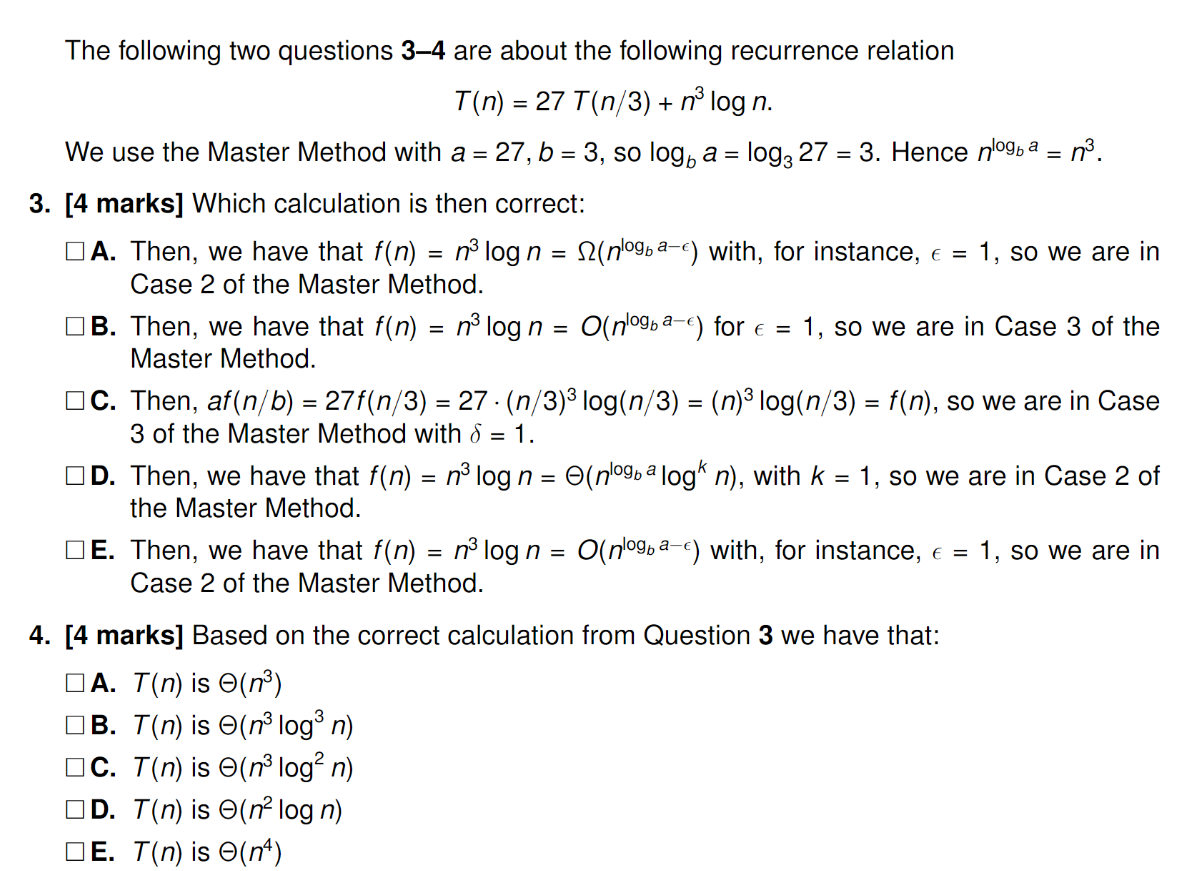
T(n)=27T(n/3)+n3logn We use the Master Method with a=27,b=3, so logba=log327=3. Hence nlogba=n3. 3. [4 marks] Which calculation is then correct: A. Then, we have that f(n)=n3logn=(nlogba) with, for instance, =1, so we are in Case 2 of the Master Method. B. Then, we have that f(n)=n3logn=O(nlogba) for =1, so we are in Case 3 of the Master Method. C. Then, af(n/b)=27f(n/3)=27(n/3)3log(n/3)=(n)3log(n/3)=f(n), so we are in Case 3 of the Master Method with =1. D. Then, we have that f(n)=n3logn=(nlogbalogkn), with k=1, so we are in Case 2 of the Master Method. E. Then, we have that f(n)=n3logn=O(nlogba) with, for instance, =1, so we are in Case 2 of the Master Method. 4. [4 marks] Based on the correct calculation from Question 3 we have that: A. T(n) is (n3) B. T(n) is (n3log3n) C. T(n) is (n3log2n) D. T(n) is (n2logn) E. T(n) is (n4)
Step by Step Solution
There are 3 Steps involved in it

Get step-by-step solutions from verified subject matter experts
 Study Help