







Question: Answer Q5 using the information given Question 5 (a) Recommend which value to use when comparing the Dividend and FCFE methods in Question 4. (8
Answer Q5 using the information given
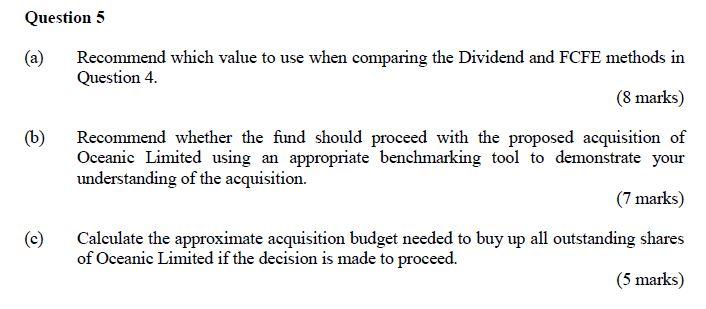
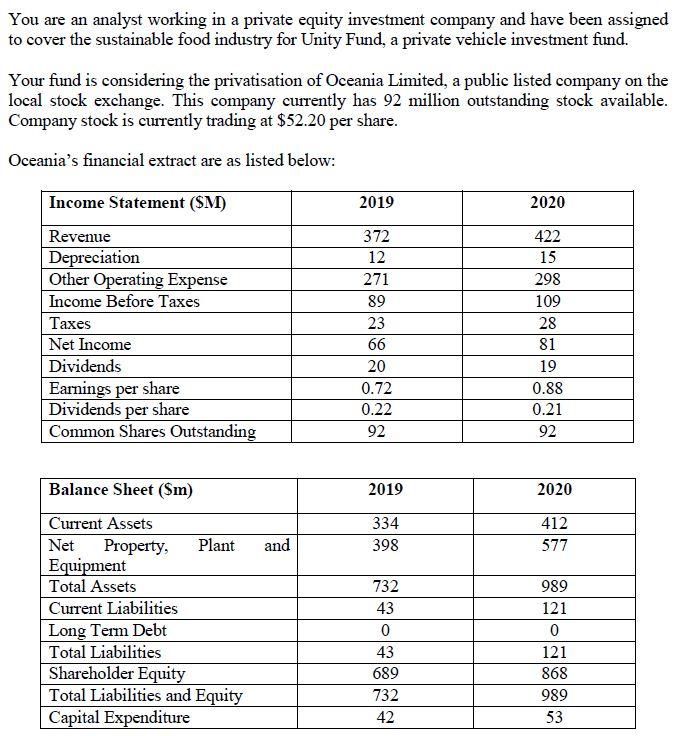
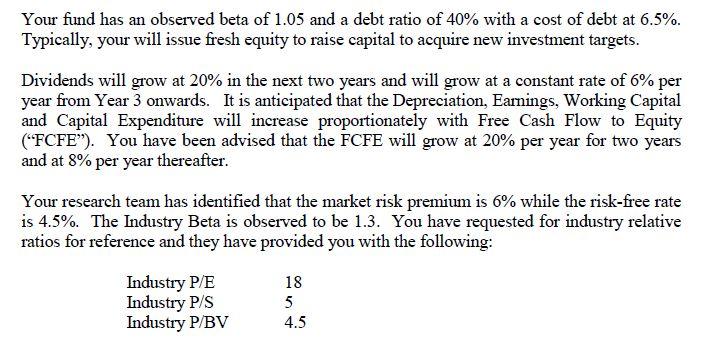
Question 5 (a) Recommend which value to use when comparing the Dividend and FCFE methods in Question 4. (8 marks) (6) Recommend whether the fund should proceed with the proposed acquisition of Oceanic Limited using an appropriate benchmarking tool to demonstrate your understanding of the acquisition. (7 marks) (c) Calculate the approximate acquisition budget needed to buy up all outstanding shares of Oceanic Limited if the decision is made to proceed. (5 marks) You are an analyst working in a private equity investment company and have been assigned to cover the sustainable food industry for Unity Fund, a private vehicle investment fund. Your fund is considering the privatisation of Oceania Limited, a public listed company on the local stock exchange. This company currently has 92 million outstanding stock available. Company stock is currently trading at $52.20 per share. Oceania's financial extract are as listed below: 2019 2020 Income Statement (SM) Revenue Depreciation Other Operating Expense Income Before Taxes Taxes Net Income Dividends Earnings per share Dividends per share Common Shares Outstanding 372 12 271 89 23 66 20 0.72 0.22 92 422 15 298 109 28 81 19 0.88 0.21 92 Balance Sheet (Sm) 2019 2020 334 398 412 577 and Current Assets Net Property, Plant Equipment Total Assets Current Liabilities Long Term Debt Total Liabilities Shareholder Equity Total Liabilities and Equity Capital Expenditure 732 43 0 43 689 732 42 989 121 0 121 868 989 53 Your fund has an observed beta of 1.05 and a debt ratio of 40% with a cost of debt at 6.5%. Typically, your will issue fresh equity to raise capital to acquire new investment targets. Dividends will grow at 20% in the next two years and will grow at a constant rate of 6% per year from Year 3 onwards. It is anticipated that the Depreciation, Earnings, Working Capital and Capital Expenditure will increase proportionately with Free Cash Flow to Equity ("FCFE). You have been advised that the FCFE will grow at 20% per year for two years and at 8% per year thereafter. Your research team has identified that the market risk premium is 6% while the risk-free rate is 4.5%. The Industry Beta is observed to be 1.3. You have requested for industry relative ratios for reference and they have provided you with the following: Industry P/E Industry P/S Industry P/BV 18 5 4.5 Question 5 (a) Recommend which value to use when comparing the Dividend and FCFE methods in Question 4. (8 marks) (6) Recommend whether the fund should proceed with the proposed acquisition of Oceanic Limited using an appropriate benchmarking tool to demonstrate your understanding of the acquisition. (7 marks) (c) Calculate the approximate acquisition budget needed to buy up all outstanding shares of Oceanic Limited if the decision is made to proceed. (5 marks) You are an analyst working in a private equity investment company and have been assigned to cover the sustainable food industry for Unity Fund, a private vehicle investment fund. Your fund is considering the privatisation of Oceania Limited, a public listed company on the local stock exchange. This company currently has 92 million outstanding stock available. Company stock is currently trading at $52.20 per share. Oceania's financial extract are as listed below: 2019 2020 Income Statement (SM) Revenue Depreciation Other Operating Expense Income Before Taxes Taxes Net Income Dividends Earnings per share Dividends per share Common Shares Outstanding 372 12 271 89 23 66 20 0.72 0.22 92 422 15 298 109 28 81 19 0.88 0.21 92 Balance Sheet (Sm) 2019 2020 334 398 412 577 and Current Assets Net Property, Plant Equipment Total Assets Current Liabilities Long Term Debt Total Liabilities Shareholder Equity Total Liabilities and Equity Capital Expenditure 732 43 0 43 689 732 42 989 121 0 121 868 989 53 Your fund has an observed beta of 1.05 and a debt ratio of 40% with a cost of debt at 6.5%. Typically, your will issue fresh equity to raise capital to acquire new investment targets. Dividends will grow at 20% in the next two years and will grow at a constant rate of 6% per year from Year 3 onwards. It is anticipated that the Depreciation, Earnings, Working Capital and Capital Expenditure will increase proportionately with Free Cash Flow to Equity ("FCFE). You have been advised that the FCFE will grow at 20% per year for two years and at 8% per year thereafter. Your research team has identified that the market risk premium is 6% while the risk-free rate is 4.5%. The Industry Beta is observed to be 1.3. You have requested for industry relative ratios for reference and they have provided you with the following: Industry P/E Industry P/S Industry P/BV 18 5 4.5
Step by Step Solution
There are 3 Steps involved in it

Get step-by-step solutions from verified subject matter experts
 Study Help