







Question: Answer question 1, 2, 3 picture #3. 4. What is the reason behind the court. a The Concussi On March 7, 1997, 16-year-old Michelle Schmidt
Answer question 1, 2, 3 picture #3.
4. What is the reason behind the court.
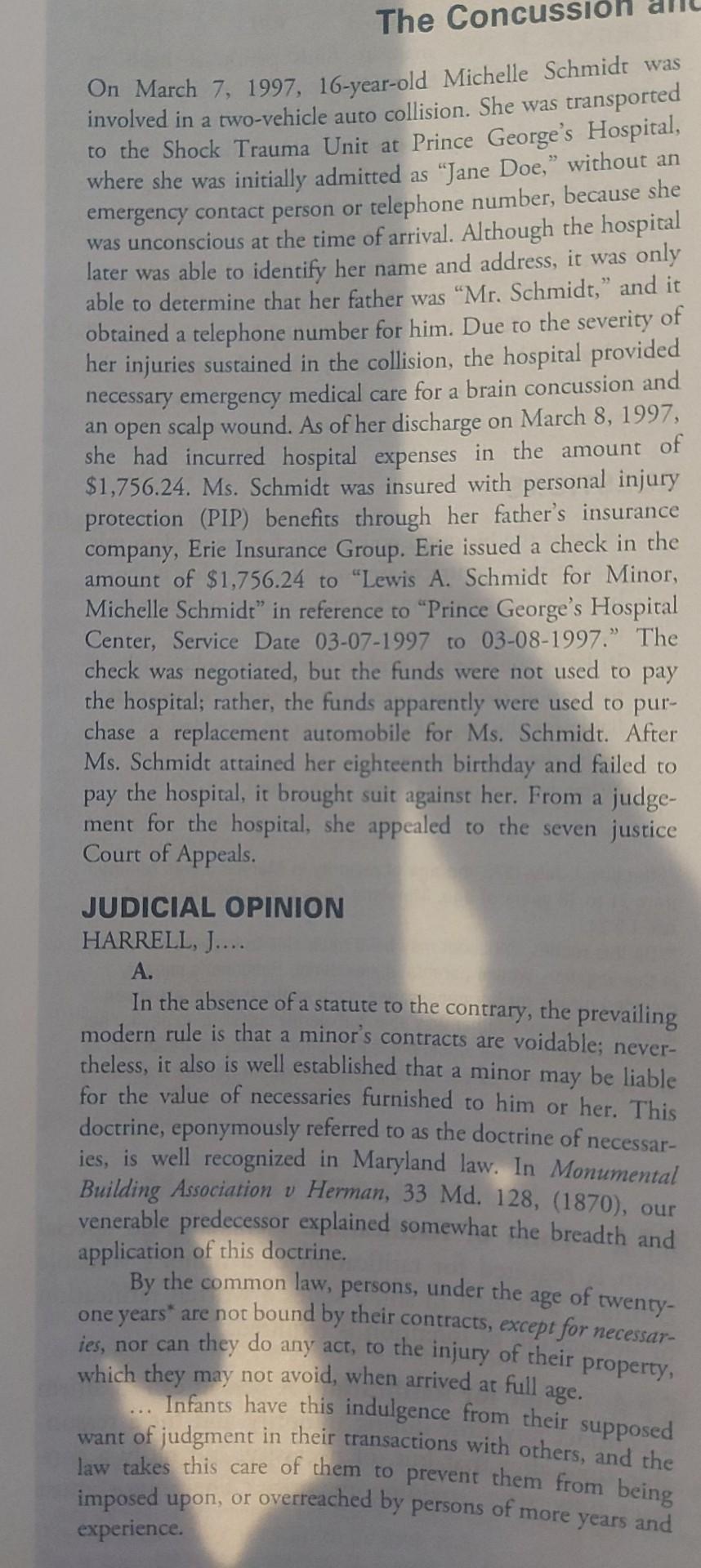
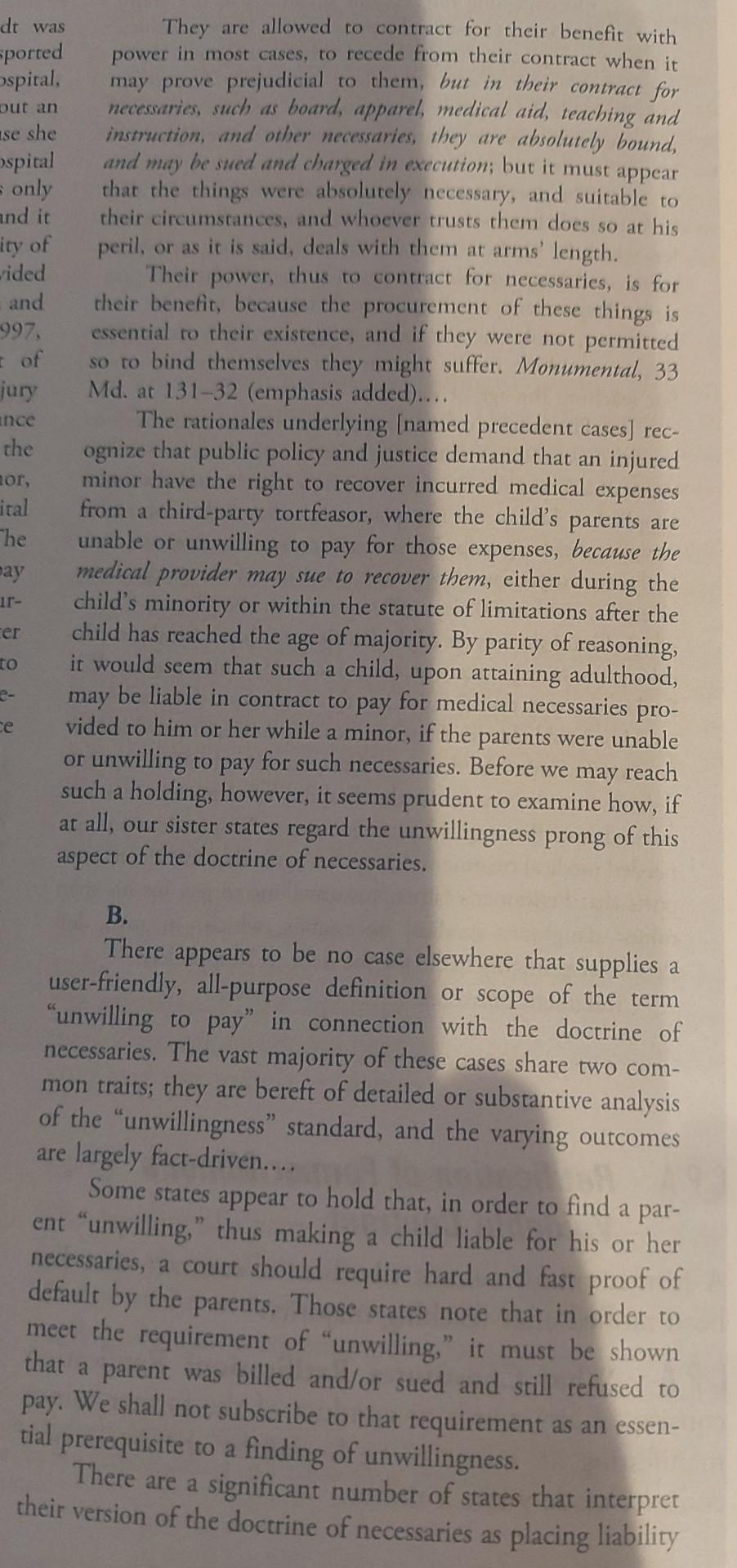
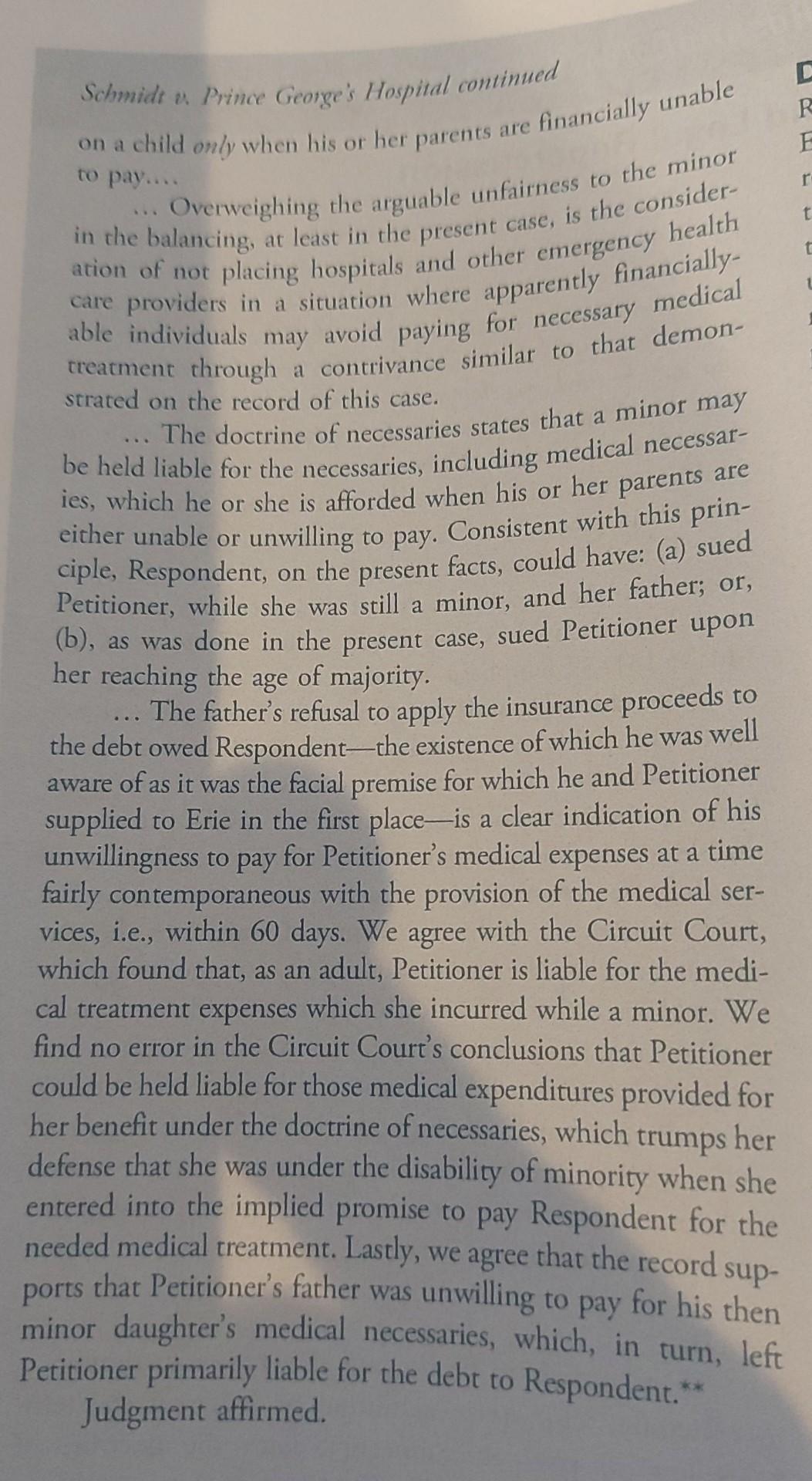
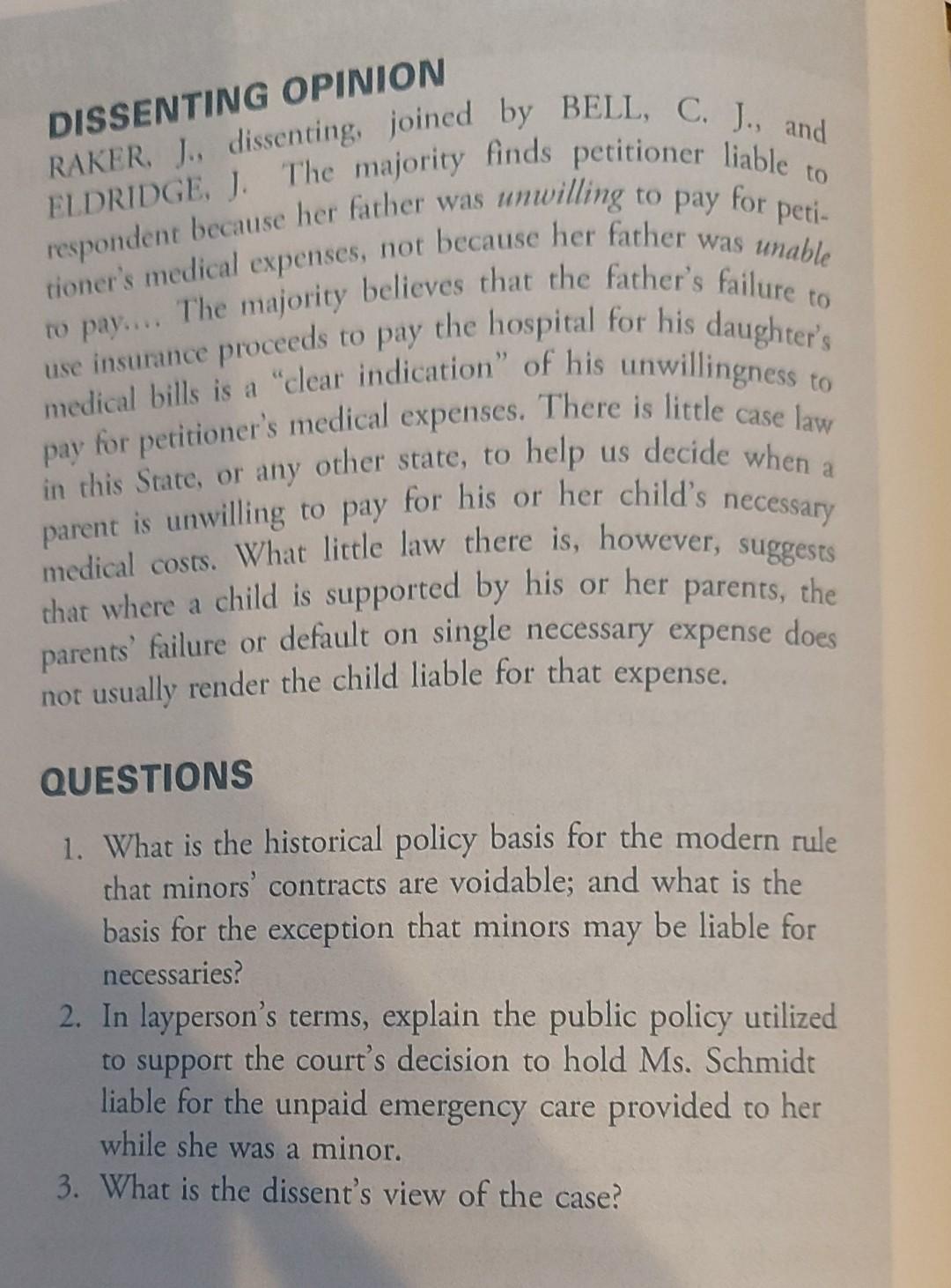
a The Concussi On March 7, 1997, 16-year-old Michelle Schmidt was involved in a two-vehicle auto collision. She was transported to the Shock Trauma Unit at Prince George's Hospital, where she was initially admitted as Jane Doe," without an emergency contact person or telephone number, because she was unconscious at the time of arrival. Although the hospital later was able to identify her name and address, it was only able to determine that her father was "Mr. Schmidt," and it obtained a telephone number for him. Due to the severity of her injuries sustained in the collision, the hospital provided necessary emergency medical care for a brain concussion and an open scalp wound. As of her discharge on March 8, 1997, she had incurred hospital expenses in the amount of $1,756.24. Ms. Schmidt was insured with personal injury protection (PIP) benefits through her father's insurance company, Erie Insurance Group. Erie issued a check in the amount of $1,756.24 to "Lewis A. Schmidt for Minor, Michelle Schmidt" in reference to "Prince George's Hospital Center, Service Date 03-07-1997 to 03-08-1997." The check was negotiated, but the funds were not used to pay the hospital; rather, the funds apparently were used to pur- chase a replacement automobile for Ms. Schmidt. After Ms. Schmidt attained her eighteenth birthday and failed to pay the hospital, it brought suit against her. From a judge- ment for the hospital, she appealed to the seven justice Court of Appeals. JUDICIAL OPINION HARRELL, J.... A. In the absence of a statute to the contrary, the prevailing modern rule is that a minor's contracts are voidable; never- theless, it also is well established that a minor may be liable for the value of necessaries furnished to him or her. This doctrine, eponymously referred to as the doctrine of necessar- ies, is well recognized in Maryland law. In Monumental Building Association v Herman, 33 Md. 128, (1870), our venerable predecessor explained somewhat the breadth and application of this doctrine. By the common law, persons, under the age of twenty- one years are not bound by their contracts, except for necessar- ies, nor can they do any act, to the injury of their property, which they may not avoid, when arrived at full age. Infants have this indulgence from their supposed want of judgment in their transactions with others, and the law takes this care of them to prevent them from being imposed upon, or overreached by persons of more years and experience. dt was out an se she I of ince They are allowed to contract for their benefit with ported power in most cases, to recede from their contract when it ospital may prove prejudicial to them, but in their contract for necessaries, such as board, apparel, medical aid, teaching and instruction, and other necessaries, they are absolutely bound, ospital and be sued and charged in execution, but it must appear only that the things were absolutely necessary, and suitable to and it their circumstances, and whoever trusts them does so at his ity of peril, or as it is said, deals with them at arms' length. vided Their power, thus to contract for necessaries, is for and their benefit, because the procurement of these things is 997. essential to their existence, and if they were not permitted so to bind themselves they might suffer. Monumental, 33 jury Md. at 131-32 (emphasis added).... The rationales underlying [named precedent cases] rec- the ognize that public policy and justice demand that an injured nor, minor have the right to recover incurred medical expenses from a third-party tortfeasor, where the child's parents are he unable or unwilling to pay for those expenses, because the ay medical provider may sue to recover them, either during the child's minority or within the statute of limitations after the child has reached the age of majority. By parity of reasoning, it would seem that such a child, upon attaining adulthood, may be liable in contract to pay for medical necessaries pro- vided to him or her while a minor, if the parents were unable or unwilling to pay for such necessaries. Before we may reach such a holding, however, it seems prudent to examine how, if at all, our sister states regard the unwillingness prong of this aspect of the doctrine of necessaries. ital a 1r- cer e- ce B. There appears to be no case elsewhere that supplies a user-friendly, all-purpose definition or scope of the term "unwilling to pay" in connection with the doctrine of necessaries. The vast majority of these cases share two com- mon traits; they are bereft of detailed or substantive analysis of the "unwillingness" standard, and the varying outcomes are largely fact-driven.... Some states appear to hold that, in order to find a par- ent "unwilling," thus making a child liable for his or her necessaries, a court should require hard and fast proof of default by the parents. Those states note that in order to meet the requirement of "unwilling," it must be shown that a parent was billed and/or sued and still refused to pay. We shall not subscribe to that requirement as an essen- tial prerequisite to a finding of unwillingness. There are a significant number of states that interpret their version of the doctrine of necessaries as placing liability 32 R E to pay.... r t Schmidt a Prince Georges Hospital continued on a child only when his or her parents are financially unable Overweighing the arguable unfairness to the minor ation of not placing hospitals and other emergency health in the balancing, at least in the present case, is the consider- care providers in a situation where apparently financially- able individuals may avoid paying for necessary medical treatment through a contrivance similar to that demon- t 1 .. a strated on the record of this case. The doctrine of necessaries states that a minor may be held liable for the necessaries, including medical necessar- ies, which he or she is afforded when his or her parents are either unable or unwilling to pay. Consistent with this prin- ciple , Respondent, on the present facts , could have: (a) sued Petitioner, while she was still a minor, and her father; or, (b), as was done in the present case, sued Petitioner upon her reaching the age of majority. The father's refusal to apply the insurance proceeds to the debt owed Respondentthe existence of which he was well aware of as it was the facial premise for which he and Petitioner supplied to Erie in the first placeis a clear indication of his unwillingness to pay for Petitioner's medical expenses at a time fairly contemporaneous with the provision of the medical ser- vices, i.e., within 60 days. We agree with the Circuit Court, which found that, as an adult, Petitioner is liable for the medi- cal treatment expenses which she incurred while a minor. We find no error in the Circuit Court's conclusions that Petitioner could be held liable for those medical expenditures provided for her benefit under the doctrine of necessaries, which trumps her defense that she was under the disability of minority when she entered into the implied promise to pay Respondent for the needed medical treatment. Lastly, we agree that the record sup- ports that Petitioner's father was unwilling to pay for his then minor daughter's medical necessaries, which in turn, left Petitioner primarily liable for the debt to Respondent. Judgment affirmed a DISSENTING OPINION RAKER. J.. dissenting, joined by BELL, C. J., and ELDRIDGE, J. The majority finds petitioner liable to respondent because her father was unwilling to pay for peti- tioner's medical expenses, not because her father was unable to pay.... The majority believes that the father's failure to use insurance proceeds to pay the hospital for his daughter's medical bills is a "clear indication" of his unwillingness to pay for petitioner's medical expenses. There is little case law in this State, or any other state, to help us decide when a medical costs. What little law there is, however, suggests parent is unwilling to pay for his or her child's necessary that where a child is supported by his or her parents, the parents' failure or default on single necessary expense does not usually render the child liable for that expense. QUESTIONS 1. What is the historical policy basis for the modern rule that minors' contracts are voidable; and what is the basis for the exception that minors may be liable for necessaries? 2. In layperson's terms, explain the public policy utilized to support the court's decision to hold Ms. Schmidt liable for the unpaid emergency care provided to her while she was a minor. 3. What is the dissent's view of the caseStep by Step Solution
There are 3 Steps involved in it
1 Expert Approved Answer
Step: 1 Unlock

Question Has Been Solved by an Expert!
Get step-by-step solutions from verified subject matter experts
Step: 2 Unlock
Step: 3 Unlock
 Study Help