







Question: Answer question 1 and 2 under your thoughts? Many argue, and some convincingly, that great teams don't last. Many disas- semble because their members move
Answer question 1 and 2 under your thoughts?
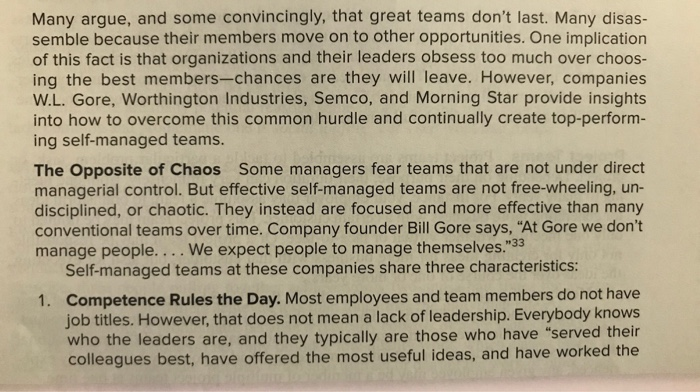
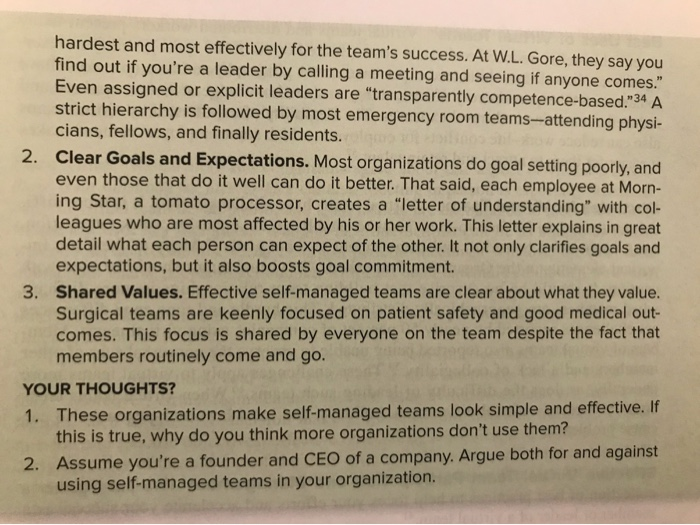
Many argue, and some convincingly, that great teams don't last. Many disas- semble because their members move on to other opportunities. One implication of this fact is that organizations and their leaders obsess too much over choos- ing the best members-chances are they will leave. However, companies W.L. Gore, Worthington Industries, Semco, and Morning Star provide insights into how to overcome this common hurdle and continually create top-perform- ing self-managed teams. The Opposite of Chaos Some managers fear teams that are not under direct managerial control. But effective self-managed teams are not free-wheeling, un- disciplined, or chaotic. They instead are focused and more effective than many conventional teams over time. Company founder Bill Gore says, "At Gore we don't manage people. ... We expect people to manage themselves."33 Self-managed teams at these companies share three characteristics: Competence Rules the Day. Most employees and team members do not have job titles. However, that does not mean a lack of leadership. Everybody knows who the leaders are, and they typically are those who have "served their colleagues best, have offered the most useful ideas, and have worked the 1. hardest and most effectively for the team's success. At W.L. Gore, they say you find out if you're a leader by calling a meeting and seeing if anyone comes." Even assigned or explicit leaders are "transparently competence-based."34 A strict hierarchy is followed by most emergency room teams-attending physi- cians, fellows, and finally residents. 2. Clear Goals and Expectations. Most organizations do goal setting poorly, and even those that do it well can do it better. That said, each employee at Morn- ing Star, a tomato processor, creates a "letter of understanding" with col- leagues who are most affected by his or her work. This letter explains in great detail what each person can expect of the other. It not only clarifies goals and expectations, but it also boosts goal commitment. 3. Shared Values. Effective self-managed teams are clear about what they value. Surgical teams are keenly focused on patient safety and good medical out- comes. This focus is shared by everyone on the team despite the fact that members routinely come and go. YOUR THOUGHTS? 1. These organizations make self-managed teams look simple and effective. If this is true, why do you think more organizations don't use them? 2. Assume you're a founder and CEO of a company. Argue both for and against using self-managed teams in your organization Step by Step Solution
There are 3 Steps involved in it
1 Expert Approved Answer
Step: 1 Unlock

Question Has Been Solved by an Expert!
Get step-by-step solutions from verified subject matter experts
Step: 2 Unlock
Step: 3 Unlock
 Study Help