





Question: Answer Question 17 {Section 14.4) The McGurk effect demonstrates that... (a) speech is created by the place you articulate. people do not usually articulate each

Answer
Answer Question 17 {Section 14.4) The McGurk
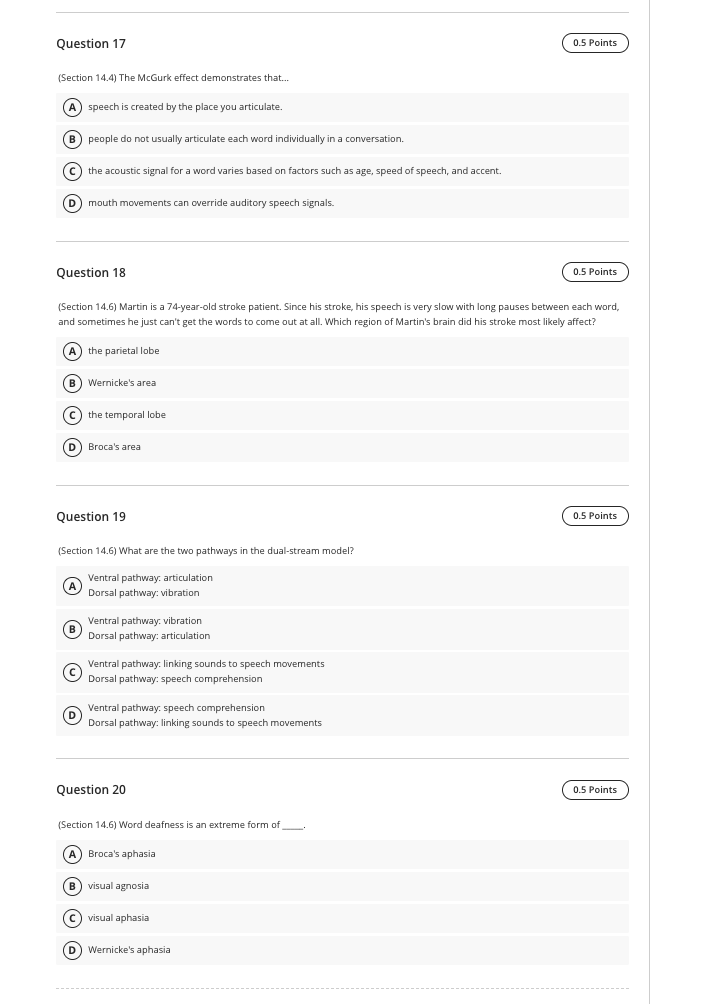
Question 17 {Section 14.4) The McGurk effect demonstrates that... (a) speech is created by the place you articulate. people do not usually articulate each word individually in a conversation. the acoustic signal for a word varies based on factors such as age, speed of speech, and accent. () mouth movements can override auditory speech signals. Question 18 (Section 14.6) Martin is a 74-year-old stroke patient. Since his stroke, his speech is very slow with long pauses between each word, and sometimes he just can't get the words to come out at all. Which region of Martin's brain did his stroke most likely affect? (a) the parietal lobe (8) Wernicke's area Question 19 {Section 14.6) What are the two pathways in the dual-stream model? Ventral pathway: articulation Dorsal pathway: vibration Ventral pathway: vibration (8) Dorsal pathway: articulation Ventral pathway: linking sounds to speech movements. Dorsal pathway: speech comprehension Ventral pathway: speech comprehension Dorsal pathway: linking sounds to speech movements: Question 20 (Section 14.6) Word deafness is an extreme form of . (a) Broca's aphasia visual agnosia () visual aphasia () Wemicke's aphasia

Step by Step Solution

There are 3 Steps involved in it

1 Expert Approved Answer
Step: 1 Unlock blur-text-image

Question Has Been Solved by an Expert!

Get step-by-step solutions from verified subject matter experts

Step: 2 Unlock
Step: 3 Unlock

Students Have Also Explored These Related Accounting Questions!