







Question: ANSWER QUESTION #2 A quick and complete response will get an instant thumbs up from me! CASE STUDY 14.3 The Navy Struggles to Avoid Cancellation
ANSWER QUESTION #2
A quick and complete response will get an instant thumbs up from me!
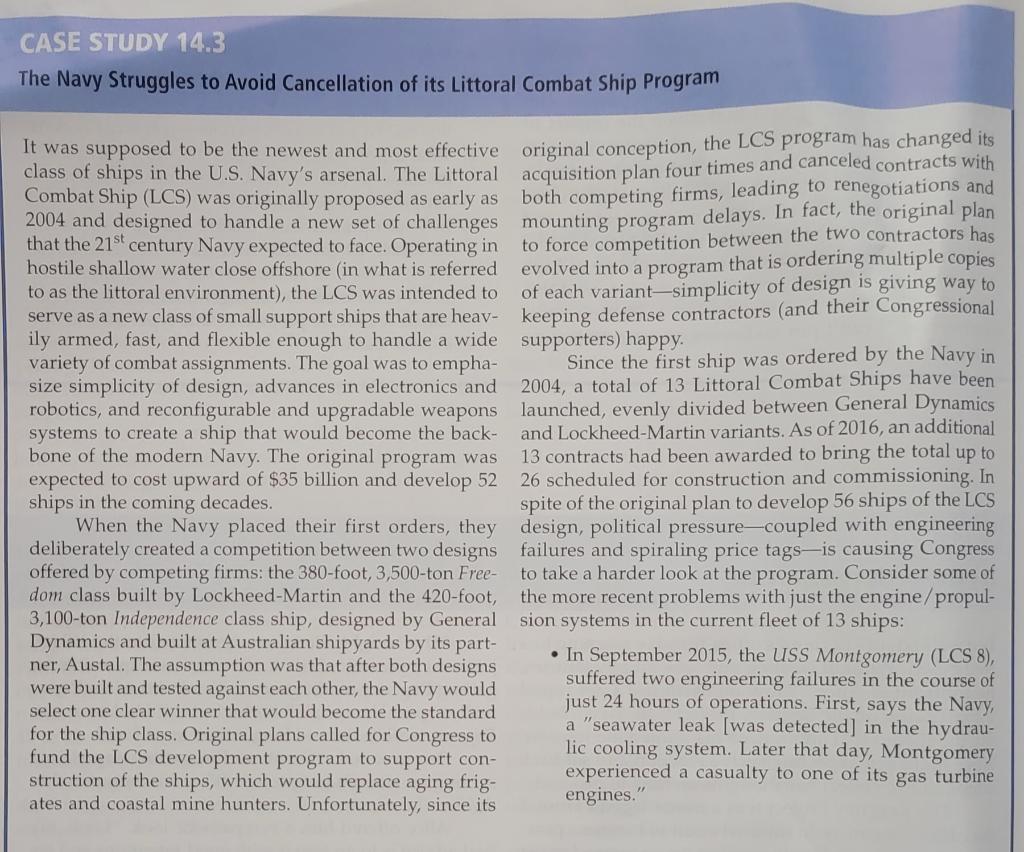
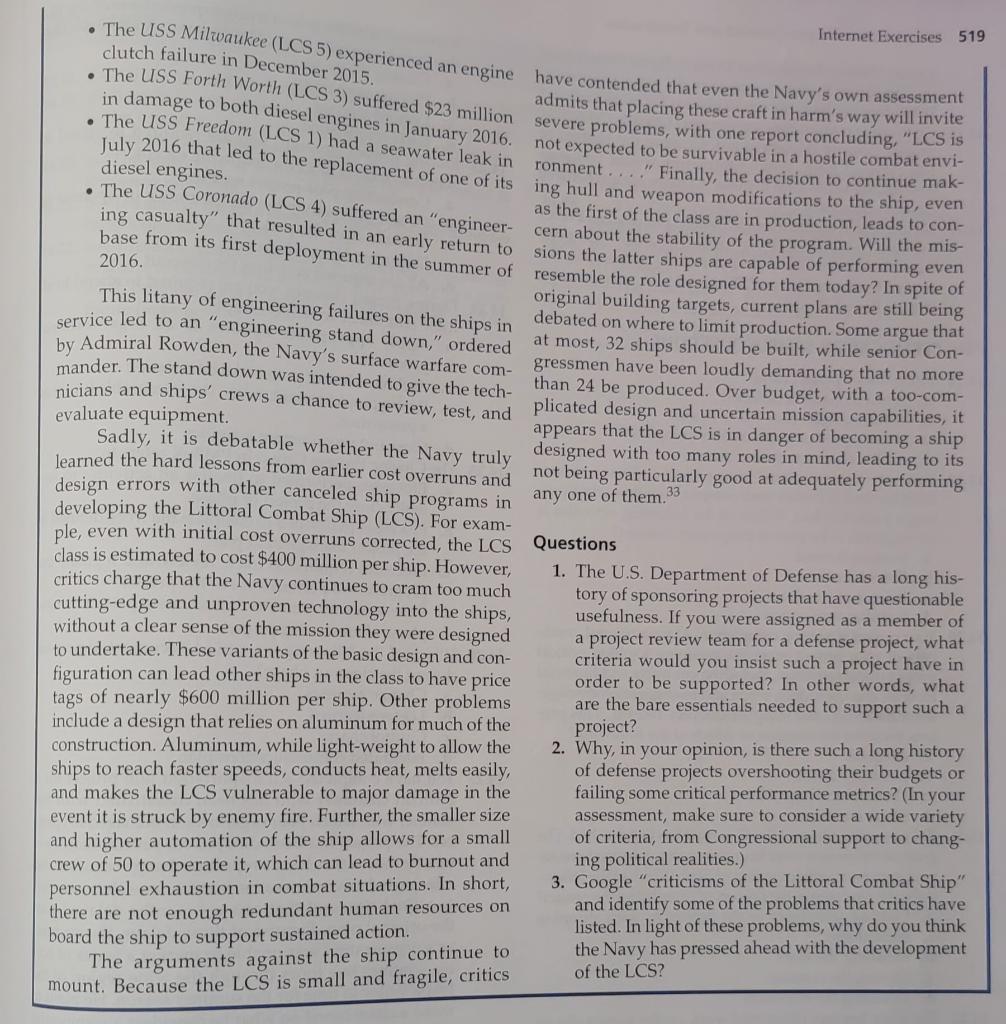
CASE STUDY 14.3 The Navy Struggles to Avoid Cancellation of its Littoral Combat Ship Program It was supposed to be the newest and most effective class of ships in the U.S. Navy's arsenal. The Littoral Combat Ship (LCS) was originally proposed as early as 2004 and designed to handle a new set of challenges that the 21st century Navy expected to face. Operating in hostile shallow water close offshore (in what is referred to as the littoral environment), the LCS was intended to serve as a new class of small support ships that are heav- ily armed, fast, and flexible enough to handle a wide variety of combat assignments. The goal was to empha- size simplicity of design, advances in electronics and robotics, and reconfigurable and upgradable weapons systems to create a ship that would become the back- bone of the modern Navy. The original program was expected to cost upward of $35 billion and develop 52 ships in the coming decades. When the Navy placed their first orders, they deliberately created a competition between two designs offered by competing firms: the 380-foot, 3,500-ton Free- dom class built by Lockheed-Martin and the 420-foot, 3,100-ton Independence class ship, designed by General Dynamics and built at Australian shipyards by its part- ner, Austal. The assumption was that after both designs were built and tested against each other, the Navy would select one clear winner that would become the standard for the ship class. Original plans called for Congress to fund the LCS development program to support con- struction of the ships, which would replace aging frig- ates and coastal mine hunters. Unfortunately, since its original conception, the LCS program has changed its acquisition plan four times and canceled contracts with both competing firms, leading to renegotiations and mounting program delays. In fact, the original plan to force competition between the two contractors has evolved into a program that is ordering multiple copies of each variant-simplicity of design is giving way to keeping defense contractors (and their Congressional supporters) happy. Since the first ship was ordered by the Navy in 2004, a total of 13 Littoral Combat Ships have been launched, evenly divided between General Dynamics and Lockheed-Martin variants. As of 2016, an additional 13 contracts had been awarded to bring the total up to 26 scheduled for construction and commissioning. In spite of the original plan to develop 56 ships of the LCS design, political pressure-coupled with engineering failures and spiraling price tags-is causing Congress to take a harder look at the program. Consider some of the more recent problems with just the engine/propul- sion systems in the current fleet of 13 ships: In September 2015, the USS Montgomery (LCS 8), suffered two engineering failures in the course of just 24 hours of operations. First, says the Navy, a "seawater leak [was detected] in the hydrau- lic cooling system. Later that day, Montgomery experienced a casualty to one of its gas turbine engines." The USS Milwaukee (LCS 5) experienced an engine clutch failure in December 2015. The USS Forth Worth (LCS 3) suffered $23 million in damage to both diesel engines in January 2016. . The USS Freedom (LCS 1) had a seawater leak in July 2016 that led to the replacement of one of its diesel engines. The USS Coronado (LCS 4) suffered an "engineer- ing casualty" that resulted in an early return to base from its first deployment in the summer of 2016. This litany of engineering failures on the ships in service led to an "engineering stand down," ordered by Admiral Rowden, the Navy's surface warfare com- mander. The stand down was intended to give the tech- nicians and ships' crews a chance to review, test, and evaluate equipment. Sadly, it is debatable whether the Navy truly learned the hard lessons from earlier cost overruns and design errors with other canceled ship programs in developing the Littoral Combat Ship (LCS). For exam- ple, even with initial cost overruns corrected, the LCS class is estimated to cost $400 million per ship. However, critics charge that the Navy continues to cram too much cutting-edge and unproven technology into the ships, without a clear sense of the mission they were designed to undertake. These variants of the basic design and con- figuration can lead other ships in the class to have price tags of nearly $600 million per ship. Other problems include a design that relies on aluminum for much of the construction. Aluminum, while light-weight to allow the ships to reach faster speeds, conducts heat, melts easily, and makes the LCS vulnerable to major damage in the event it is struck by enemy fire. Further, the smaller size and higher automation of the ship allows for a small crew of 50 to operate it, which can lead to burnout and personnel exhaustion in combat situations. In short, there are not enough redundant human resources on board the ship to support sustained action. The arguments against the ship continue to mount. Because the LCS is small and fragile, critics Internet Exercises 519 have contended that even the Navy's own assessmeite admits that placing these craft in harm's way will invite severe problems, with one report concluding, "LCS is not expected to be survivable in a hostile combat envi- ronment...." Finally, the decision to continue mak- ing hull and weapon modifications to the ship, even as the first of the class are in production, leads to con- cern about the stability of the program. Will the mis- sions the latter ships are capable of performing even resemble the role designed for them today? In spite of original building targets, current plans are still being debated on where to limit production. Some argue that at most, 32 ships should be built, while senior Con- gressmen have been loudly demanding that no more plicated design and uncertain mission capabilities, it than 24 be produced. Over budget, with a too-com- appears that the LCS is in danger of becoming a ship designed with too many roles in mind, leading to its not being particularly good at adequately performing any one of them.33 Questions 1. The U.S. Department of Defense has a long his- tory of sponsoring projects that have questionable usefulness. If you were assigned as a member of a project review team for a defense project, what criteria would you insist such a project have in order to be supported? In other words, what are the bare essentials needed to support such a project? 2. Why, in your opinion, is there such a long history of defense projects overshooting their budgets or failing some critical performance metrics? (In your assessment, make sure to consider a wide variety of criteria, from Congressional support to chang- ing political realities.) 3. Google "criticisms of the Littoral Combat Ship" and identify some of the problems that critics have listed. In light of these problems, why do you think the Navy has pressed ahead with the development of the LCSStep by Step Solution
There are 3 Steps involved in it
1 Expert Approved Answer
Step: 1 Unlock

Question Has Been Solved by an Expert!
Get step-by-step solutions from verified subject matter experts
Step: 2 Unlock
Step: 3 Unlock
 Study Help