







Question: ANSWER QUESTION C ONLY 3. This question examines the innovator's dilemma in a Hoteling framework. Firms A and B compete in a differentiated products market
ANSWER QUESTION C ONLY
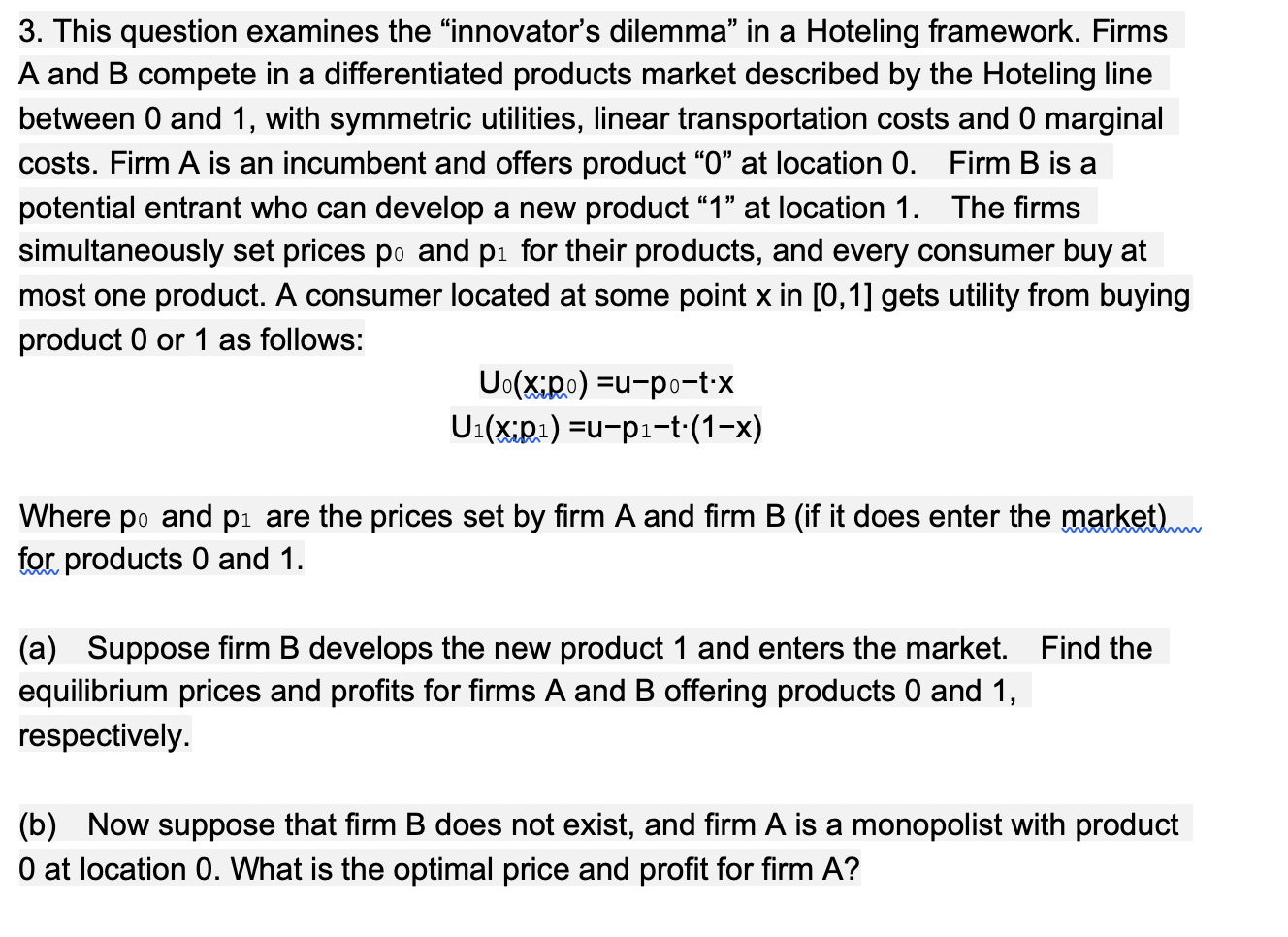

3. This question examines the innovator's dilemma" in a Hoteling framework. Firms A and B compete in a differentiated products market described by the Hoteling line between 0 and 1, with symmetric utilities, linear transportation costs and 0 marginal costs. Firm A is an incumbent and offers product O at location O. Firm B is a potential entrant who can develop a new product 1 at location 1. The firms simultaneously set prices po and pi for their products, and every consumer buy at most one product. A consumer located at some point x in [0,1] gets utility from buying product 0 or 1 as follows: U.(x:Ro) =u-po-t:x U1(x: 1) =u-pi-t:(1-x) Where po and pi are the prices set by firm A and firm B (if it does enter the market.mm for products 0 and 1. (a) Suppose firm B develops the new product 1 and enters the market. Find the equilibrium prices and profits for firms A and B offering products 0 and 1, respectively. (b) Now suppose that firm B does not exist, and firm A is a monopolist with product O at location 0. What is the optimal price and profit for firm A? (c) Now suppose firm A can itself develop the new product at location 1 and then sell both products at 0 and at 1. Assume firm A wants to cover the whole market and charge the same price for both products, po=pimeWhat would be the optimal prices and profits for firm A in this case? 3. This question examines the innovator's dilemma" in a Hoteling framework. Firms A and B compete in a differentiated products market described by the Hoteling line between 0 and 1, with symmetric utilities, linear transportation costs and 0 marginal costs. Firm A is an incumbent and offers product O at location O. Firm B is a potential entrant who can develop a new product 1 at location 1. The firms simultaneously set prices po and pi for their products, and every consumer buy at most one product. A consumer located at some point x in [0,1] gets utility from buying product 0 or 1 as follows: U.(x:Ro) =u-po-t:x U1(x: 1) =u-pi-t:(1-x) Where po and pi are the prices set by firm A and firm B (if it does enter the market.mm for products 0 and 1. (a) Suppose firm B develops the new product 1 and enters the market. Find the equilibrium prices and profits for firms A and B offering products 0 and 1, respectively. (b) Now suppose that firm B does not exist, and firm A is a monopolist with product O at location 0. What is the optimal price and profit for firm A? (c) Now suppose firm A can itself develop the new product at location 1 and then sell both products at 0 and at 1. Assume firm A wants to cover the whole market and charge the same price for both products, po=pimeWhat would be the optimal prices and profits for firm A in this case
Step by Step Solution
There are 3 Steps involved in it

Get step-by-step solutions from verified subject matter experts
 Study Help