





Question: Answer Question D c) Using the EDD (earliest due date) decision rule for sequencing the jobs, the order is (to resolve a tie, use the

Answer Question DAnswer Question D c) Using the EDD (earliest due
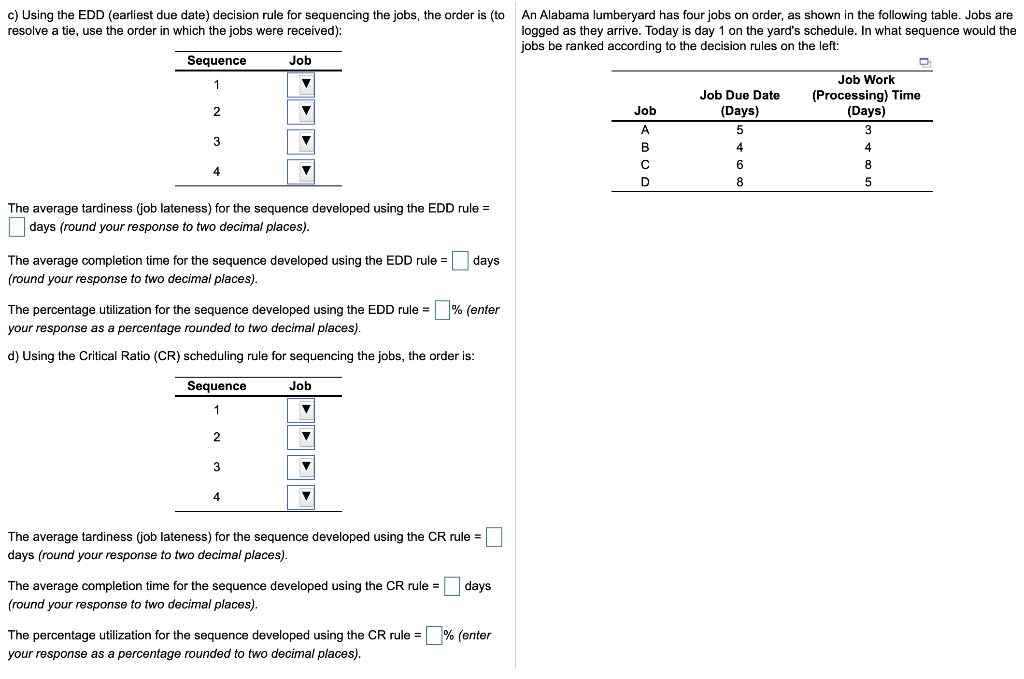
c) Using the EDD (earliest due date) decision rule for sequencing the jobs, the order is (to resolve a tie, use the order in which the jobs were received): An Alabama lumberyard has four jobs on order, as shown in the following table. Jobs are logged as they arrive. Today is day 1 on the yard's schedule. In what sequence would the jobs be ranked according to the decision rules on the left: Sequence Job Job Due Date (Days) Job Work (Processing) Time (Days) The average tardiness (job lateness) for the sequence developed using the EDD rule = days (round your response to two decimal places). days The average completion time for the sequence developed using the EDD rule = (round your response to two decimal places). % (enter The percentage utilization for the sequence developed using the EDD rule - your response as a percentage rounded to two decimal places). d) Using the Critical Ratio (CR) scheduling rule for sequencing the jobs, the order is: Sequence Job The average tardiness (job lateness) for the sequence developed using the CR rule = days (round your response to two decimal places). days The average completion time for the sequence developed using the CR rule = (round your response to two decimal places). % (enter The percentage utilization for the sequence developed using the CR rule = your response as a percentage rounded to two decimal places)

Step by Step Solution

There are 3 Steps involved in it

1 Expert Approved Answer
Step: 1 Unlock blur-text-image

Question Has Been Solved by an Expert!

Get step-by-step solutions from verified subject matter experts

Step: 2 Unlock
Step: 3 Unlock

Students Have Also Explored These Related General Management Questions!