







Question: answer question MANAGING PEOPLE There Is Really No Good Answer to the Question: Rogue Employees or Toxic Culture? One of the key strategic pillars to
answer question 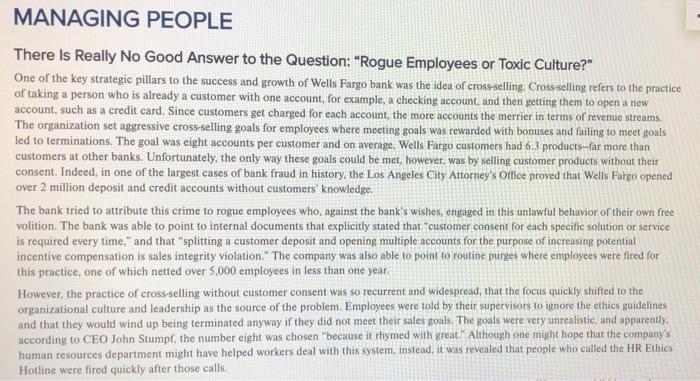
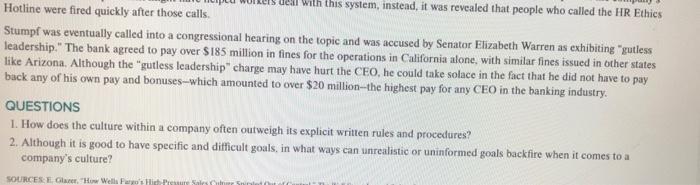
MANAGING PEOPLE There Is Really No Good Answer to the Question: "Rogue Employees or Toxic Culture?" One of the key strategic pillars to the success and growth of Wells Fargo bank was the idea of cross-selling Cross selling refers to the practice of taking a person who is already a customer with one account, for example, a checking account, and then getting them to open a new account, such as a credit card. Since customers get charged for each account, the more accounts the merrier in terms of revenue streams. The organization set aggressive cross-selling goals for employees where meeting goals was rewarded with bonuses and failing to meet goals led to terminations. The goal was eight accounts per customer and on average. Wells Fargo customers had 6.3 products-far more than customers at other banks. Unfortunately, the only way these goals could be met, however, was by selling customer products without their consent. Indeed, in one of the largest cases of bank fraud in history, the Los Angeles City Attorney's Office proved that Wells Fargo opened over 2 million deposit and credit accounts without customers' knowledge. The bank tried to attribute this crime to rogue employees who, against the bank's wishes, engaged in this unlawful behavior of their own free volition. The bank was able to point to internal documents that explicitly stated that "customer consent for each specific solution or service is required every time," and that "splitting a customer deposit and opening multiple accounts for the purpose of increasing potential incentive compensation is sales integrity violation." The company was also able to point to routine purges where employees were fired for this practice, one of which netted over 5,000 employees in less than one year However, the practice of cross-selling without customer consent was so recurrent and widespread, that the focus quickly shifted to the organizational culture and leadership as the source of the problem. Employees were told by their supervisors to ignore the ethics guidelines and that they would wind up being terminated anyway if they did not meet their sales goals. The goals were very unrealistic and apparently, according to CEO John Stumpf, the number eight was chosen "because it rhymed with great." Although one might hope that the company's human resources department might have helped workers deal with this system, instead, it was revealed that people who called the HR Ethics Hotline were fired quickly after those calls ell with this system, instead, it was revealed that people who called the HR Ethics Hotline were fired quickly after those calls. Stumpf was eventually called into a congressional hearing on the topic and was accused by Senator Elizabeth Warren as exhibiting "gutless leadership." The bank agreed to pay over $185 million in fines for the operations in California alone, with similar fines issued in other states like Arizona. Although the "gutless leadership" charge may have hurt the CEO, he could take solace in the fact that he did not have to pay back any of his own pay and bonuses-which amounted to over $20 million-the highest pay for any CEO in the banking industry. QUESTIONS 1. How does the culture within a company often outweigh its explicit written rules and procedures? 2. Although it is good to have specific and difficult goals, in what ways can unrealistic or uninformed goals backfire when it comes to a company's culture? SOURCES E G. How Wells Fargo Hich Step by Step Solution
There are 3 Steps involved in it
1 Expert Approved Answer
Step: 1 Unlock

Question Has Been Solved by an Expert!
Get step-by-step solutions from verified subject matter experts
Step: 2 Unlock
Step: 3 Unlock
 Study Help