







Question: Answer questions 1. 2a, 2b,, 2c from chapter 8 in Business organization textbook. 1.Why might a large business choose to operate as an LLC rather
 Answer questions 1. 2a, 2b,, 2c from chapter 8 in Business organization textbook.
1.Why might a large business choose to operate as an LLC rather than as an S corporation?
2.Jackson Building Services, Inc. is a corporation formed in New York. It has 15 shareholders, all of whom are active in managing the business.
a. The corporation would like to expand into Pennsylvania and New Jersey. May it do so?
b. In which state(s) is the corporation a domestic entity, and in which state(s) is it a foreign corporation?
c. Rather than issuing dividends to its 15 shareholders, the corporation has decided to award each of its shareholder-employees a cash bonus. Of what advantage is this, if any, to the shareholder-employees and to the corporation?
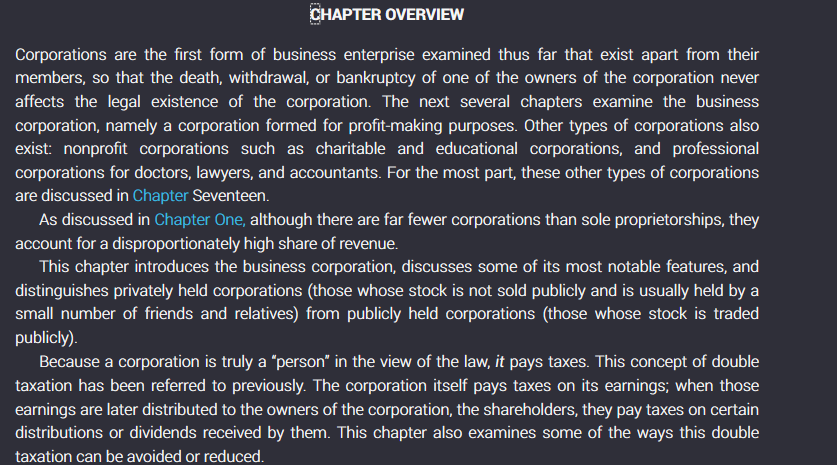
CHAPTER OVERVIEW Corporations are the first form of business enterprise examined thus far that exist apart from their members, so that the death, withdrawal, or bankruptcy of one of the owners of the corporation never affects the legal existence of the corporation. The next several chapters examine the business corporation, namely a corporation formed for profit-making purposes. Other types of corporations also exist: nonprofit corporations such as charitable and educational corporations, and professional corporations for doctors, lawyers, and accountants. For the most part, these other types of corporations are discussed in Chapter Seventeen. As discussed in Chapter One, although there are far fewer corporations than sole proprietorships, they account for a disproportionately high share of revenue. This chapter introduces the business corporation, discusses some of its most notable features, and distinguishes privately held corporations (those whose stock is not sold publicly and is usually held by a small number of friends and relatives) from publicly held corporations (those whose stock is traded publicly). Because a corporation is truly a "person" in the view of the law, it pays taxes. This concept of double taxation has been referred to previously. The corporation itself pays taxes on its earnings; when those earnings are later distributed to the owners of the corporation, the shareholders, they pay taxes on certain distributions or dividends received by them. This chapter also examines some of the ways this double taxation can be avoided or reducedStep by Step Solution
There are 3 Steps involved in it

Get step-by-step solutions from verified subject matter experts
 Study Help