







Question: answer questions 1 and 2 Answer questions 1-5 TRUE OR FALSE Case 16.3 Digital Realty Trust v. Somers, 138 S. Ct. 767 (2018) (p. 558)
answer questions 1 and 2
Answer questions 1-5 TRUE OR FALSE
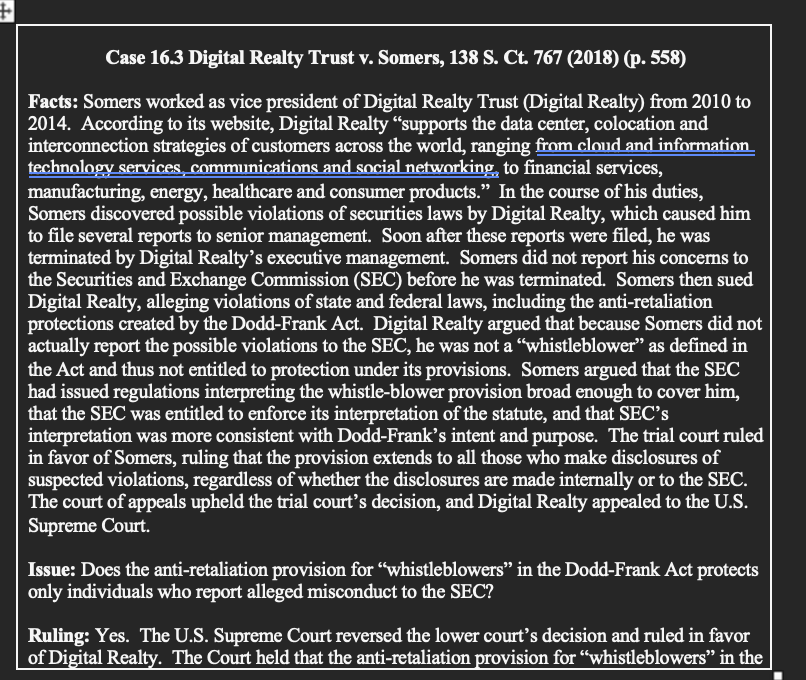
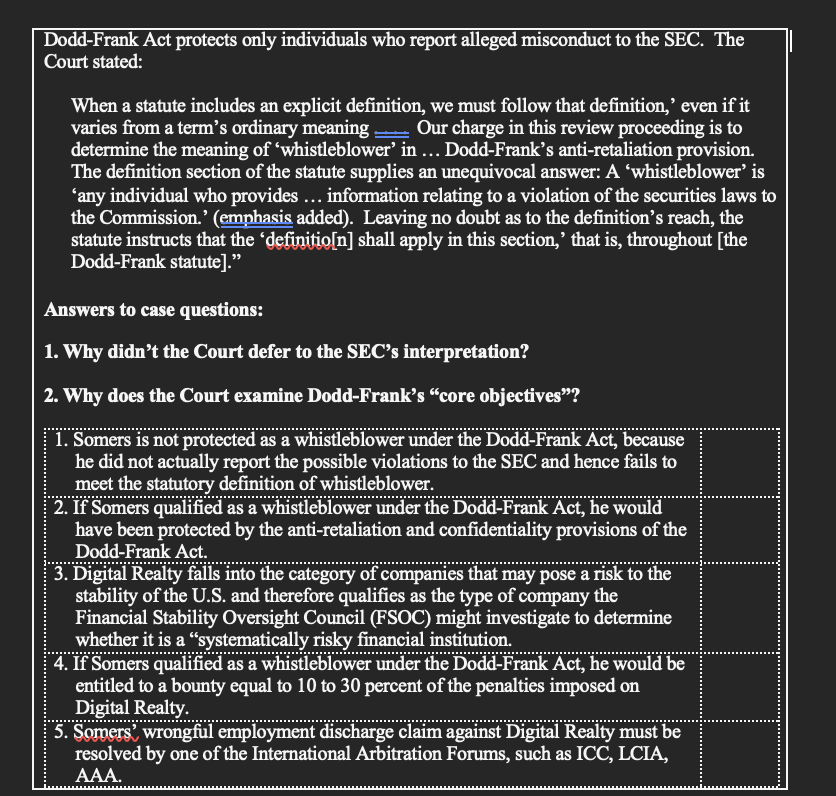
Case 16.3 Digital Realty Trust v. Somers, 138 S. Ct. 767 (2018) (p. 558) Facts: Somers worked as vice president of Digital Realty Trust (Digital Realty) from 2010 to 2014. According to its website, Digital Realty "supports the data center, colocation and interconnection strategies of customers across the world, ranging from cloud and information technolngy services, communications and social networking to financial services, manufacturing, energy, healthcare and consumer products." In the course of his duties, Somers discovered possible violations of securities laws by Digital Realty, which caused him to file several reports to senior management. Soon after these reports were filed, he was terminated by Digital Realty's executive management. Somers did not report his concerns to the Securities and Exchange Commission (SEC) before he was terminated. Somers then sued Digital Realty, alleging violations of state and federal laws, including the anti-retaliation protections created by the Dodd-Frank Act. Digital Realty argued that because Somers did not actually report the possible violations to the SEC, he was not a "whistleblower" as defined in the Act and thus not entitled to protection under its provisions. Somers argued that the SEC had issued regulations interpreting the whistle-blower provision broad enough to cover him, that the SEC was entitled to enforce its interpretation of the statute, and that SEC's interpretation was more consistent with Dodd-Frank's intent and purpose. The trial court ruled in favor of Somers, ruling that the provision extends to all those who make disclosures of suspected violations, regardless of whether the disclosures are made internally or to the SEC. The court of appeals upheld the trial court's decision, and Digital Realty appealed to the U.S. Supreme Court. Issue: Does the anti-retaliation provision for "whistleblowers" in the Dodd-Frank Act protects only individuals who report alleged misconduct to the SEC? Ruling: Yes. The U.S. Supreme Court reversed the lower court's decision and ruled in favor of Digital Realty. The Court held that the anti-retaliation provision for "whistleblowers" in the Dodd-Frank Act protects only individuals who report alleged misconduct to the SEC. The Court stated: When a statute includes an explicit definition, we must follow that definition,' even if it varies from a term's ordinary meaning _.. Our charge in this review proceeding is to determine the meaning of 'whistleblower' in ... Dodd-Frank's anti-retaliation provision. The definition section of the statute supplies an unequivocal answer: A 'whistleblower' is 'any individual who provides ... information relating to a violation of the securities laws to the Commission.' (emphasis added). Leaving no doubt as to the definition's reach, the statute instructs that the 'definitio[n] shall apply in this section,' that is, throughout [the Dodd-Frank statute]." Answers to case questions: 1. Why didn't the Court defer to the SEC's interpretation? 2. Why does the Court examine Dodd-Frank's "core objectives"? 1. Somers is not protected as a whistleblower under the Dodd-Frank Act, because he did not actually report the possible violations to the SEC and hence fails to meet the statutory definition of whistleblower. 2. If Somers qualified as a whistleblower under the Dodd-Frank Act, he would have been protected by the anti-retaliation and confidentiality provisions of the Dodd-Frank Act. 3. Digital Realty falls into the category of companies that may pose a risk to the stability of the U.S. and therefore qualifies as the type of company the Financial Stability Oversight Council (FSOC) might investigate to determine whether it is a "systematically risky financial institution. 4. If Somers qualified as a whistleblower under the Dodd-Frank Act, he would be entitled to a bounty equal to 10 to 30 percent of the penalties imposed on Digital Realty. 5. Somers' wrongful employment discharge claim against Digital Realty must be resolved by one of the International Arbitration Forums, such as ICC, LCIA, AAA. Case 16.3 Digital Realty Trust v. Somers, 138 S. Ct. 767 (2018) (p. 558) Facts: Somers worked as vice president of Digital Realty Trust (Digital Realty) from 2010 to 2014. According to its website, Digital Realty "supports the data center, colocation and interconnection strategies of customers across the world, ranging from cloud and information technolngy services, communications and social networking to financial services, manufacturing, energy, healthcare and consumer products." In the course of his duties, Somers discovered possible violations of securities laws by Digital Realty, which caused him to file several reports to senior management. Soon after these reports were filed, he was terminated by Digital Realty's executive management. Somers did not report his concerns to the Securities and Exchange Commission (SEC) before he was terminated. Somers then sued Digital Realty, alleging violations of state and federal laws, including the anti-retaliation protections created by the Dodd-Frank Act. Digital Realty argued that because Somers did not actually report the possible violations to the SEC, he was not a "whistleblower" as defined in the Act and thus not entitled to protection under its provisions. Somers argued that the SEC had issued regulations interpreting the whistle-blower provision broad enough to cover him, that the SEC was entitled to enforce its interpretation of the statute, and that SEC's interpretation was more consistent with Dodd-Frank's intent and purpose. The trial court ruled in favor of Somers, ruling that the provision extends to all those who make disclosures of suspected violations, regardless of whether the disclosures are made internally or to the SEC. The court of appeals upheld the trial court's decision, and Digital Realty appealed to the U.S. Supreme Court. Issue: Does the anti-retaliation provision for "whistleblowers" in the Dodd-Frank Act protects only individuals who report alleged misconduct to the SEC? Ruling: Yes. The U.S. Supreme Court reversed the lower court's decision and ruled in favor of Digital Realty. The Court held that the anti-retaliation provision for "whistleblowers" in the Dodd-Frank Act protects only individuals who report alleged misconduct to the SEC. The Court stated: When a statute includes an explicit definition, we must follow that definition,' even if it varies from a term's ordinary meaning _.. Our charge in this review proceeding is to determine the meaning of 'whistleblower' in ... Dodd-Frank's anti-retaliation provision. The definition section of the statute supplies an unequivocal answer: A 'whistleblower' is 'any individual who provides ... information relating to a violation of the securities laws to the Commission.' (emphasis added). Leaving no doubt as to the definition's reach, the statute instructs that the 'definitio[n] shall apply in this section,' that is, throughout [the Dodd-Frank statute]." Answers to case questions: 1. Why didn't the Court defer to the SEC's interpretation? 2. Why does the Court examine Dodd-Frank's "core objectives"? 1. Somers is not protected as a whistleblower under the Dodd-Frank Act, because he did not actually report the possible violations to the SEC and hence fails to meet the statutory definition of whistleblower. 2. If Somers qualified as a whistleblower under the Dodd-Frank Act, he would have been protected by the anti-retaliation and confidentiality provisions of the Dodd-Frank Act. 3. Digital Realty falls into the category of companies that may pose a risk to the stability of the U.S. and therefore qualifies as the type of company the Financial Stability Oversight Council (FSOC) might investigate to determine whether it is a "systematically risky financial institution. 4. If Somers qualified as a whistleblower under the Dodd-Frank Act, he would be entitled to a bounty equal to 10 to 30 percent of the penalties imposed on Digital Realty. 5. Somers' wrongful employment discharge claim against Digital Realty must be resolved by one of the International Arbitration Forums, such as ICC, LCIA, AAA
Step by Step Solution
There are 3 Steps involved in it

Get step-by-step solutions from verified subject matter experts
 Study Help