



Question: Answer questions 5 and 6 based on the following inf A, B, and C are three non-cyclical commodities traded on a futures exchange. On April
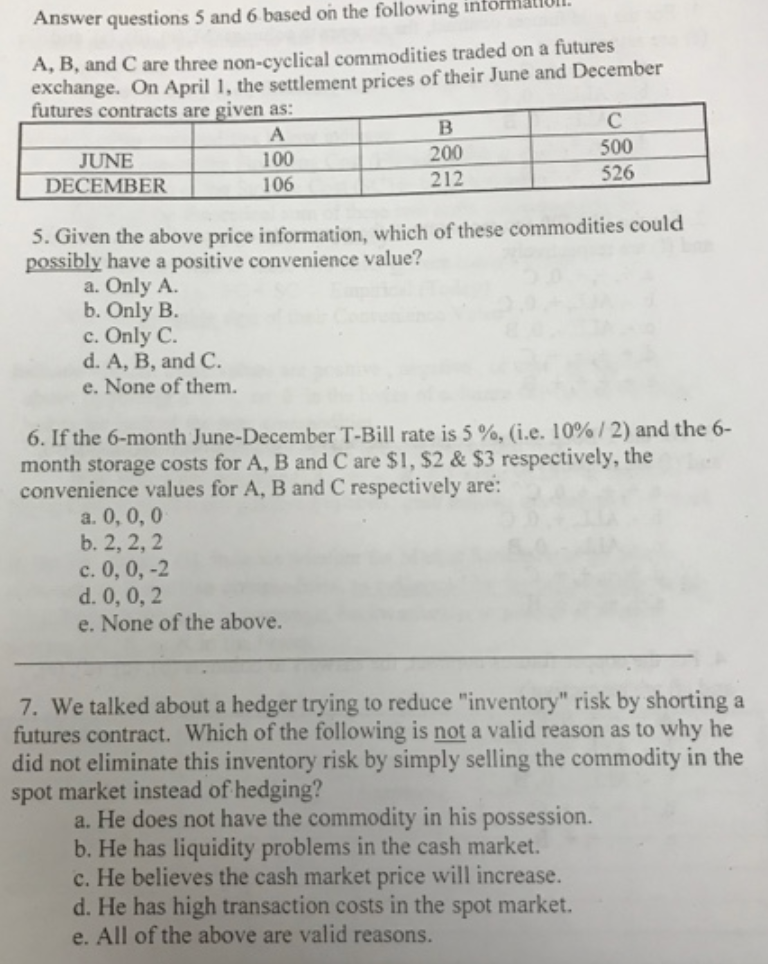
Answer questions 5 and 6 based on the following inf A, B, and C are three non-cyclical commodities traded on a futures exchange. On April 1, the settlement prices of their June and December futures contracts are given as: 500 200 100 JUNE 526 212 106 DECEMBER 5. Given the above price information, which of these commodities could possibly have a positive convenience value? a. Only A. b. Only B. c. Only C. d. A, B, and C. e. None of them. 6. If the 6-month June-December T-Bill rate is 5 %, (i.e. 10% / 2) and the 6- month storage costs for A, B and C are $1, $2 & $3 respectively, the convenience values for A, B and C respectively are: a. 0, 0, 0 b. 2, 2, 2 c. 0, 0, -2 d. 0, 0, 2 e. None of the above. 7. We talked about a hedger trying to reduce "inventory" risk by shorting a futures contract. Which of the following is not a valid reason as to why he did not eliminate this inventory risk by simply selling the commodity in the spot market instead of hedging? a. He does not have the commodity in his possession. b. He has liquidity problems in the cash market. c. He believes the cash market price will increase. d. He has high transaction costs in the spot market. e. All of the above are valid reasons. Answer questions 5 and 6 based on the following inf A, B, and C are three non-cyclical commodities traded on a futures exchange. On April 1, the settlement prices of their June and December futures contracts are given as: 500 200 100 JUNE 526 212 106 DECEMBER 5. Given the above price information, which of these commodities could possibly have a positive convenience value? a. Only A. b. Only B. c. Only C. d. A, B, and C. e. None of them. 6. If the 6-month June-December T-Bill rate is 5 %, (i.e. 10% / 2) and the 6- month storage costs for A, B and C are $1, $2 & $3 respectively, the convenience values for A, B and C respectively are: a. 0, 0, 0 b. 2, 2, 2 c. 0, 0, -2 d. 0, 0, 2 e. None of the above. 7. We talked about a hedger trying to reduce "inventory" risk by shorting a futures contract. Which of the following is not a valid reason as to why he did not eliminate this inventory risk by simply selling the commodity in the spot market instead of hedging? a. He does not have the commodity in his possession. b. He has liquidity problems in the cash market. c. He believes the cash market price will increase. d. He has high transaction costs in the spot market. e. All of the above are valid reasons
Step by Step Solution
There are 3 Steps involved in it

Get step-by-step solutions from verified subject matter experts