Question: Answer Questions C and E CASE PROBLEM 2.3 Quality Problems at the Tech Bookstores Tech is a major state university located in a small, rural
Answer Questions C and E
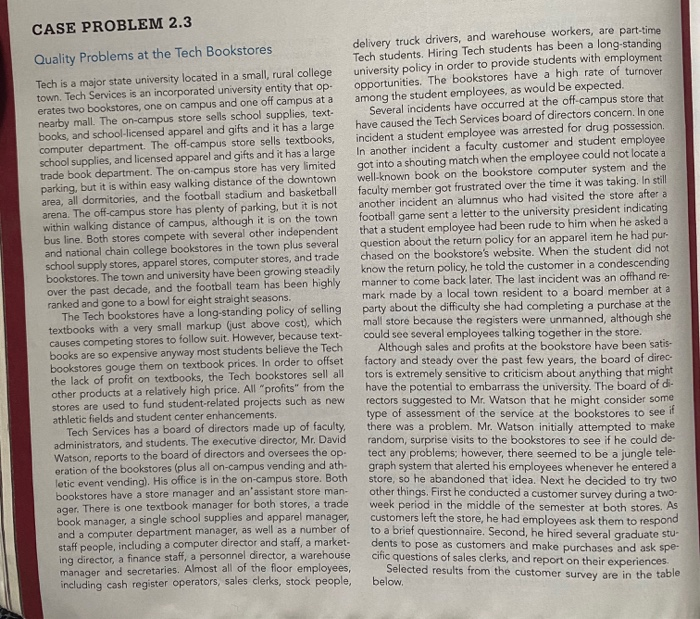
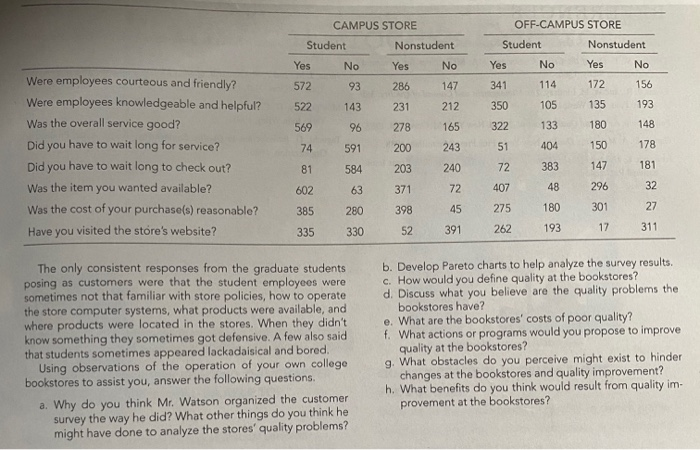
CASE PROBLEM 2.3 Quality Problems at the Tech Bookstores Tech is a major state university located in a small, rural college town. Tech Services is an incorporated university entity that op. erates two bookstores, one on campus and one off campus at a nearby mall. The on-campus store sells school supplies, text- books, and school-licensed apparel and gifts and it has a large computer department. The off-campus store sells textbooks, school supplies, and licensed apparel and gifts and it has a large trade book department. The on-campus store has very limited parking, but it is within easy walking distance of the downtown area, all dormitories, and the football stadium and basketball arena. The off-campus store has plenty of parking, but it is not within walking distance of campus, although it is on the town bus line. Both stores compete with several other independent and national chain college bookstores in the town plus several school supply stores, apparel stores, computer stores, and trade bookstores. The town and university have been growing steadily over the past decade, and the football team has been highly ranked and gone to a bowl for eight straight seasons. The Tech bookstores have a long-standing policy of selling textbooks with a very small markup (just above cost), which causes competing stores to follow suit. However, because text- books are so expensive anyway most students believe the Tech bookstores gouge them on textbook prices. In order to offset the lack of profit on textbooks, the Tech bookstores sell all other products at a relatively high price. All "profits" from the stores are used to fund student-related projects such as new athletic fields and student center enhancements. Tech Services has a board of directors made up of faculty, administrators, and students. The executive director, Mr. David Watson, reports to the board of directors and oversees the op. eration of the bookstores (plus all on-campus vending and ath- letic event vending). His office is in the on-campus store. Both bookstores have a store manager and an'assistant store man- ager. There is one textbook manager for both stores, a trade book manager, a single school supplies and apparel manager, and a computer department manager, as well as a number of staff people, including a computer director and staff, a market- ing director, a finance staff, a personnel director, a warehouse manager and secretaries. Almost all of the floor employees, including cash register operators, sales clerks, stock people, delivery truck drivers, and warehouse workers, are part-time Tech students. Hiring Tech students has been a long-standing university policy in order to provide students with employment opportunities. The bookstores have a high rate of turnover among the student employees, as would be expected. Several incidents have occurred at the off-campus store that have caused the Tech Services board of directors concern. In one incident a student employee was arrested for drug possession In another incident a faculty customer and student employee got into a shouting match when the employee could not locate a well-known book on the bookstore computer system and the faculty member got frustrated over the time it was taking. In still another incident an alumnus who had visited the store after a football game sent a letter to the university president indicating that a student employee had been rude to him when he asked a question about the return policy for an apparel item he had pur- chased on the bookstore's website. When the student did not know the return policy, he told the customer in a condescending manner to come back later. The last incident was an offhand re- mark made by a local town resident to a board member at a party about the difficulty she had completing a purchase at the mall store because the registers were unmanned, although she could see several employees talking together in the store. Although sales and profits at the bookstore have been satis- factory and steady over the past few years, the board of direc tors is extremely sensitive to criticism about anything that might have the potential to embarrass the university. The board of di- rectors suggested to Mr. Watson that he might consider some type of assessment of the service at the bookstores to see if there was a problem. Mr. Watson initially attempted to make random, surprise visits to the bookstores to see if he could de tect any problems; however, there seemed to be a jungle tele- graph system that alerted his employees whenever he entered a store, so he abandoned that idea. Next he decided to try two other things. First he conducted a customer survey during a two- week period in the middle of the semester at both stores. As customers left the store, he had employees ask them to respond to a brief questionnaire. Second, he hired several graduate stu- dents to pose as customers and make purchases and ask spe- cific questions of sales clerks, and report on their experiences. Selected results from the customer survey are in the table below. CAMPUS STORE Student Nonstudent OFF-CAMPUS STORE Student Nonstudent Yes No Yes 341 114 172 156 No Yes No No Yes 572 93 286 147 522 143 231 212 350 105 135 193 569 96 278 165 322 133 180 148 74 591 243 51 404 150 178 Were employees courteous and friendly? Were employees knowledgeable and helpful? Was the overall service good? Did you have to wait long for service? Did you have to wait long to check out? Was the item you wanted available? Was the cost of your purchase(s) reasonable? Have you visited the store's website? 200 203 81 584 240 72 181 383 147 602 63 371 72 407 48 32 296 385 280 398 45 275 180 301 27 335 52 330 391 262 17 193 311 The only consistent responses from the graduate students posing as customers were that the student employees were sometimes not that familiar with store policies, how to operate the store computer systems, what products were available, and where products were located in the stores. When they didn't know something they sometimes got defensive. A few also said that students sometimes appeared lackadalsical and bored. Using observations of the operation of your own college bookstores to assist you, answer the following questions a. Why do you think Mr. Watson organized the customer survey the way he did? What other things do you think he might have done to analyze the stores' quality problems? b. Develop Pareto charts to help analyze the survey results. c. How would you define quality at the bookstores? d. Discuss what you believe are the quality problems the bookstores have? e. What are the bookstores' costs of poor quality? f. What actions or programs would you propose to improve quality at the bookstores? g. What obstacles do you perceive might exist to hinder changes at the bookstores and quality improvement? h. What benefits do you think would result from quality im- provement at the bookstores









 Study Help