







Question: ANSWER QUESTIONS FROM EXERCISE 8.16 Exercise 1.1 Consider the following process for the admission of graduate students at a university. In order to apply for
ANSWER QUESTIONS FROM EXERCISE 8.16
Exercise 1.1 Consider the following process for the admission of graduate students at a university.
In order to apply for admission, students first fill in an online form. Online applications are recorded in an information system to which all staff members involved in the admissions process have access to. After a student has submitted the online form, a PDF document is generated and the student is requested to download it, sign it, and send it by post together with the required documents, which include:
-
Certified copies of previous degree and academic transcripts.
-
Results of English language test.
-
Curriculum vitae.
When these documents are received by the admissions office, an officer checks the completeness of the documents. If any document is missing, an e-mail is sent to the student. The student has to send the missing documents by post. Assuming the application is complete, the admissions office sends the certified copies of the degrees to an academic recognition agency, which checks the degrees and gives an assessment of their validity and equivalence in terms of local education standards. This agency requires that all documents be sent to it by post, and all documents must be certified copies of the originals. The agency sends back its assessment to the university by post as well. Assuming the degree verification is successful, the English language test results are then checked online by an officer at the admissions office. If the validity of the English language test results cannot be verified, the application is rejected (such notifications of rejection are sent by e-mail). Once all documents of a given student have been validated, the admission office forwards these documents by internal mail to the corresponding academic committee responsible for deciding whether to offer admission or not. The committee makes its decision based on the academic transcripts and the CV. The committee meets once every 2 to 3 weeks and examines all applications that are ready for academic assessment at the time of the meeting. At the end of the committee meeting, the chair of the committee notifies the admissions office of the selection outcomes. This notification includes a list of admitted and rejected candidates. A few days later, the admission office notifies the outcome to each candidate via e-mail. Additionally, successful candidates are sent a confirmation letter by post.
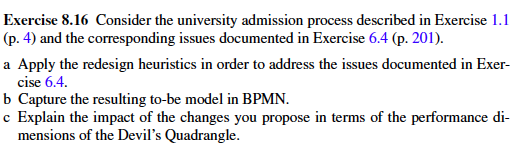
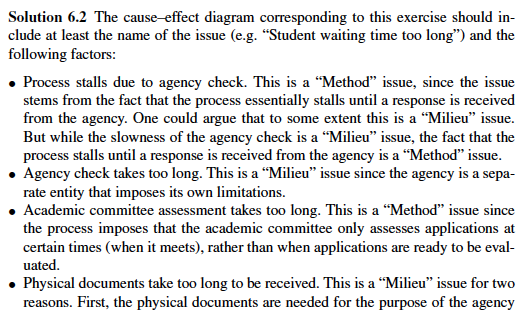
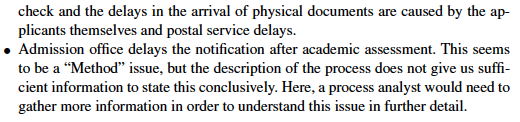
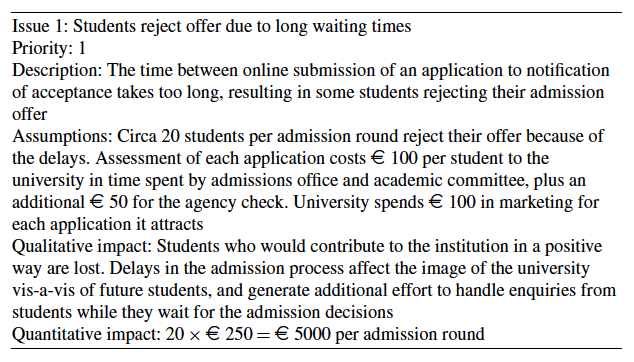
Exercise 8.16 Consider the university admission process described in Exercise 1.1 (p. 4) and the corresponding issues documented in Exercise 6.4 (p. 201). a Apply the redesign heuristics in order to address the issues documented in Exer- cise 6.4. b Capture the resulting to be model in BPMN. c Explain the impact of the changes you propose in terms of the performance di- mensions of the Devil's Quadrangle. Solution 6.2 The cause-effect diagram corresponding to this exercise should in- clude at least the name of the issue (e.g. "Student waiting time too long") and the following factors: Process stalls due to agency check. This is a Method issue, since the issue stems from the fact that the process essentially stalls until a response is received from the agency. One could argue that to some extent this is a Milieu issue. But while the slowness of the agency check is a Milieu" issue, the fact that the process stalls until a response is received from the agency is a Method issue. Agency check takes too long. This is a Milieu" issue since the agency is a sepa- rate entity that imposes its own limitations. Academic committee assessment takes too long. This is a Method" issue since the process imposes that the academic committee only assesses applications at certain times (when it meets), rather than when applications are ready to be eval- uated. . Physical documents take too long to be received. This is a Milieu" issue for two reasons. First, the physical documents are needed for the purpose of the agency check and the delays in the arrival of physical documents are caused by the ap- plicants themselves and postal service delays. Admission office delays the notification after academic assessment. This seems to be a Method issue, but the description of the process does not give us suffi- cient information to state this conclusively. Here, a process analyst would need to gather more information in order to understand this issue in further detail. Issue 1: Students reject offer due to long waiting times Priority: 1 Description: The time between online submission of an application to notification of acceptance takes too long, resulting in some students rejecting their admission offer Assumptions: Circa 20 students per admission round reject their offer because of the delays. Assessment of each application costs 100 per student to the university in time spent by admissions office and academic committee, plus an additional 50 for the agency check. University spends 100 in marketing for each application it attracts Qualitative impact: Students who would contribute to the institution in a positive way are lost. Delays in the admission process affect the image of the university vis-a-vis of future students, and generate additional effort to handle enquiries from students while they wait for the admission decisions Quantitative impact: 20 250= 5000 per admission round
Step by Step Solution
There are 3 Steps involved in it

Get step-by-step solutions from verified subject matter experts
 Study Help