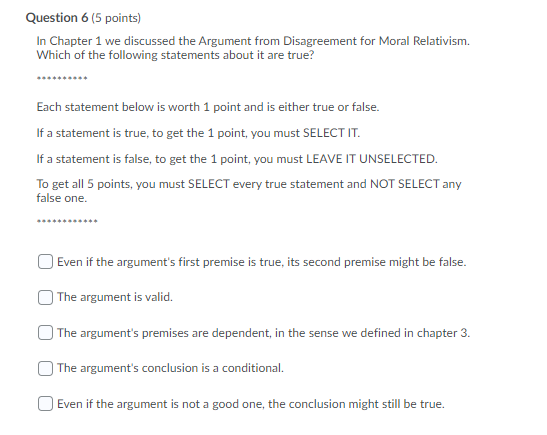
Question: answer quick and correctly!! Question 6 (5 points) In Chapter 1 we discussed the Argument from Disagreement for Moral Relativism. Which of the following statements
 answer quick and correctly!!
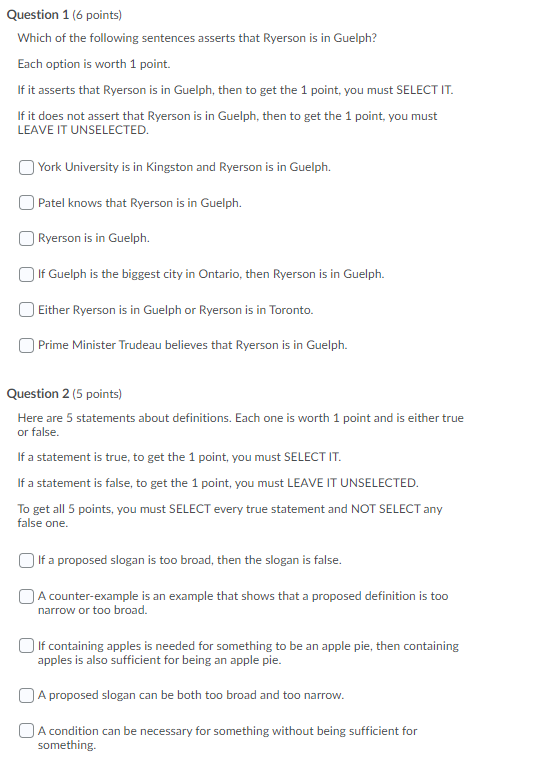
Question 6 (5 points) In Chapter 1 we discussed the Argument from Disagreement for Moral Relativism. Which of the following statements about it are true? Each statement below is worth 1 point and is either true or false. If a statement is true, to get the 1 point, you must SELECT IT. If a statement is false, to get the 1 point, you must LEAVE IT UNSELECTED. To get all 5 points, you must SELECT every true statement and NOT SELECT any false one. Even if the argument's first premise is true, its second premise might be false. The argument is valid The argument's premises are dependent, in the sense we defined in chapter 3. The argument's conclusion is a conditional. Even if the argument is not a good one, the conclusion might still be true. Question 16 points) Which of the following sentences asserts that Ryerson is in Guelph? Each option is worth 1 point. If it asserts that Ryerson is in Guelph, then to get the 1 point, you must SELECT IT. If it does not assert that Ryerson is in Guelph, then to get the 1 point, you must LEAVE IT UNSELECTED. York University is in Kingston and Ryerson is in Guelph. Patel knows that Ryerson is in Guelph. Ryerson is in Guelph. If Guelph is the biggest city in Ontario, then Ryerson is in Guelph. Either Ryerson is in Guelph or Ryerson is in Toronto. Prime Minister Trudeau believes that Ryerson is in Guelph. Question 2 (5 points) Here are 5 statements about definitions. Each one is worth 1 point and is either true or false. If a statement is true, to get the 1 point, you must SELECT IT. If a statement is false, to get the 1 point, you must LEAVE IT UNSELECTED. To get all 5 points, you must SELECT every true statement and NOT SELECT any false one. If a proposed slogan is too broad, then the slogan is false. A counter-example is an example that shows that a proposed definition is too narrow or too broad. If containing apples is needed for something to be an apple pie, then containing apples is also sufficient for being an apple pie. A proposed slogan can be both too broad and too narrow. A condition can be necessary for something without being sufficient for something









 Study Help