







Question: Answer quickly for thumbs up Answer these questions about the lab below. 1. a. Why is it important to file the ends of the pipes
Answer quickly for thumbs up
Answer these questions about the lab below.
1. a. Why is it important to file the ends of the pipes to obtain an even and smoothed edge?
b. Why are the cuttings periodically removed from the stock and die during threading of the pipe?
c. Why is cutting oil periodically applied onto the die and pipe during threading?
d. What is the purpose of thread seal on the threaded pipes
e. In which direction should thread seal be applied, and why?
f. Why are valves places before the pump and rotameter?
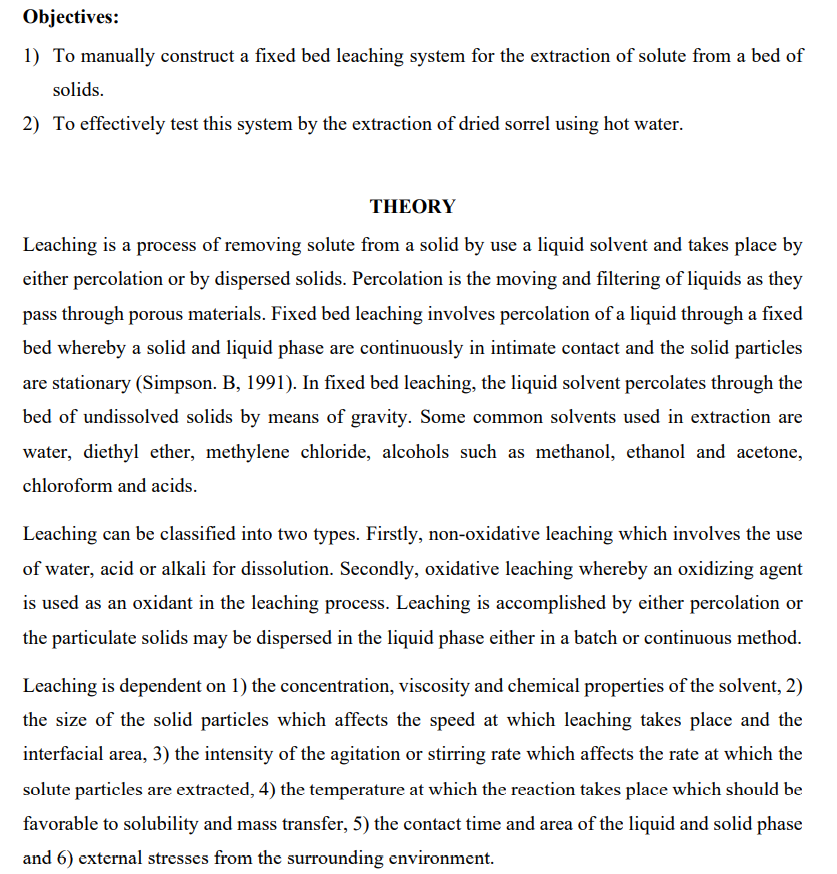
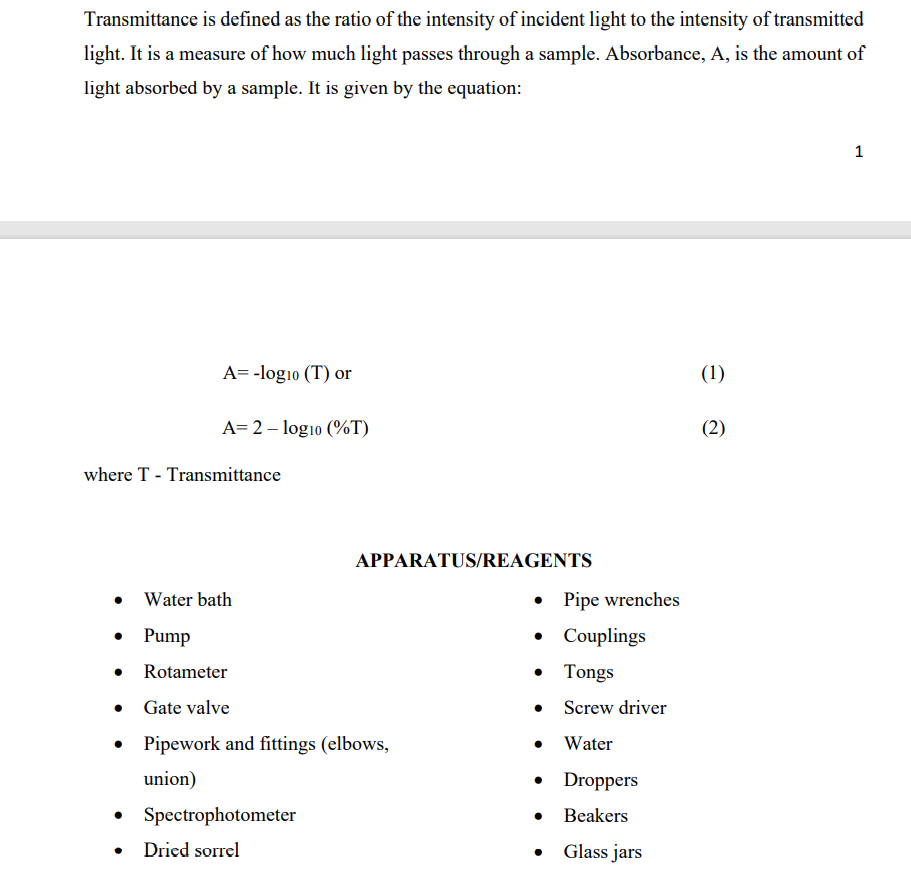
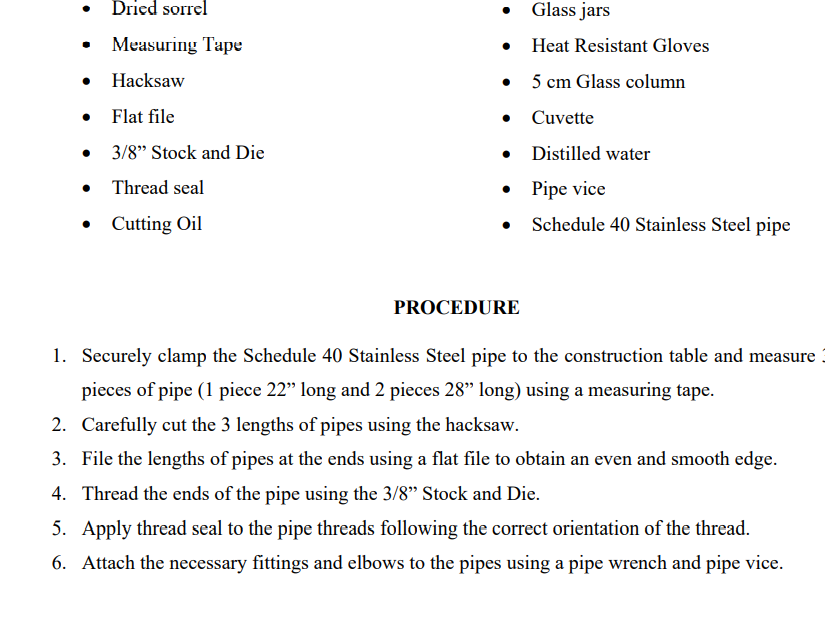
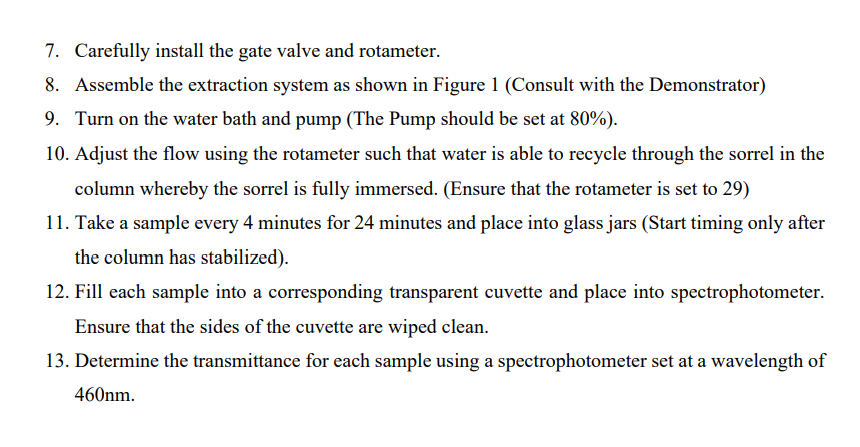
Objectives: 1) To manually construct a fixed bed leaching system for the extraction of solute from a bed of solids. 2) To effectively test this system by the extraction of dried sorrel using hot water. THEORY Leaching is a process of removing solute from a solid by use a liquid solvent and takes place by either percolation or by dispersed solids. Percolation is the moving and filtering of liquids as they pass through porous materials. Fixed bed leaching involves percolation of a liquid through a fixed bed whereby a solid and liquid phase are continuously in intimate contact and the solid particles are stationary (Simpson. B, 1991). In fixed bed leaching, the liquid solvent percolates through the bed of undissolved solids by means of gravity. Some common solvents used in extraction are water, diethyl ether, methylene chloride, alcohols such as methanol, ethanol and acetone, chloroform and acids. Leaching can be classified into two types. Firstly, non-oxidative leaching which involves the use of water, acid or alkali for dissolution. Secondly, oxidative leaching whereby an oxidizing agent is used as an oxidant in the leaching process. Leaching is accomplished by either percolation or the particulate solids may be dispersed in the liquid phase either in a batch or continuous method. Leaching is dependent on 1) the concentration, viscosity and chemical properties of the solvent, 2) the size of the solid particles which affects the speed at which leaching takes place and the interfacial area, 3) the intensity of the agitation or stirring rate which affects the rate at which the solute particles are extracted, 4) the temperature at which the reaction takes place which should be favorable to solubility and mass transfer, 5) the contact time and area of the liquid and solid phase and 6) external stresses from the surrounding environment. Transmittance is defined as the ratio of the intensity of incident light to the intensity of transmitted light. It is a measure of how much light passes through a sample. Absorbance, A, is the amount of light absorbed by a sample. It is given by the equation: 1 A=-log10 (T) or (1) A= 2 - logio (%T) (2) where T - Transmittance APPARATUS/REAGENTS Water bath Pipe wrenches Pump Couplings Rotameter Tongs Gate valve Screw driver Pipework and fittings (elbows, Water union) Droppers Spectrophotometer Beakers Dried sorrel Glass jars . . Glass jars . Dried sorrel Measuring Tape Hacksaw Flat file 3/8" Stock and Die Thread seal Cutting Oil Heat Resistant Gloves 5 cm Glass column Cuvette Distilled water Pipe vice Schedule 40 Stainless Steel pipe . . PROCEDURE 1. Securely clamp the Schedule 40 Stainless Steel pipe to the construction table and measure pieces of pipe (1 piece 22 long and 2 pieces 28" long) using a measuring tape. 2. Carefully cut the 3 lengths of pipes using the hacksaw. 3. File the lengths of pipes at the ends using a flat file to obtain an even and smooth edge. 4. Thread the ends of the pipe using the 3/8 Stock and Die. 5. Apply thread seal to the pipe threads following the correct orientation of the thread. 6. Attach the necessary fittings and elbows to the pipes using a pipe wrench and pipe vice. 7. Carefully install the gate valve and rotameter. 8. Assemble the extraction system as shown in Figure 1 (Consult with the Demonstrator) 9. Turn on the water bath and pump (The Pump should be set at 80%). 10. Adjust the flow using the rotameter such that water is able to recycle through the sorrel in the column whereby the sorrel is fully immersed. (Ensure that the rotameter is set to 29) 11. Take a sample every 4 minutes for 24 minutes and place into glass jars (Start timing only after the column has stabilized). 12. Fill each sample into a corresponding transparent cuvette and place into spectrophotometer. Ensure that the sides of the cuvette are wiped clean. 13. Determine the transmittance for each sample using a spectrophotometer set at a wavelength of 460nm
Step by Step Solution
There are 3 Steps involved in it

Get step-by-step solutions from verified subject matter experts
 Study Help