Question: Answer Reflection question#5 on page 102. 1000-2000 words with introduction, body and conclusion. 102 Part Two The US New Dealustrial Relations System General Motors sit
Answer Reflection question#5 on page 102. 1000-2000 words with introduction, body and conclusion.
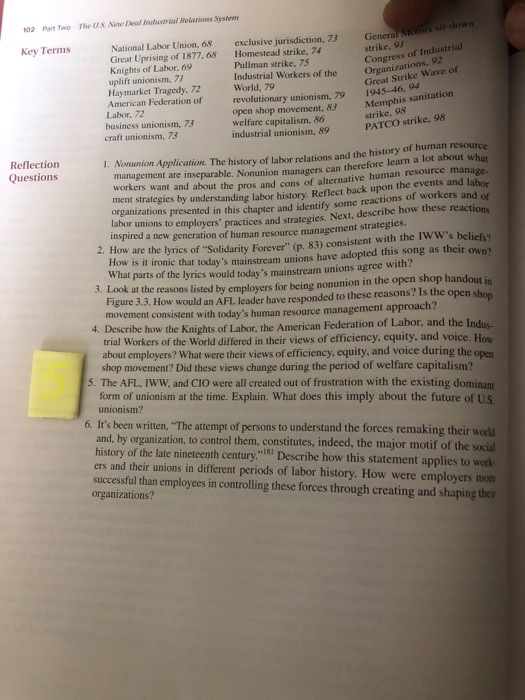
102 Part Two The US New Dealustrial Relations System General Motors sit down strike, 9/ Congress of Industrial Organizations, 92 Great Strike Wave of 1945-46, 94 Memphis sanitation strike, 98 PATCO strike, 98 Key Terms National Labor Union, 68 exclusive jurisdiction, 73 Great Uprising of 1877.68 Homestead strike, 74 Knights of Labor, 69 Pullman strike, 75 uplift unionism, 77 Industrial Workers of the Haymarket Tragedy. 72 World, 79 American Federation of revolutionary unionism. 79 Labor, 72 open shop movement, 83 business unionism, 73 welfare capitalism, 86 craft unionism, 73 industrial unionism, 89 Reflection Questions 1. Nonunion Application. The history of labor relations and the history of human resource management are inseparable. Nonunion managers can therefore learn a lot about what workers want and about the pros and cons of alternative human resource manage ment strategies by understanding labor history. Reflect back upon the events and labor organizations presented in this chapter and identify some reactions of workers and of labor unions to employers' practices and strategies. Next, describe how these reactions inspired a new generation of human resource management strategies. 2. How are the lyrics of "Solidarity Forever" (p. 83) consistent with the IWW's beliefs? How is it ironic that today's mainstream unions have adopted this song as their own? What parts of the lyrics would today's mainstream unions agree with? 3. Look at the reasons listed by employers for being nonunion in the open shop handout in Figure 3.3. How would an AFL leader have responded to these reasons? Is the open shop movement consistent with today's human resource management approach? 4. Describe how the Knights of Labor, the American Federation of Labor, and the Indus- trial Workers of the World differed in their views of efficiency, equity, and voice. How about employers? What were their views of efficiency, equity, and voice during the open shop movement? Did these views change during the period of welfare capitalism? 5. The AFL, IWW, and CIO were all created out of frustration with the existing dominant form of unionism at the time. Explain. What does this imply about the future of U.S. unionism? 6. It's been written, "The attempt of persons to understand the forces remaking their world and, by organization, to control them, constitutes, indeed, the major motif of the social history of the late nineteenth century. Describe how this statement applies to work ers and their unions in different periods of labor history. How were employers more successful than employees in controlling these forces through creating and shaping the organizations? 181









 Study Help