







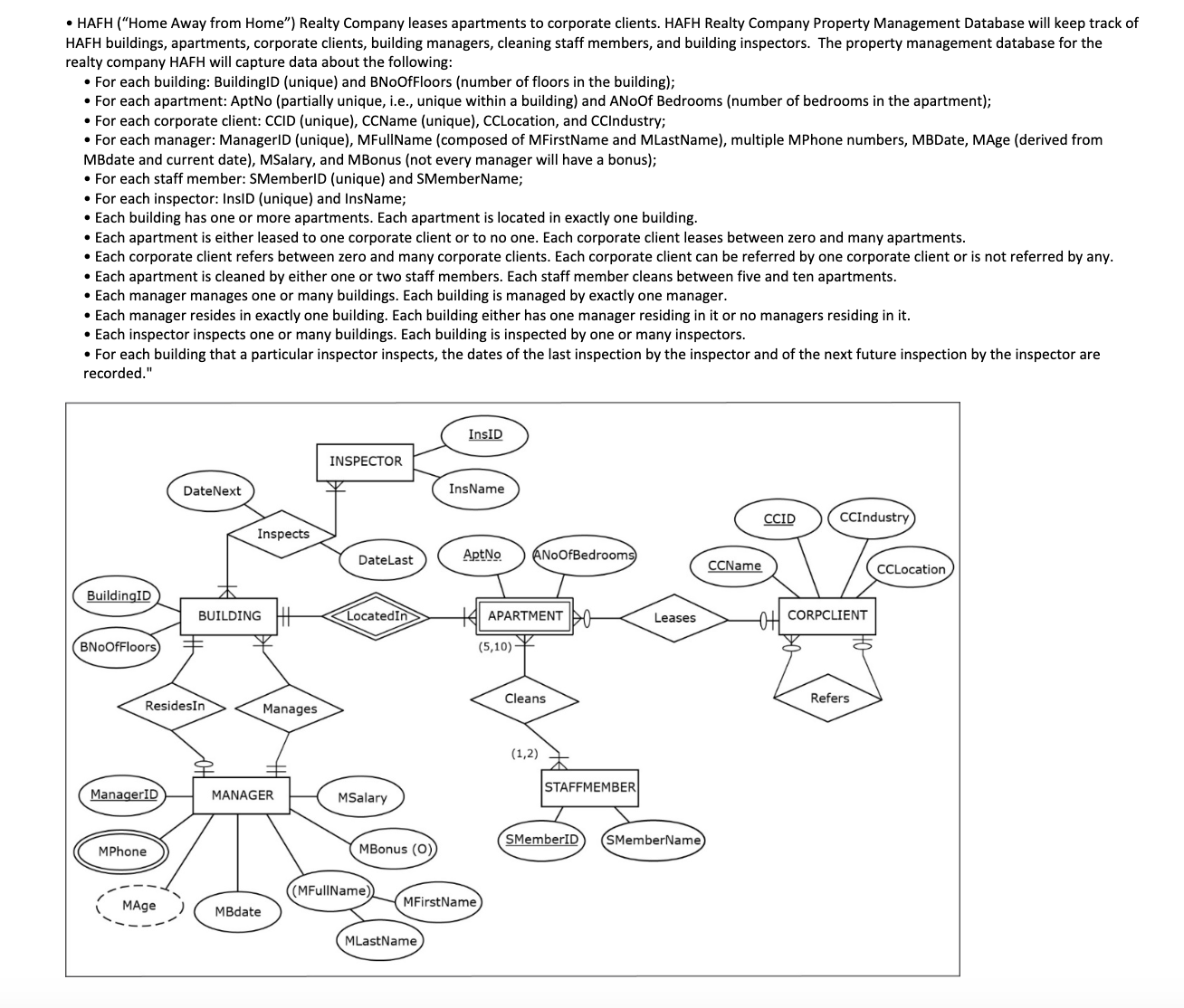
Question: Answer steps 1 to 6 , use 3 rd image for more info: List the Regular Entity, last page is example: List only Types in
Answer steps to use rd image for more info: List the Regular Entity, last page is example: List only Types in the HAFH ER diagram.
INSPECTOR
BUILDING
CORPCLIENT
MANAGER
STAFFMEMBER
List the Weak Entity Types in the HAFH ER diagram. For each Weak Entity Type in the HA
For foreign key attributes, please use the same names as their matching primary key attributes, except that in step when mapping
the Refers relationship please use the foreign key name CCIDreferredby. A different foreign key name is necessary in that case
because the foreign key attribute and its matching primary key attribute are in the same table.
Step List only the tables or "relations" that would be created in "Step : Mapping of Regular Entity Types" and all of those table's
attributes that are created in step Specify the primary key of each table you list. Specify any additional unique keys. If there are
no Regular Entity Types, then write, "There are no Regular Entity Types."
Your answer for Step goes here.
Step List only the tables or "relations" that would be created in "Step : Mapping of Weak Entity Types" and all of those table's
attributes that are created in step Specify the primary key of each table you list. If there are no Weak Entity Types, then write,
"There are no Weak Entity Types."
Step List only the tables or "relations" that would have attributes added to them in "Step : Mapping of Binary : Relationship
Types" using the Foreign key approach. For each table you list, specify only the attributes added in step Indicate which attributes
are foreign keys. If there are no : Relationship Types, then write, "There are no : Relationship Types."
Your answer for Step goes here.
Step List only the tables or "relations" that would have attributes added to them in "Step : Mapping of Binary :N Relationship
Types" using the Foreign key approach. For each table you list, specify only the attributes added in step Indicate which attributes
are foreign keys. If there are no :N Relationship Types, then write, "There are no :N Relationship Types."
Your answer for Step goes here.
Step List only the tables or "relations" that would be created in "Step : Mapping of Binary M:N Relationship Types" using the
Foreign key approach. For each table you list, specify only the attributes created in step Specify the primary key of each table you
list. Indicate which attributes are foreign keys. If there are no M:N Relationship Types, then write, "There are no M:N Relationship
Types."
Your answer for Step goes here.
Step List only the tables or "relations" that would be created in "Step : Mapping of Multivalued Attributes." For each table you
list, specify only the attributes created in step Specify the primary key of each table you list. Indicate which attributes are foreign
keys. If there are no Multivalued Attributes, then write, "There are no Multivalued Attributes."
Your answer for Step goes here.HAFH Home Away from Home" Realty Company leases apartments to corporate clients. HAFH Realty Company Property Management Database will keep track of HAFH buildings, apartments, corporate clients, building managers, cleaning staff members, and building inspectors. The property management database for the realty company HAFH will capture data about the following:
For each building: BuildingID unique and BNoOfFloors number of floors in the building;
For each apartment: AptNo partially unique, ie unique within a building and ANoOf Bedrooms number of bedrooms in the apartment;
For each corporate client: CCID unique CCName unique CCLocation, and CCIndustry;
For each manager: ManagerID unique MFullName composed of MFirstName and MLastName multiple MPhone numbers, MBDate, MAge derived from MBdate and current date MSalary, and MBonus not every manager will have a bonus;
For each staff member: SMemberID unique and SMemberName;
For each inspector: InsID unique and InsName;
Each building has one or more apartments. Each apartment is located in exactly one building.
Each apartment is either leased to one corporate client or to no one. Each corporate client leases between zero and many apartments.
Each corporate client refers between zero and many corporate clients. Each corporate client can be referred by one corporate client or is not referred by any.
Each apartment is cleaned by either one or two staff members. Each sta
Step by Step Solution
There are 3 Steps involved in it
1 Expert Approved Answer
Step: 1 Unlock

Question Has Been Solved by an Expert!
Get step-by-step solutions from verified subject matter experts
Step: 2 Unlock
Step: 3 Unlock
 Study Help