







Question: Answer sufficiently. 10 Exercise 6.6 There are K computers in an office, and a single repairman. Each computer breaks down after an exponentially distributed time
Answer sufficiently.
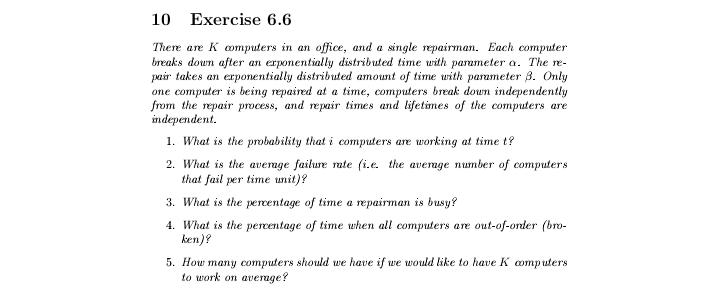
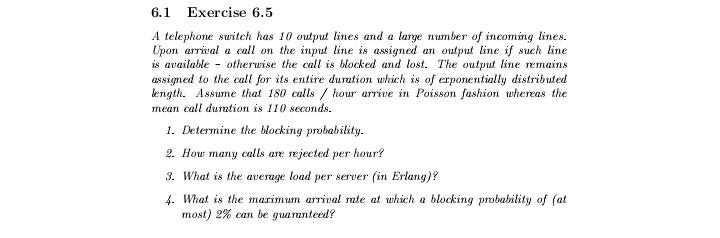
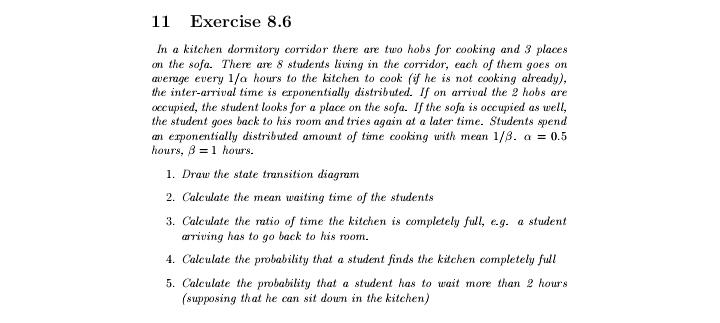
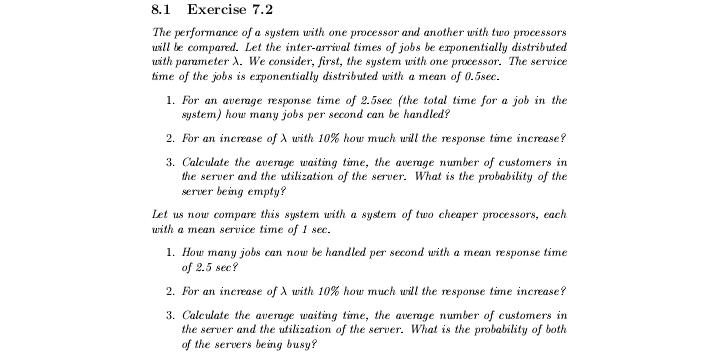
10 Exercise 6.6 There are K computers in an office, and a single repairman. Each computer breaks down after an exponentially distributed time with parameter a. The re- pair takes an exponentially distributed amount of time with parameter S. Only one computer is being repaired at a time, computers break down independently from the repair process, and repair times and lifetunes of the computers are independent. 1. What is the probability that i computers are working at time t? 2. What is the average failure rate file. the average number of computers that fail per time unit)? 3. What is the percentage of time a repairman is busy? 4. What is the percentage of time when all computers are out-of-order (bro- ken)? 5. How many computers should we have if we would like to have K computers to work on average?6.1 Exercise 6.5 A telephone switch has 10 output lines and a large number of incoming lines. Upon arrival a call on the input line is assigned an output line if such line is available - otherwise the call is Mocked and lost. The output line remains assigned to the call for its entire duration which is of exponentially distributed length. Assume that 180 calls / hour arrive in Poisson fashion whereas the mean call duration is 110 seconds. 1. Determine the blocking probability. 2. How many calls are rejected per hour? 3. What is the average load per server (in Erlang)? 4. What is the marimum arrival rate at which a blocking probability of fat most) 2 can be guaranteed?11 Exercise 8.6 In a kitchen dormitory corridor there are two hobs for cooking and 3 places on the sofa. There are 8 students living in the corridor, each of them goes on average every 1/a hours to the kitchen to cook (if he is not cooking already), the inter-arrival time is exponentially distributed. If on arrival the 2 hobs are occupied, the student looks for a place on the sofa. If the sofa is occupied as well, the student goes back to his mom and tries again at a later time. Students spend on exponentially distributed amount of time cooking with mean 1/8. a = 0.5 hours, 8 = 1 hours. 1. Draw the state transition diagram 2. Calculate the mean waiting time of the students 3. Calculate the ratio of time the kitchen is completely full, e.g. a student arriving has to go back to his mom. 4. Calculate the probability that a student finds the kitchen completely full 5. Calculate the probability that a student has to wait more than 2 hours (supposing that he can sit down in the kitchen)8.1 Exercise 7.2 The performance of a system with one processor and another with two processors will be compared. Let the inter-arrival times of jobs be exponentially distributed with parameter A. We consider, first, the system with one processor. The service time of the jobs is exponentially distributed with a mean of 0.5sec. 1. For an average response time of 2.5see (the total time for a job in the system) how many jobs per second can be handled? 2. For an increase of A with 10% how much will the response time increase? 3. Calculate the average waiting time, the average number of customers in the server and the utilization of the server. What is the probability of the server being empty? Let us now compare this system with a system of two cheaper processors, each with a mean service time of I sec. 1. How many jobs can now be handled per second with a mean response time of 2.5 sec? 2. For an increase of A with 10% how much will the response time increase? 3. Calculate the average waiting time, the average number of customers in the server and the utilization of the server. What is the probability of both of the servers being busy?c. An article in Bloomberg on June 19", summarized the press conference of Mervin King, Governor of the Bank of England that day. Mervyn King said that British living standards will slip (go down) and economic growth needs to weaken as policy makers refuse to flinch (refuse to give up) in their fight against accelerating inflation. "It will not be an easy time, and I know that some families will find it particularly difficult," King said yesterday in London. "These changes to our spending power and to the housing market are real shifts that, although not easy to accept, we cannot side- step." Can you explain what he means by this statement? What if he tries to fight against the decline in living standards that the families are experiencing? How would he do it? What would be the consequences? (7 points)
Step by Step Solution
There are 3 Steps involved in it

Get step-by-step solutions from verified subject matter experts
 Study Help