







Question: Answer the 2 case study questions (be specific) 200 word minimum. Case Study 1: Micronutrient: Aflatoxin B1 In 1960, more than 100,000 young turkeys on
Answer the 2 case study questions (be specific) 200 word minimum. 
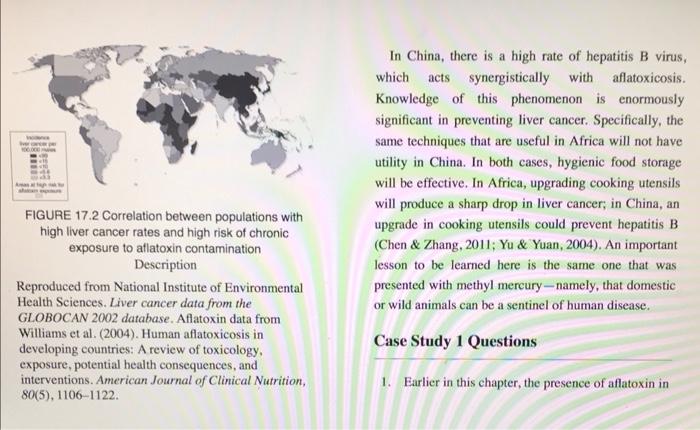
Case Study 1: Micronutrient: Aflatoxin B1 In 1960, more than 100,000 young turkeys on poultry farms in England died from an apparently new liver disease that was termed "Turkey X disease." It was soon found that ducklings and young pheasants were also affected, and heavy mortality among these fowl populations was experienced. This disease became associated with feed, particularly peanut meal from Brazil. Subsequently, it was found that a potent toxin, aflatoxin B1, was present in the feed. Aflatoxin B1 was produced by a storage mold that grew on the peanuts because of the relative humidity on the surface of the peanuts. Visual selection of peanuts for human consumption could eliminate the aflatoxin contamination. Chronic toxicology studies in rats revealed that aflatoxin B1 is among the most potent carcinogens known, causing liver cancer in rats. However, in some geographic areas in the world, aflatoxin exposure causes no increase in liver cancer. Confounding environmental factors involved in aflatoxin-related liver cancer based on the global distribution of liver cancer and aflatoxin exposure can be present in some world locations, such as central Africa. Within central Africa, hemosiderosis, produced by iron toxicity from using rusty cooking utensils, causes liver cancer (Mandishona et al., 1998). Figure 17-2 shows a global perspective of the correlation between populations with higher liver cancer rates and higher risk of chronic exposure to aflatoxin concentration. FIGURE 17.2 Correlation between populations with high liver cancer rates and high risk of chronic exposure to aflatoxin contamination Description Reproduced from National Institute of Environmental Health Sciences. Liver cancer data from the GLOBOCAN 2002 database. Aflatoxin data from Williams et al. (2004). Human aflatoxicosis in developing countries: A review of toxicology, exposure, potential health consequences, and interventions. American Journal of Clinical Nutrition, 80(5), 1106-1122. In China, there is a high rate of hepatitis B virus, which acts synergistically with aflatoxicosis. Knowledge of this phenomenon is enormously significant in preventing liver cancer. Specifically, the same techniques that are useful in Africa will not have utility in China. In both cases, hygienic food storage will be effective. In Africa, upgrading cooking utensils will produce a sharp drop in liver cancer; in China, an upgrade in cooking utensils could prevent hepatitis B (Chen & Zhang, 2011; Yu & Yuan, 2004). An important lesson to be learned here is the same one that was presented with methyl mercury-namely, that domestic or wild animals can be a sentinel of human disease. Case Study 1 Questions 1. Earlier in this chapter, the presence of aflatoxin in peanuts was discussed. Are there any other foods that might be contaminated by aflatoxin? 2. Because there may have been two factors required for the appearance of human cancer, is the risk from aflatoxin overestimated
Step by Step Solution
There are 3 Steps involved in it
1 Expert Approved Answer
Step: 1 Unlock

Question Has Been Solved by an Expert!
Get step-by-step solutions from verified subject matter experts
Step: 2 Unlock
Step: 3 Unlock
 Study Help