







Question: Answer the 4th question in this assignment please Using Miller-Rabin primality test algorithm to write a Java program which can test if an integer is
Answer the 4th question in this assignment please
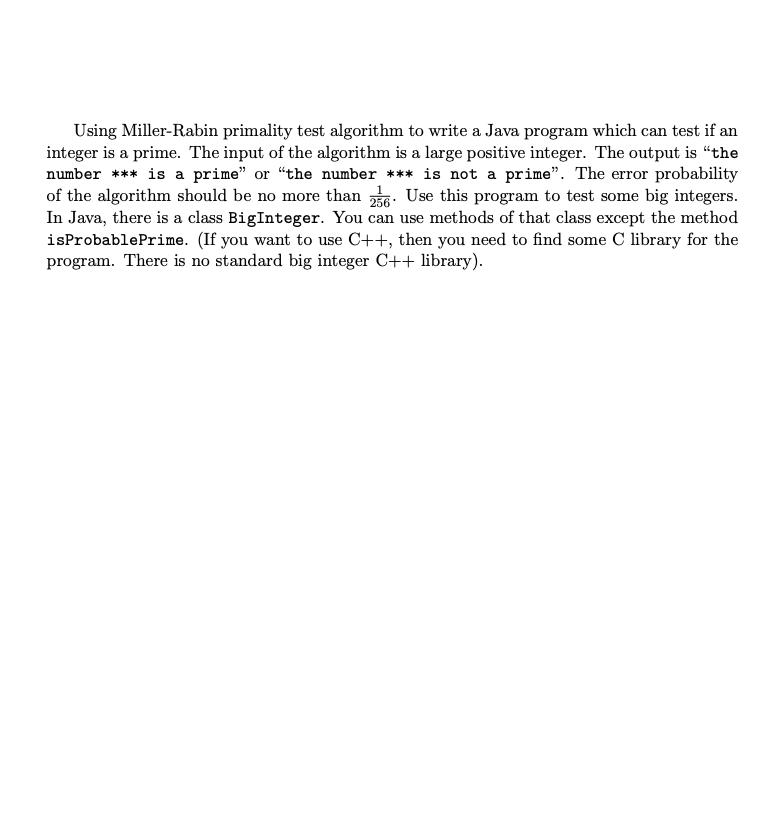
Using Miller-Rabin primality test algorithm to write a Java program which can test if an integer is a prime. The input of the algorithm is a large positive integer. The output is the number *** is a prime or the number *** is not a prime. The error probability of the algorithm should be no more than 1 256 . Use this program to test some big integers. In Java, there is a class BigInteger. You can use methods of that class except the method isProbablePrime. (If you want to use C++, then you need to find some C library for the program. There is no standard big integer C++ library).
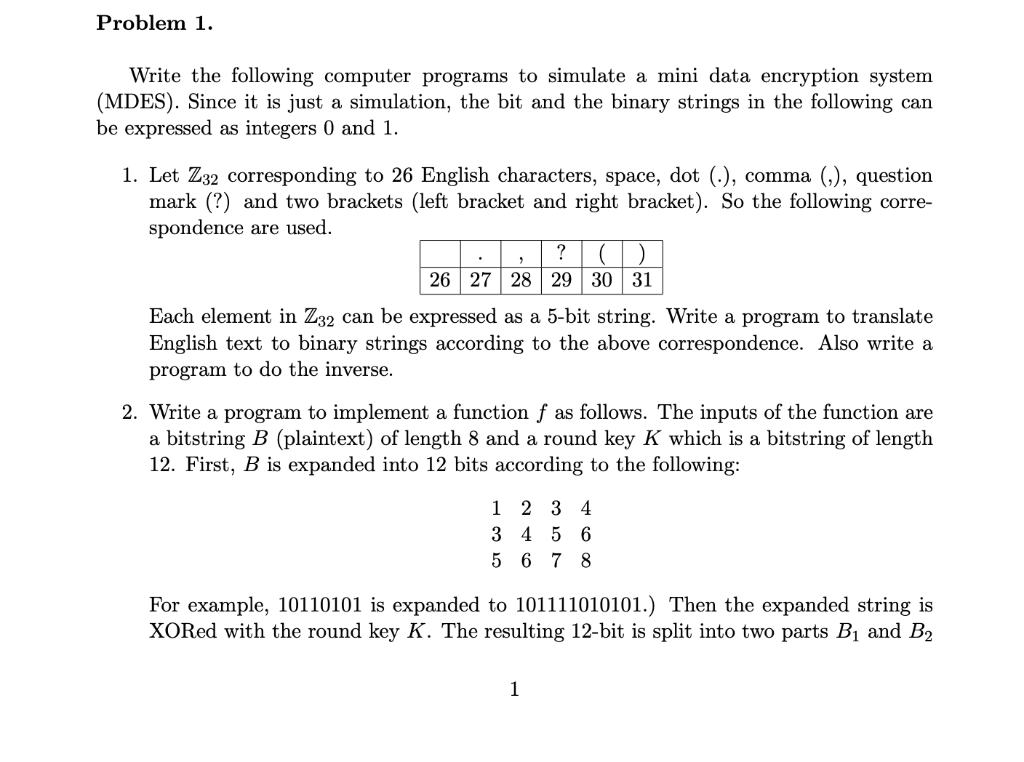
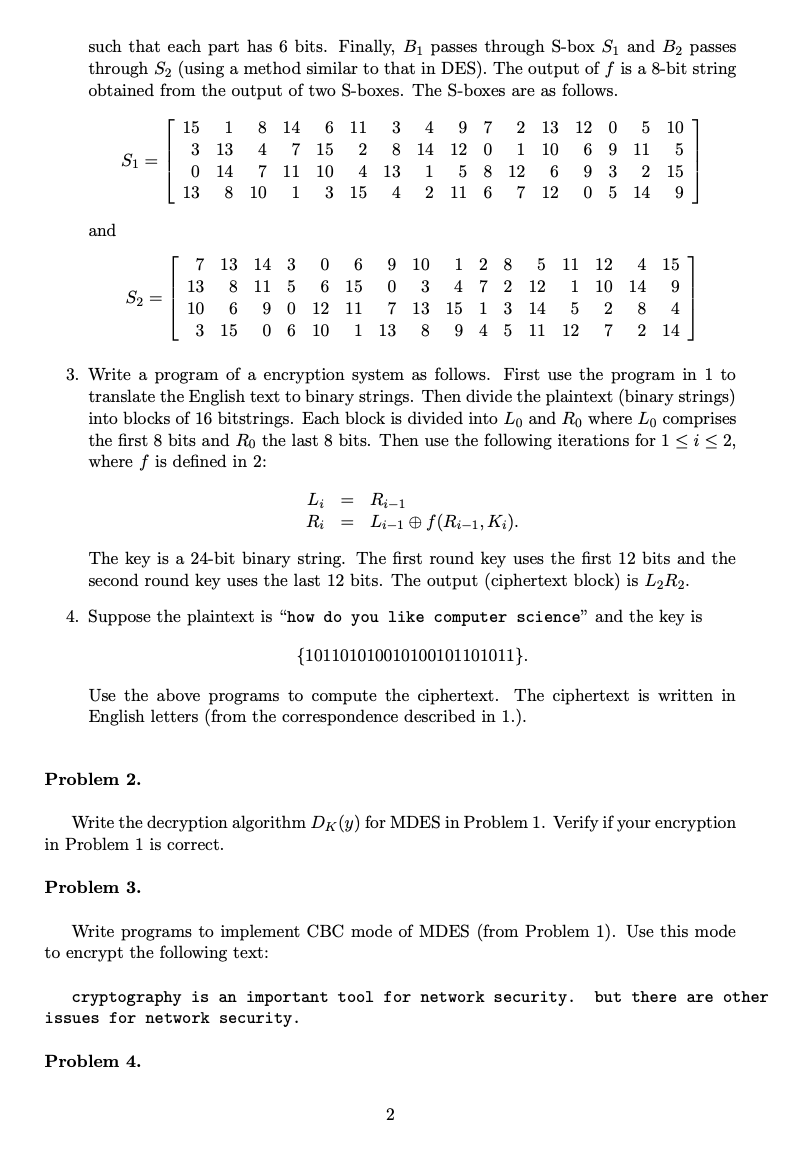
Problem 1. Write the following computer programs to simulate a mini data encryption system (MDES). Since it is just a simulation, the bit and the binary strings in the following can be expressed as integers 0 and 1. 1. Let Z32 corresponding to 26 English characters, space, dot (.), comma (,), question mark (?) and two brackets (left bracket and right bracket). So the following corre- spondence are used. ? ( ) 26 27 28 29 30 31 Each element in Z32 can be expressed as a 5-bit string. Write a program to translate English text to binary strings according to the above correspondence. Also write a program to do the inverse. 2. Write a program to implement a function f as follows. The inputs of the function are a bitstring B (plaintext) of length 8 and a round key K which is a bitstring of length 12. First, B is expanded into 12 bits according to the following: 1 2 3 4 3 4 5 6 5 6 7 8 For example, 10110101 is expanded to 101111010101.) Then the expanded string is XORed with the round key K. The resulting 12-bit is split into two parts B1 and B2 1 such that each part has 6 bits. Finally, B1 passes through S-box S1 and B2 passes through S2 (using a method similar to that in DES). The output of f is a 8-bit string obtained from the output of two S-boxes. The S-boxes are as follows. Si = 15 3 0 13 1 8 14 13 4 7 14 7 11 8 10 1 6 11 15 2 10 4 3 15 3 4 8 14 13 1 4 2 7 2 13 12 0 5 10 12 0 1 10 6 11 5 5 8 12 6 9 3 2 15 11 6 7 12 0 5 14 9 and S2 = 7 13 13 8 10 6 3 15 14 3 0 11 5 6 9 0 12 0 6 10 6 9 10 15 0 3 11 7 13 1 13 8 1 28 5 11 12 4 15 4 7 2 12 1 10 14 9 15 1 3 14 5 2 8 4 9 4 5 11 12 7 2 14 3. Write a program of a encryption system as follows. First use the program in 1 to translate the English text to binary strings. Then divide the plaintext (binary strings) into blocks of 16 bitstrings. Each block is divided into Lo and Ro where Lo comprises the first 8 bits and Ro the last 8 bits. Then use the following iterations for 1
Step by Step Solution
There are 3 Steps involved in it

Get step-by-step solutions from verified subject matter experts
 Study Help