Question: Answer the activity, with explanation/ solution 21. Consider the unbalanced redox reaction: MnOs + C20.2 Mn2* + CO; |dentify the changes in oxidation numbers for
Answer the activity, with explanation/ solution
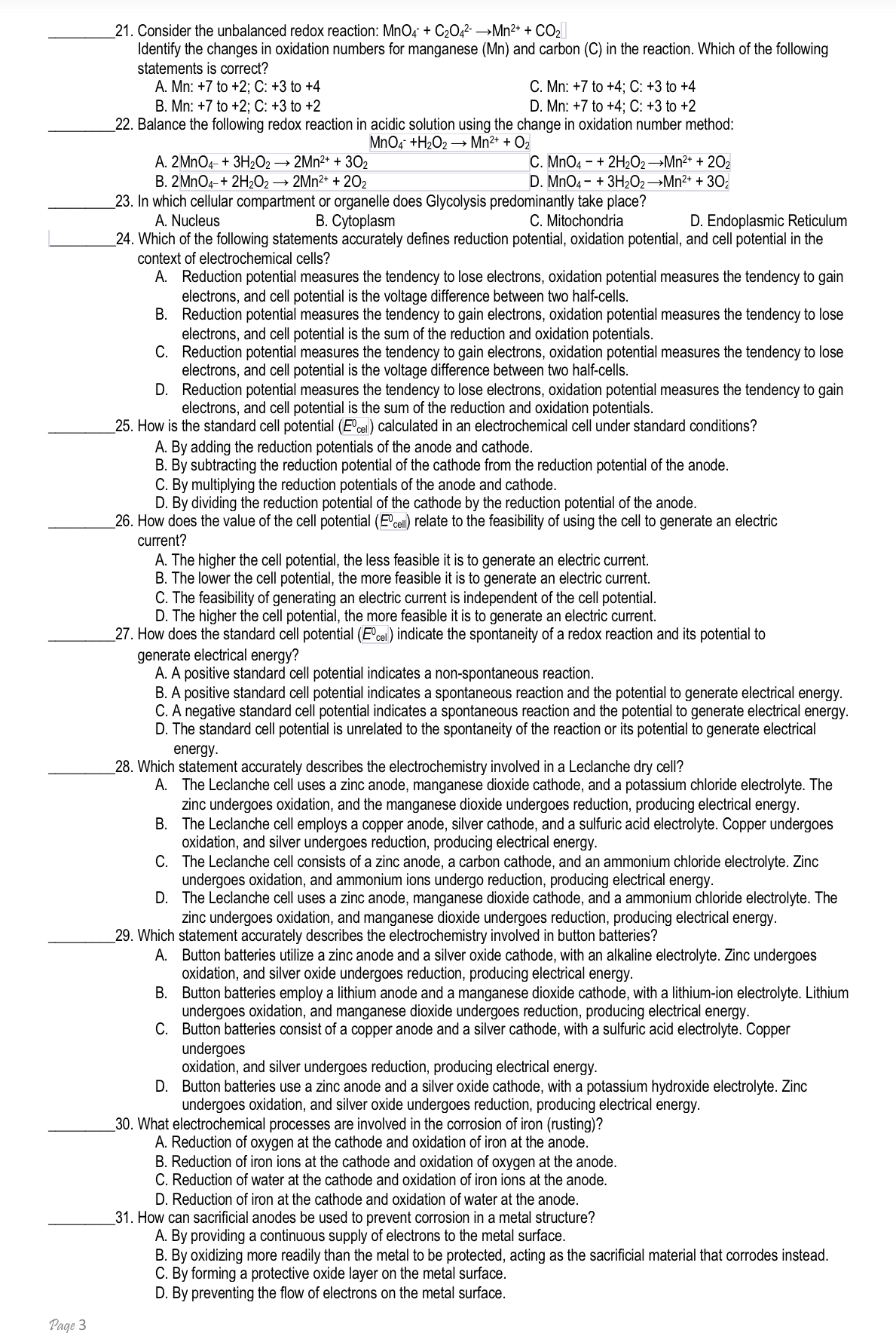
21. Consider the unbalanced redox reaction: MnOs + C20.2 Mn2* + CO; |dentify the changes in oxidation numbers for manganese (Mn) and carbon (C) in the reaction. Which of the following statements is correct? A Mn:+7t0+2; C: +3to +4 C.Mn:+7to+4; C: +3fo +4 B. Mn: +7 to +2; C: +3 to +2 D. Mn: +7 to+4; C: +3 fo +2 22. Balance the following redox reaction in acidic solution using the change in oxidation number method: MnQg4 +Hz0; Mn2* + Oy A. 2MnQ4- + 3H,0; 2Mn?* + 30; C. MnO4 - + 2H;0, Mn2* + 20, B. 2Mn0Os-+ 2H;0: 2Mn#* + 20, D. MnO4 - + 3H:0; Mn2* + 30: 23. In which cellular compartment or organelle does Glycolysis predominantly take place? A. Nucleus B. Cytoplasm C. Mitochondria D. Endoplasmic Reticulum 24. Which of the following statements accurately defines reduction potential, oxidation potential, and cell potential in the context of electrochemical cells? A. Reduction potential measures the tendency to lose electrons, oxidation potential measures the tendency to gain electrons, and cell potential is the voltage difference between two half-cells. B. Reduction potential measures the tendency to gain electrons, oxidation potential measures the tendency to lose electrons, and cell potential is the sum of the reduction and oxidation potentials. C. Reduction potential measures the tendency to gain electrons, oxidation potential measures the tendency to lose electrons, and cell potential is the voltage difference between two half-cells. D. Reduction potential measures the tendency to lose electrons, oxidation potential measures the tendency to gain electrons, and cell potential is the sum of the reduction and oxidation potentials. 25. How is the standard cell potential (E%) calculated in an electrochemical cell under standard conditions? A. By adding the reduction potentials of the anode and cathode. B. By subtracting the reduction potential of the cathode from the reduction potential of the anode. C. By multiplying the reduction potentials of the anode and cathode. D. By dividing the reduction potential of the cathode by the reduction potential of the anode. 26. How does the value of the cell potential (E i) relate to the feasibility of using the cell to generate an electric current? A. The higher the cell potential, the less feasible it is to generate an electric current. B. The lower the cell potential, the more feasible it is to generate an electric current. C. The feasibility of generating an electric current is independent of the cell potential. D. The higher the cell potential, the more feasible it is to generate an electric current. 27. How does the standard cell potential (E%q ) indicate the spontaneity of a redox reaction and its potential to generate electrical energy? A. A positive standard cell potential indicates a non-spontaneous reaction. B. A positive standard cell potential indicates a spontaneous reaction and the potential to generate electrical energy. C. A negative standard cell potential indicates a spontaneous reaction and the potential to generate electrical energy. D. The standard cell potential is unrelated to the spontaneity of the reaction or its potential to generate electrical energy. 28. Which statement accurately describes the electrochemistry involved in a Leclanche dry cell? A. The Leclanche cell uses a zinc anode, manganese dioxide cathode, and a potassium chloride electrolyte. The zinc undergoes oxidation, and the manganese dioxide undergoes reduction, producing electrical energy. B. The Leclanche cell employs a copper anode, silver cathode, and a sulfuric acid electrolyte. Copper undergoes oxidation, and silver undergoes reduction, producing electrical energy. C. The Leclanche cell consists of a zinc anode, a carbon cathode, and an ammonium chloride electrolyte. Zinc undergoes oxidation, and ammonium ions undergo reduction, producing electrical energy. D. The Leclanche cell uses a zinc anode, manganese dioxide cathode, and a ammonium chloride electrolyte. The zinc undergoes oxidation, and manganese dioxide undergoes reduction, producing electrical energy. 29. Which statement accurately describes the electrochemistry involved in button batteries? A. Button batteries utilize a zinc anode and a silver oxide cathode, with an alkaline electrolyte. Zinc undergoes oxidation, and silver oxide undergoes reduction, producing electrical energy. B. Button batteries employ a lithium anode and a manganese dioxide cathode, with a lithium-ion electrolyte. Lithium undergoes oxidation, and manganese dioxide undergoes reduction, producing electrical energy. C. Button batteries consist of a copper anode and a silver cathode, with a sulfuric acid electrolyte. Copper undergoes oxidation, and silver undergoes reduction, producing electrical energy. D. Button batteries use a zinc anode and a silver oxide cathode, with a potassium hydroxide electrolyte. Zinc undergoes oxidation, and silver oxide undergoes reduction, producing electrical energy. 30. What electrochemical processes are involved in the corrosion of iron (rusting)? A. Reduction of oxygen at the cathode and oxidation of iron at the anode. B. Reduction of iron ions at the cathode and oxidation of oxygen at the anode. C. Reduction of water at the cathode and oxidation of iron ions at the anode. D. Reduction of iron at the cathode and oxidation of water at the anode. 31. How can sacrificial anodes be used to prevent corrosion in a metal structure? A. By providing a continuous supply of electrons to the metal surface. B. By oxidizing more readily than the metal to be protected, acting as the sacrificial material that corrodes instead. C. By forming a protective oxide layer on the metal surface. D. By preventing the flow of electrons on the metal surface. Page 3









 Study Help