







Question: Answer the case Identify influence tactics : What influence tactics could you use on the Smiths? . Assess social power and network influence : What
Answer the case
Identify influence tactics: What influence tactics could you use on the Smiths?
. Assess social power and network influence:
What power bases do you (as Peggy Fischer) have in regards to each of the Smiths?
Explain.
How might you (again as Peggy Fischer) draw on you personal network to influence each of the Smiths? Explain.
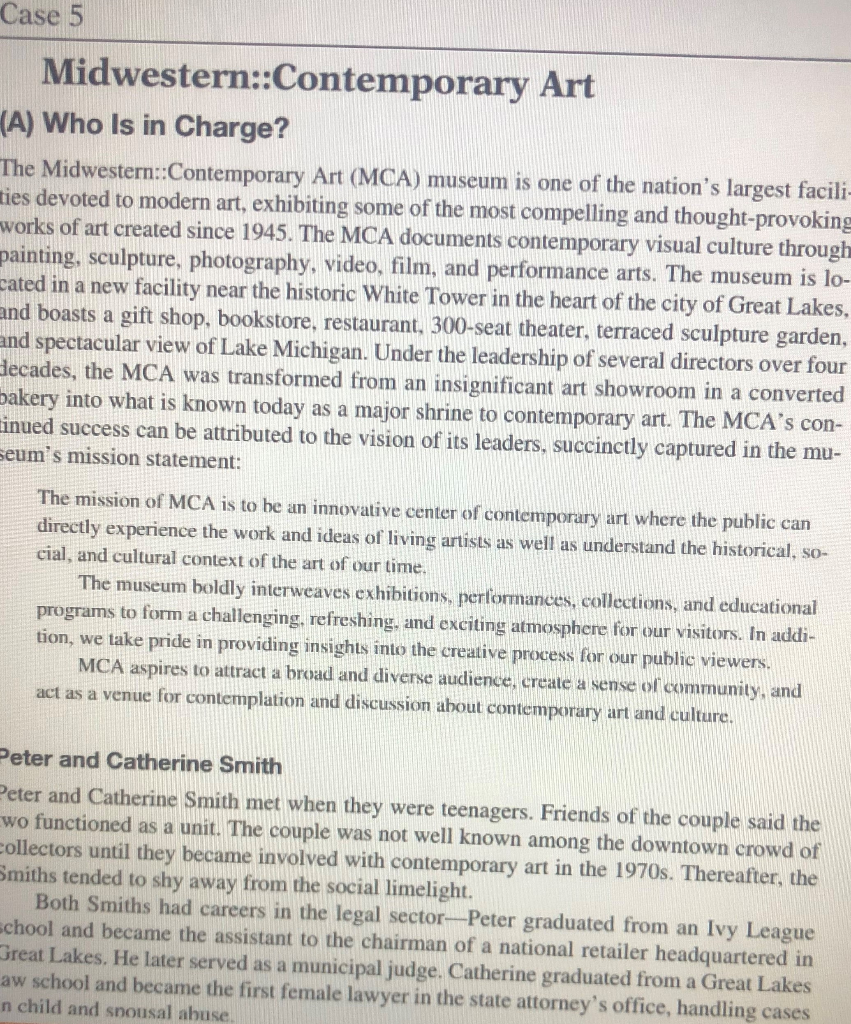
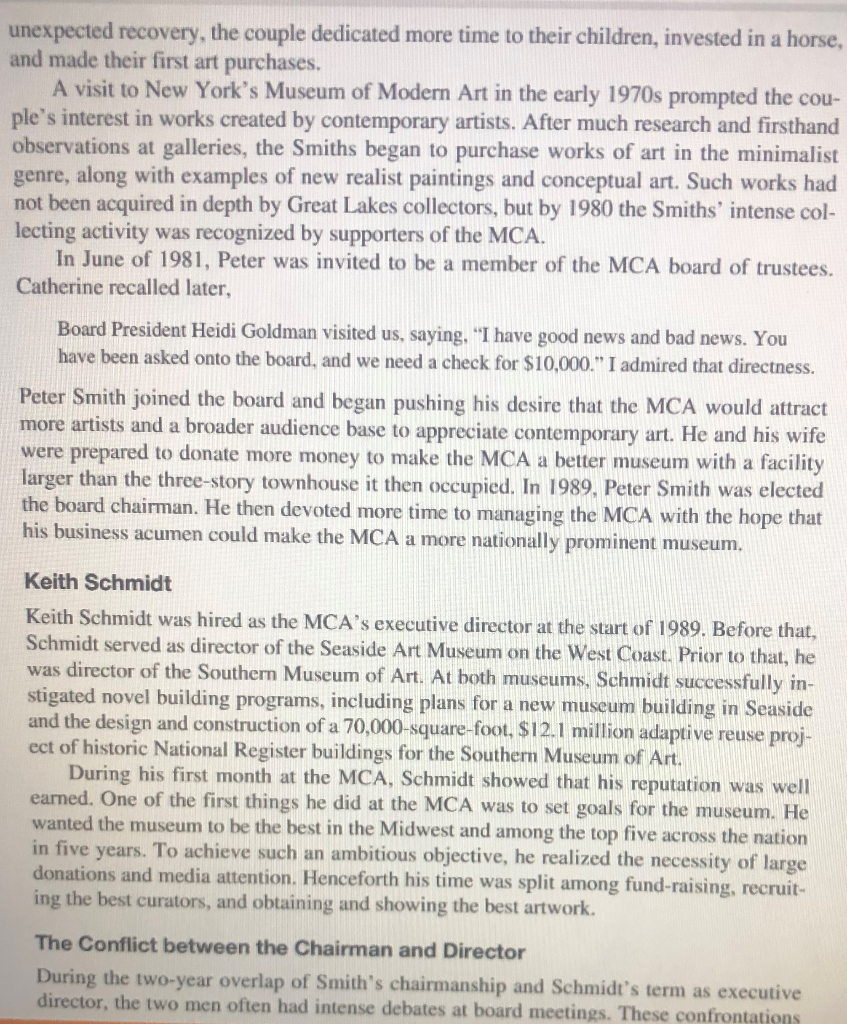
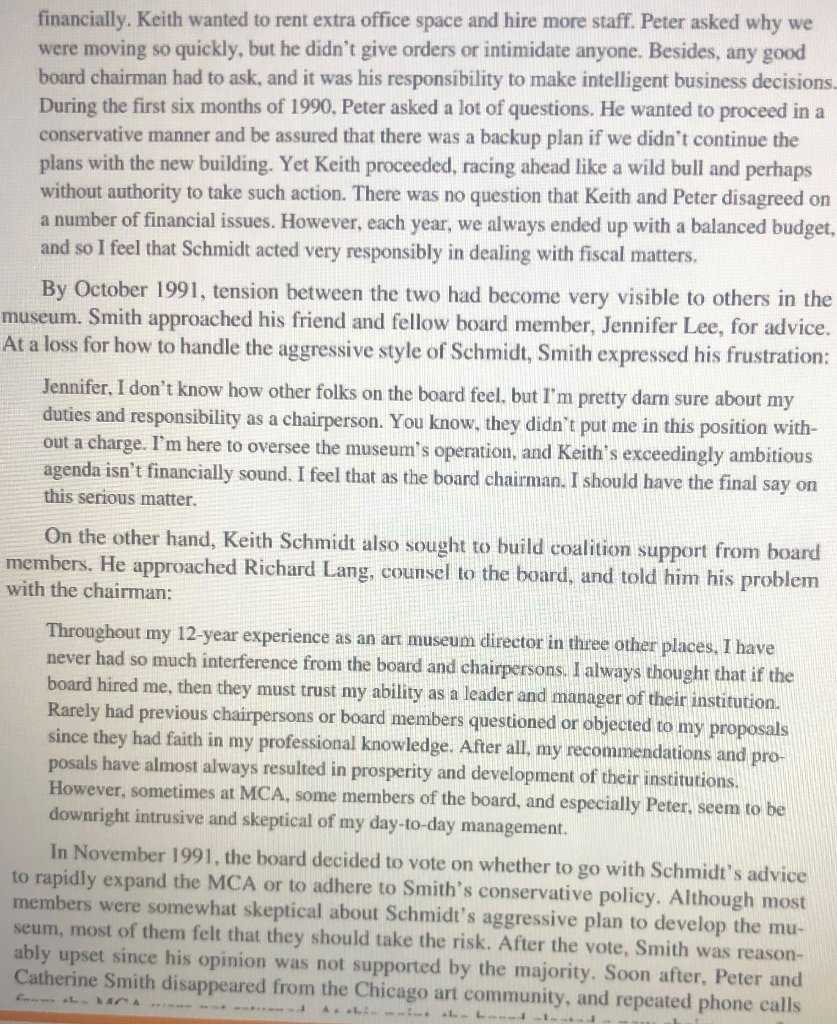
Case 5 Midwestern::Contemporary Art (A) Who Is in Charge? The Midwestern::Contemporary Art (MCA) museum is one of the nation's largest facili- ties devoted to modern art, exhibiting some of the most compelling and thought-provoking works of art created since 1945. The MCA documents contemporary visual culture through painting, sculpture, photography, video, film, and performance arts. The museum is lo- cated in a new facility near the historic White Tower in the heart of the city of Great Lakes, and boasts a gift shop, bookstore, restaurant, 300-seat theater, terraced sculpture garden, and spectacular view of Lake Michigan. Under the leadership of several directors over four decades, the MCA was transformed from an insignificant art showroom in a converted bakery into what is known today as a major shrine to contemporary art. The MCA's con- tinued success can be attributed to the vision of its leaders, succinctly captured in the mu- seum's mission statement: The mission of MCA is to be an innovative center of contemporary art where the public can directly experience the work and ideas of living artists as well as understand the historical, so- cial, and cultural context of the art of our time. The museum boldly interweaves exhibitions, performances, collections, and educational programs to form a challenging, refreshing, and exciting atmosphere for our visitors. In addi- tion, we take pride in providing insights into the creative process for our public viewers. MCA aspires to attract a broad and diverse audience, create a sense of community, and act as a venue for contemplation and discussion about contemporary art and culture. Peter and Catherine Smith Peter and Catherine Smith met when they were teenagers. Friends of the couple said the wo functioned as a unit. The couple was not well known among the downtown crowd of collectors until they became involved with contemporary art in the 1970s. Thereafter, the Smiths tended to shy away from the social limelight. Both Smiths had careers in the legal sector-Peter graduated from an Ivy League school and became the assistant to the chairman of a national retailer headquartered in Great Lakes. He later served as a municipal judge. Catherine graduated from a Great Lakes aw school and became the first female lawyer in the state attorney's office, handling cases n child and spousal abuse unexpected recovery, the couple dedicated more time to their children, invested in a horse, and made their first art purchases. A visit to New York's Museum of Modern Art in the early 1970s prompted the cou- ple's interest in works created by contemporary artists. After much research and firsthand observations at galleries, the Smiths began to purchase works of art in the minimalist genre, along with examples of new realist paintings and conceptual art. Such works had not been acquired in depth by Great Lakes collectors, but by 1980 the Smiths' intense col- lecting activity was recognized by supporters of the MCA. In June of 1981, Peter was invited to be a member of the MCA board of trustees. Catherine recalled later, Board President Heidi Goldman visited us, saying, "I have good news and bad news. You have been asked onto the board, and we need a check for $10,000." I admired that directness. Peter Smith joined the board and began pushing his desire that the MCA would attract more artists and a broader audience base to appreciate contemporary art. He and his wife were prepared to donate more money to make the MCA a better museum with a facility larger than the three-story townhouse it then occupied. In 1989, Peter Smith was elected the board chairman. He then devoted more time to managing the MCA with the hope that his business acumen could make the MCA a more nationally prominent museum. Keith Schmidt Keith Schmidt was hired as the MCA's executive director at the start of 1989. Before that, Schmidt served as director of the Seaside Art Museum on the West Coast. Prior to that, he was director of the Southern Museum of Art. At both museums, Schmidt successfully in- stigated novel building programs, including plans for a new museum building in Seaside and the design and construction of a 70,000-square-foot, $12.1 million adaptive reuse proj- ect of historic National Register buildings for the Southern Museum of Art, During his first month at the MCA, Schmidt showed that his reputation was well earned. One of the first things he did at the MCA was to set goals for the museum. He wanted the museum to be the best in the Midwest and among the top five across the nation in five years. To achieve such an ambitious objective, he realized the necessity of large donations and media attention. Henceforth his time was split among fund-raising, recruit- ing the best curators, and obtaining and showing the best artwork. The Conflict between the Chairman and Director During the two-year overlap of Smith's chairmanship and Schmidt's term as executive director, the two men often had intense debates at board meetings. These confrontations financially. Keith wanted to rent extra office space and hire more staff. Peter asked why we were moving so quickly, but he didn't give orders or intimidate anyone. Besides, any good board chairman had to ask, and it was his responsibility to make intelligent business decisions. During the first six months of 1990, Peter asked a lot of questions. He wanted to proceed in a conservative manner and be assured that there was a backup plan if we didn't continue the plans with the new building. Yet Keith proceeded, racing ahead like a wild bull and perhaps without authority to take such action. There was no question that Keith and Peter disagreed on a number of financial issues. However, each year, we always ended up with a balanced budget, and so I feel that Schmidt acted very responsibly in dealing with fiscal matters. By October 1991, tension between the two had become very visible to others in the museum. Smith approached his friend and fellow board member, Jennifer Lee, for advice. At a loss for how to handle the aggressive style of Schmidt, Smith expressed his frustration: Jennifer, I don't know how other folks on the board feel, but I'm pretty darn sure about my duties and responsibility as a chairperson. You know, they didn't put me in this position with- out a charge. I'm here to oversee the museum's operation, and Keith's exceedingly ambitious agenda isn't financially sound. I feel that as the board chairman. I should have the final say on this serious matter. On the other hand, Keith Schmidt also sought to build coalition support from board members. He approached Richard Lang, counsel to the board, and told him his problem with the chairman: Throughout my 12-year experience as an art museum director in three other places. I have never had so much interference from the board and chairpersons. I always thought that if the board hired me, then they must trust my ability as a leader and manager of their institution. Rarely had previous chairpersons or board members questioned or objected to my proposals since they had faith in my professional knowledge. After all, my recommendations and pro- posals have almost always resulted in prosperity and development of their institutions. However, sometimes at MCA, some members of the board, and especially Peter, seem to be downright intrusive and skeptical of my day-to-day management. In November 1991, the board decided to vote on whether to go with Schmidt's advice to rapidly expand the MCA or to adhere to Smith's conservative policy. Although most members were somewhat skeptical about Schmidt's aggressive plan to develop the mu- seum, most of them felt that they should take the risk. After the vote, Smith was reason- ably upset since his opinion was not supported by the majority. Soon after, Peter and Catherine Smith disappeared from the Chicago art community, and repeated phone calls .L.LStep by Step Solution
There are 3 Steps involved in it
1 Expert Approved Answer
Step: 1 Unlock

Question Has Been Solved by an Expert!
Get step-by-step solutions from verified subject matter experts
Step: 2 Unlock
Step: 3 Unlock
 Study Help