







Question: Answer the case study questions, will give thumbs up The XIII International AIDS Conference was held in Durban, South Africa, in July 2000. This conference
Answer the case study questions, will give thumbs up 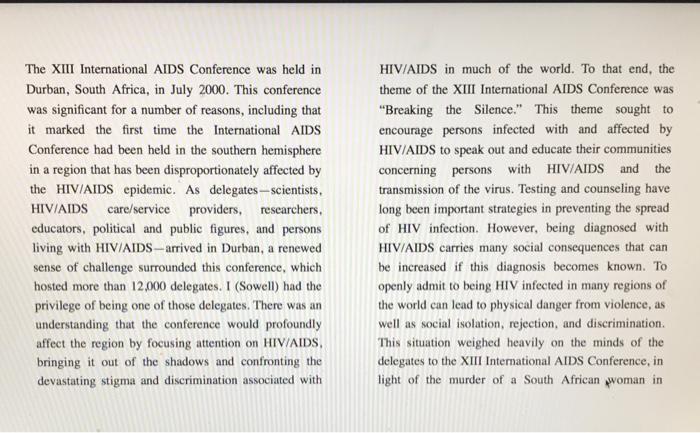
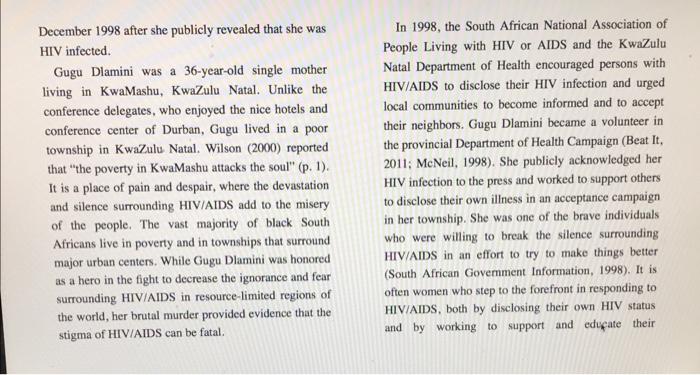
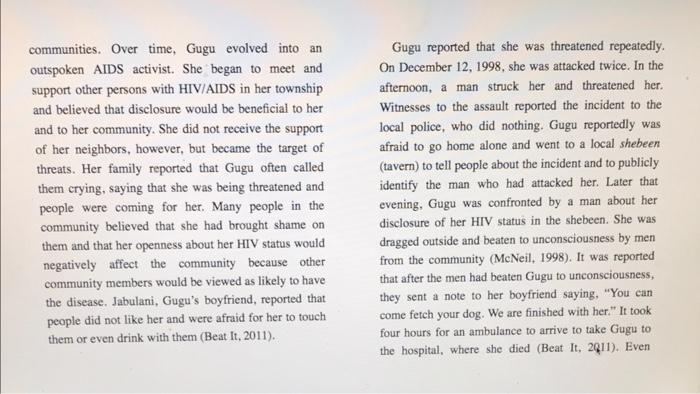
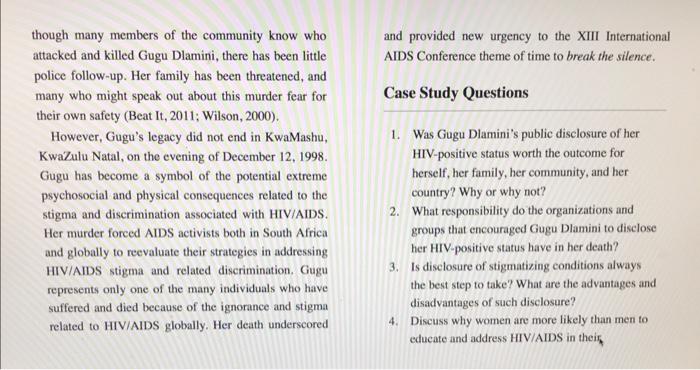
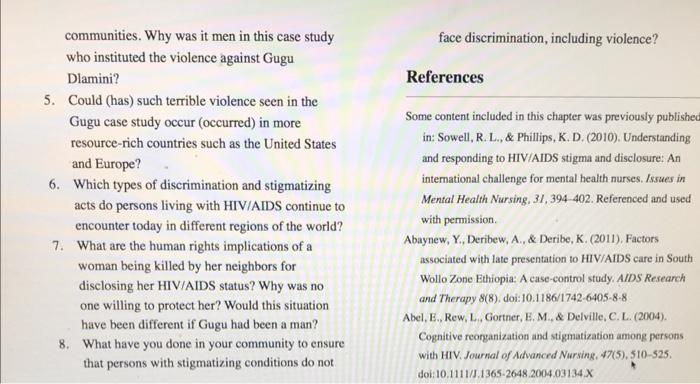
The XIII International AIDS Conference was held in Durban, South Africa, in July 2000. This conference was significant for a number of reasons, including that it marked the first time the International AIDS Conference had been held in the southern hemisphere in a region that has been disproportionately affected by the HIV/AIDS epidemic. As delegates -scientists, HIV/AIDS care/service providers, researchers, educators, political and public figures, and persons living with HIV/AIDS-arrived in Durban, a renewed sense of challenge surrounded this conference, which hosted more than 12.000 delegates. I (Sowell) had the privilege of being one of those delegates. There was an understanding that the conference would profoundly affect the region by focusing attention on HIV/AIDS, bringing it out of the shadows and confronting the devastating stigma and discrimination associated with HIV/AIDS in much of the world. To that end, the theme of the XIII International AIDS Conference was "Breaking the Silence." This theme sought to encourage persons infected with and affected by HIV/AIDS to speak out and educate their communities concerning persons with HIV/AIDS and the transmission of the virus. Testing and counseling have long been important strategies in preventing the spread of HIV infection. However, being diagnosed with HIV/AIDS carries many social consequences that can be increased if this diagnosis becomes known. To openly admit to being HIV infected in many regions of the world can lead to physical danger from violence, as well as social isolation, rejection, and discrimination. This situation weighed heavily on the minds of the delegates to the XIII International AIDS Conference, in light of the murder of a South African woman in December 1998 after she publicly revealed that she was HIV infected. Gugu Dlamini was a 36-year-old single mother living in KwaMashu, KwaZulu Natal. Unlike the conference delegates, who enjoyed the nice hotels and conference center of Durban, Gugu lived in a poor township in KwaZulu Natal. Wilson (2000) reported that "the poverty in KwaMashu attacks the soul" (p. 1). It is a place of pain and despair, where the devastation and silence surrounding HIV/AIDS add to the misery of the people. The vast majority of black South Africans live in poverty and in townships that surround major urban centers. While Gugu Dlamini was honored as a hero in the fight to decrease the ignorance and fear surrounding HIV/AIDS in resource-limited regions of the world, her brutal murder provided evidence that the stigma of HIV/AIDS can be fatal. In 1998, the South African National Association of People Living with HIV or AIDS and the KwaZulu Natal Department of Health encouraged persons with HIV/AIDS to disclose their HIV infection and urged local communities to become informed and to accept their neighbors. Gugu Dlamini became a volunteer in the provincial Department of Health Campaign (Beat It, 2011; McNeil, 1998). She publicly acknowledged her HIV infection to the press and worked to support others to disclose their own illness in an acceptance campaign in her township. She was one of the brave individuals who were willing to break the silence surrounding HIV/AIDS in an effort to try to make things better (South African Government Information, 1998). It is often women who step to the forefront in responding to HIV/AIDS, both by disclosing their own HIV status and by working to support and educate their a communities. Over time, Gugu evolved into an outspoken AIDS activist. She began to meet and support other persons with HIV/AIDS in her township and believed that disclosure would be beneficial to her and to her community. She did not receive the support of her neighbors, however, but became the target of threats. Her family reported that Gugu often called them crying, saying that she was being threatened and people were coming for her. Many people in the community believed that she had brought shame on them and that her openness about her HIV status would negatively affect the community because other community members would be viewed as likely to have the disease. Jabulani, Gugu's boyfriend, reported that people did not like her and were afraid for her to touch them or even drink with them (Beat It, 2011). Gugu reported that she was threatened repeatedly. On December 12, 1998, she was attacked twice. In the afternoon, a man struck her and threatened her Witnesses to the assault reported the incident to the local police, who did nothing. Gugu reportedly was afraid to go home alone and went to a local shebeen (tavern) to tell people about the incident and to publicly identify the man who had attacked her. Later that evening, Gugu was confronted by a man about her disclosure of her HIV status in the shebeen. She was dragged outside and beaten to unconsciousness by men from the community (McNeil, 1998). It was reported that after the men had beaten Gugu to unconsciousness, they sent a note to her boyfriend saying, "You can come fetch your dog. We are finished with her." It took four hours for an ambulance to arrive to take Gugu to the hospital, where she died (Beat It, 2011). Even and provided new urgency to the XIII International AIDS Conference theme of time to break the silence. Case Study Questions though many members of the community know who attacked and killed Gugu Dlamini, there has been little police follow-up. Her family has been threatened, and many who might speak out about this murder fear for their own safety (Beat It, 2011; Wilson, 2000). However, Gugu's legacy did not end in KwaMashu, KwaZulu Natal, on the evening of December 12, 1998. Gugu has become a symbol of the potential extreme psychosocial and physical consequences related to the stigma and discrimination associated with HIV/AIDS. Her murder forced AIDS activists both in South Africa and globally to reevaluate their strategies in addressing HIV/AIDS stigma and related discrimination. Gugu represents only one of the many individuals who have suffered and died because of the ignorance and stigma related to HIV/AIDS globally. Her death underscored 1. Was Gugu Dlamini's public disclosure of her HIV-positive status worth the outcome for herself, her family, her community, and her country? Why or why not? 2. What responsibility do the organizations and groups that encouraged Gugu Dlamini to disclose her HIV-positive status have in her death? 3. Is disclosure of stigmatizing conditions always the best step to take? What are the advantages and disadvantages of such disclosure? 4. Discuss why women are more likely than men to educate and address HIV/AIDS in their face discrimination, including violence? References communities. Why was it men in this case study who instituted the violence against Gugu Dlamini? 5. Could (has) such terrible violence seen in the Gugu case study occur (occurred) in more resource-rich countries such as the United States and Europe? 6. Which types of discrimination and stigmatizing acts do persons living with HIV/AIDS continue to encounter today in different regions of the world? 7. What are the human rights implications of a woman being killed by her neighbors for disclosing her HIV/AIDS status? Why was no one willing to protect her? Would this situation have been different if Gugu had been a man? 8. What have you done in your community to ensure that persons with stigmatizing conditions do not Some content included in this chapter was previously published in: Sowell, R. L., & Phillips, K. D. (2010). Understanding and responding to HIV/AIDS stigma and disclosure: An international challenge for mental health nurses. Issues in Mental Health Nursing. 31, 394-402. Referenced and used with permission Abaynew, Y., Deribew, A., & Deribe, K. (2011). Factors associated with late presentation to HIV/AIDS care in South Wollo Zone Ethiopia: A case-control study, AIDS Research and Therapy 8(8), doi:10.1186/1742-6405-8-8 Abel, E., Row, L. Gortner, E.M., & Delville, C.L. (2004). Cognitive reorganization and stigmatization among persons with HIV. Journal of Advanced Nursing, 17(5), 510-525. doi:10.1111/J.1365-2648.2004 03134.X
Step by Step Solution
There are 3 Steps involved in it
1 Expert Approved Answer
Step: 1 Unlock

Question Has Been Solved by an Expert!
Get step-by-step solutions from verified subject matter experts
Step: 2 Unlock
Step: 3 Unlock
 Study Help