







Question: ANSWER THE CASE SUMMARY QUESTIONS! Read the following case summary (the summary is of an actual court case in Canada - Mikisew Cree First Nation
ANSWER THE CASE SUMMARY QUESTIONS!
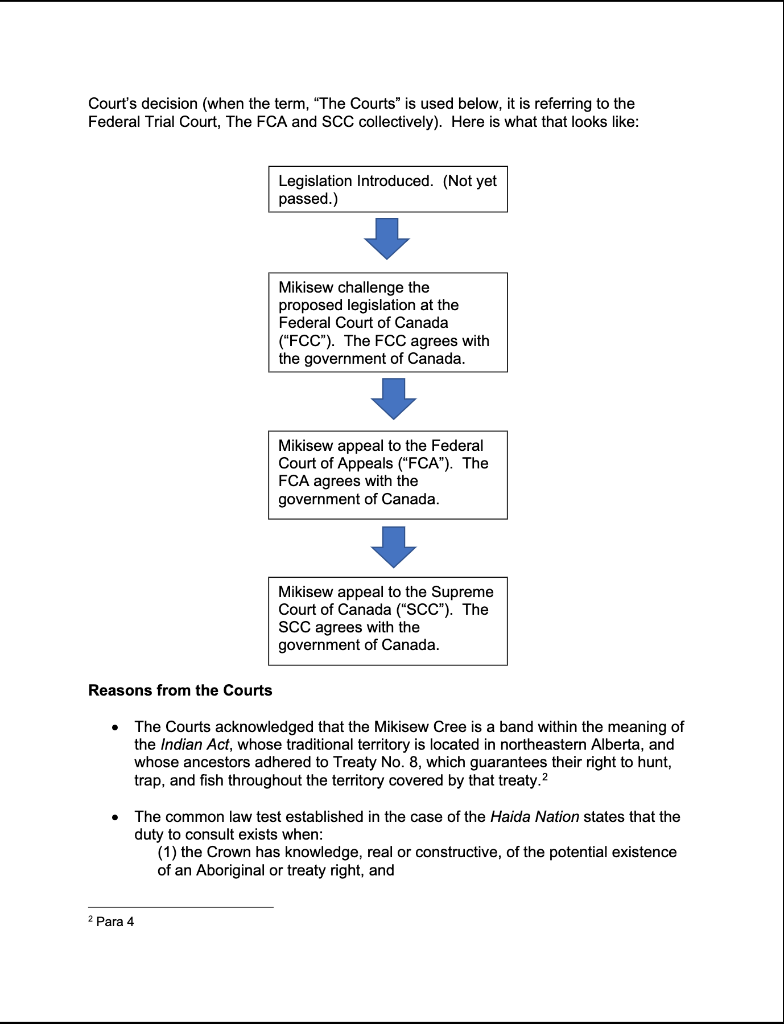
Read the following case summary (the summary is of an actual court case in Canada - Mikisew Cree First Nation v. Canada, 2018 SCC 40) and answer the questions that follow the summary. In Mikisew Cree First Nation the Federal Court had to answer the question: Does the Crown have an obligation to consult when contemplating changes to legislation that may adversely impact treat rights? The Mikisew filed the court action after the Federal Minister of Finance introduced the Jobs, Growth and Long-Term Prosperity Act and the Jobs and Growth Act. The Mikisew argued that the legislative changes and corresponding initiatives would reduce navigable waters and diminish fish habitats. 1 The Federal Court concluded that the Federal government did not have to consult the Mikisew Cree First Nation when preparing a bill (proposed law) that would adversely impact natural resources and the First Nation's treaty rights. The Mikisew appealed first to the Federal Court of Appeal ("FCA") and then the Supreme Court of Canada ("SCC"). Both the FCA and SCC upheld the Federal Trial Court's decision (when the term, "The Courts" is used below, it is referring to the Federal Trial Court, The FCA and SCC collectively). Here is what that looks like: Reasons from the Courts - The Courts acknowledged that the Mikisew Cree is a band within the meaning of the Indian Act, whose traditional territory is located in northeastern Alberta, and whose ancestors adhered to Treaty No. 8, which guarantees their right to hunt, trap, and fish throughout the territory covered by that treaty. 2 - The common law test established in the case of the Haida Nation states that the duty to consult exists when: (1) the Crown has knowledge, real or constructive, of the potential existence of an Aboriginal or treaty right, and (2) contemplates conduct that might adversely affect it. 3 - The Courts concluded that the judicial branch of government could not interfere with the executive's policy choices to develop legislation. That would interfere with the legislative branch (remember the three branches of government from Chapter 1 of your textbook). The Courts said that their role comes into effect after legislation is passed, and not before. Allowing the courts a role before legislation is passed would blur the separation between the branches of government. 4 - The Courts also concluded that imposing the duty to consult during the legislative process offends the "separation of powers" doctrine and the principle of "parliamentary privilege". 5 Imposing a duty to consult at any stage of the process, as a legal requirement, would not only be impractical and cumbersome and potentially grind the legislative process to a halt, but would also fetter ministers and other members of Parliament in their law-making capacity. As Justice Hughes astutely observed, "[...] intervention into the law-making process would constitute undue judicial interference on Parliament's law-making function, thus compromising the sovereignty of Parliament" (Reasons for Judgment at para. 71). 6 - The Courts considered the "honour of the Crown", and concluded that "Treaty No. 8 contained no special provisions that would allow the Mikisew, in preference to other Canadians, to intervene in the legislative process before a bill that may, in some arguable way, interfere with the Mikisew's treaty rights of fishing and trapping 7 It is the "honour of the Crown" from section 35 of the Constitution Act, 1982, the Royal Proclamation, 1763, and the reconciliation initiative of the Federal government that is the source of the duty to consult. 8 - The court first applied section 35 of the Constitution in Rv. Sparrow (1990) and established the following process for a duty to consult case. First, the plaintiff must show an "Aboriginal" or treaty right, then an infringement on that right. Once those two factors are established, the burden shifts to the Crown to justify the infringement. To justify the infringement the Crown must demonstrate that there is a valid legislative objective, that it upheld its honour of the Crown, and its fiduciary duty to First Nations peoples. The court indicated that consulting First Nations people is a part of upholding the honour of the Crown. 9 3 Para 13 citing para 35 of the Haida Nation case 4 Para 53 5 Para 3 6 Para 60 7 Para 12 quoting para 71 of the trial court's decision. 8 Para 41 9 Para 42 Case Summary Questions Question 1: Summarize in your own words (minimum 100 words) what the court's decision was. (3 marks) You can use detailed point form to answer. Question 2: What is an example of stare decisis, and the doctrine of precedent, in the case study? (Hint: what past court cases were cited) (2 marks) Question 3a \& 3b: If you were a Supreme Court Judge in this case, what would your decision have been? Write your judgement below. (10 marks) Your judgement must include the following: - A statement of whether you are upholding the Federal Court of Appeal's decision or whether you are overturning the decision. - Question 3a: An explanation of why you are upholding or overturning the decision. Be detailed and specific. (5 marks). Minimum 500 words. Please use full paragraphs when answering. Be sure to edit your work for refined sentence and paragraph composition. - Question 3b: Provide specific detail on how you think the duty to consult should be actioned. (5 marks). Minimum 500 words. You can use detailed point form. One bullet point per action item you recommend. Be sure to edit your work for refined sentence and paragraph composition. - Note, the duty to consult is a complicated issue. The SCC explicitly declined to address the question of whether the government has a duty to consult when taking legislative action in Rio Tinto Alcan Inc. 10 These are hard questions to tackle, however, they are important questions to consider. Do your best. 10 Rio Tinto Alcan Inc. v. Carrier Sekani Tribal Council (2010 SCC 43 at para. 44, [2010] 2 S.C.R. 650 at para 44
Step by Step Solution
There are 3 Steps involved in it

Get step-by-step solutions from verified subject matter experts
 Study Help