







Question: Answer the discussion questions after analyzing the provided case study. In April of 2017, Jeff Holden, the chief product officer at Uber Technologies Inc. announced
Answer the discussion questions after analyzing the provided case study.
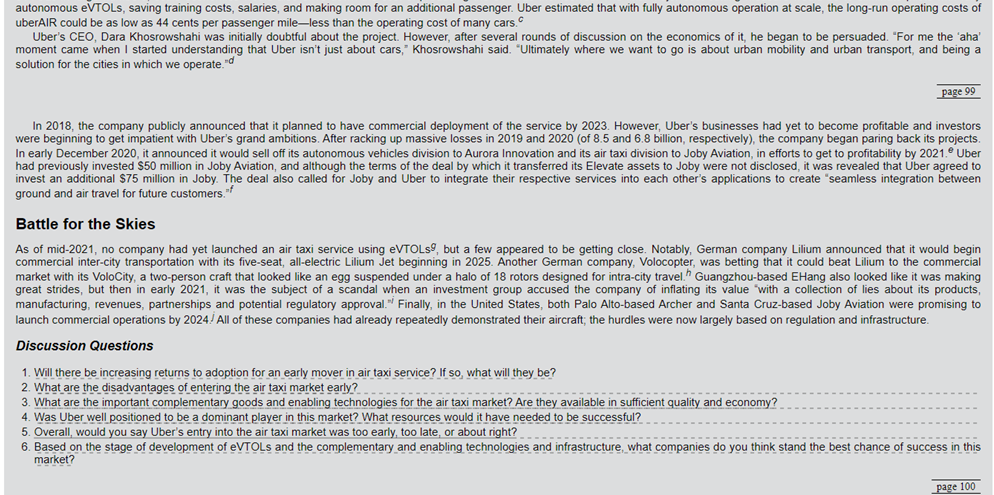
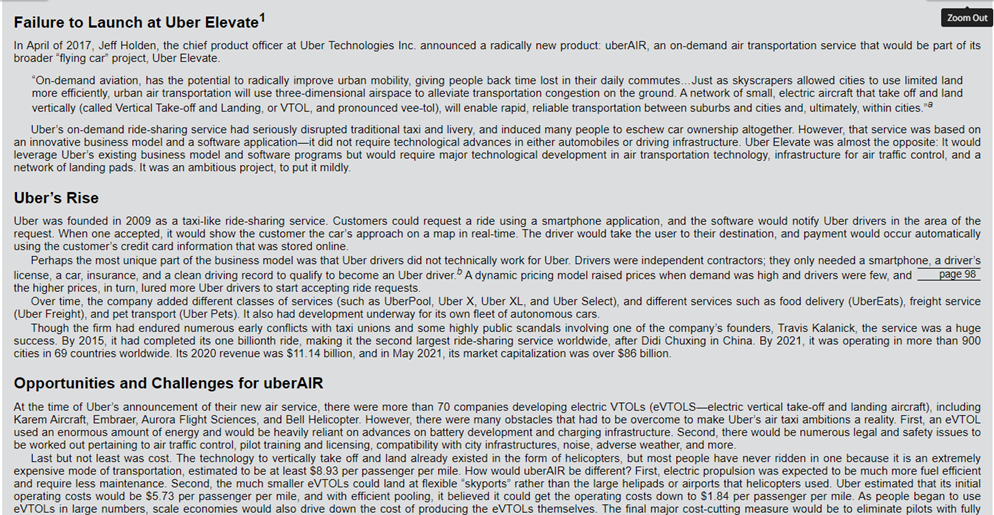
In April of 2017, Jeff Holden, the chief product officer at Uber Technologies Inc. announced a radically new product: uberAIR, an on-demand air transportation service that would be part of its broader "flying car" project, Uber Elevate. "On-demand aviation, has the potential to radically improve urban mobility, giving people back time lost in their daily commutes...Just as skyscrapers allowed cities to use limited land more efficiently, urban air transportation will use three-dimensional airspace to alleviate transportation congestion on the ground. A network of small, electric aircraft that take off and land vertically (called Vertical Take-off and Landing, or VTOL, and pronounced vee-tol), will enable rapid, reliable transportation between suburbs and cities and, ultimately, within cities." 8 Uber's on-demand ride-sharing service had seriously disrupted traditional taxi and livery, and induced many people to eschew car ownership altogether. However, that service was based on an innovative business model and a software application-it did not require technological advances in either automobiles or driving infrastructure. Uber Elevate was almost the opposite: It would leverage Uber's existing business model and software programs but would require major technological development in air transportation technology, infrastructure for air traffic control, and a network of landing pads. It was an ambitious project, to put it mildly. Uber's Rise Uber was founded in 2009 as a taxi-like ride-sharing service. Customers could request a ride using a smartphone application, and the software would notify Uber drivers in the area of the request. When one accepted, it would show the customer the car's approach on a map in real-time. The driver would take the user to their destination, and payment would occur automatically using the customer's credit card information that was stored online. Perhaps the most unique part of the business model was that Uber drivers did not technically work for Uber. Drivers were independent contractors; they only needed a smartphone, a driver's license, a car, insurance, and a clean driving record to qualify to become an Uber driver. b Adynamic pricing model raised prices when demand was high and drivers were few, and the higher prices, in turn, lured more Uber drivers to start accepting ride requests. Over time, the company added different classes of services (such as UberPool, Uber X, Uber XL, and Uber Select), and different services such as food delivery (UberEats), freight service (Uber Freight), and pet transport (Uber Pets). It also had development underway for its own fleet of autonomous cars. Though the firm had endured numerous early conflicts with taxi unions and some highly public scandals involving one of the company's founders, Travis Kalanick, the service was a huge success. By 2015, it had completed its one billionth ride, making it the second largest ride-sharing service worldwide, after Didi Chuxing in China. By 2021, it was operating in more than 900 cities in 69 countries worldwide. Its 2020 revenue was \$11.14 billion, and in May 2021, its market capitalization was over \$86 billion. Opportunities and Challenges for uberAIR At the time of Uber's announcement of their new air service, there were more than 70 companies developing electric VTOLs (eVTOLS-electric vertical take-off and landing aircraft), including Karem Aircraft, Embraer, Aurora Flight Sciences, and Bell Helicopter. However, there were many obstacles that had to be overcome to make Uber's air taxi ambitions a reality. First, an eVTOL used an enormous amount of energy and would be heavily reliant on advances on battery development and charging infrastructure. Second, there would be numerous legal and safety issues to be worked out pertaining to air traffic control, pilot training and licensing, compatibility with city infrastructures, noise, adverse weather, and more. Last but not least was cost. The technology to vertically take off and land already existed in the form of helicopters, but most people have never ridden in one because it is an extremely expensive mode of transportation, estimated to be at least \$8.93 per passenger per mile. How would uberAlR be different? First, electric propulsion was expected to be much more fuel efficient and require less maintenance. Second, the much smaller eVTOLs could land at flexible "skyports" rather than the large helipads or airports that helicopters used. Uber estimated that its initial autonomous eVTOLs, saving training costs, salaries, and making room for an additional passenger. Uber estimated that with fully autonomous operation at scale, the long-run operating costs of uberAIR could be as low as 44 cents per passenger mile-less than the operating cost of many cars. C Uber's CEO, Dara Khosrowshahi was initially doubtful about the project. However, after several rounds of discussion on the economics of it, he began to be persuaded. "For me the 'aha' moment came when I started understanding that Uber isn't just about cars," Khosrowshahi said. "Ultimately where we want to go is about urban mobility and urban transport, and being a solution for the cities in which we operate. .d page 99 In 2018, the company publicly announced that it planned to have commercial deployment of the service by 2023 . However, Uber's businesses had yet to become profitable and investors were beginning to get impatient with Uber's grand ambitions. After racking up massive losses in 2019 and 2020 (of 8.5 and 6.8 billion, respectively), the company began paring back its projects. In early December 2020, it announced it would sell off its autonomous vehicles division to Aurora Innovation and its air taxi division to Joby Aviation, in efforts to get to profitability by 2021 . Uber had previously invested $50 million in Joby Aviation, and although the terms of the deal by which it transferred its Elevate assets to Joby were not disclosed, it was revealed that Uber agreed to invest an additional $75 million in Joby. The deal also called for Joby and Uber to integrate their respective services into each other's applications to create "seamless integration between ground and air travel for future customers. f Battle for the Skies As of mid-2021, no company had yet launched an air taxi service using eVTOLs g, but a few appeared to be getting close. Notably, German company Lilium announced that it would begin commercial inter-city transportation with its five-seat, all-electric Lilium Jet beginning in 2025. Another German company, Volocopter, was betting that it could beat Lilium to the commercial market with its VoloCity, a two-person craft that looked like an egg suspended under a halo of 18 rotors designed for intra-city travel. h Guangzhou-based EHang also looked like it was making great strides, but then in early 2021, it was the subject of a scandal when an investment group accused the company of inflating its value "with a collection of lies about its products, manufacturing, revenues, partnerships and potential regulatory approval. ii Finally, in the United States, both Palo Alto-based Archer and Santa Cruz-based Joby Aviation were promising to launch commercial operations by 2024 . All of these companies had already repeatedly demonstrated their aircraft; the hurdles were now largely based on regulation and infrastructure. Discussion Questions 1. Will there be increasing returns to adoption for an early mover in air taxi service? If so, what will they be? 2. What are the disadvantages of entering the air taxi market early? 3. What are the important complementary goods and enabling technologies for the air taxi market? Are they available in sufficient quality and economy? 4. Was Uber well positioned to be a dominant player in this market? What resources would it have needed to be successful? 5. Overall, would you say Uber's entry into the air taxi market was too early, too late, or about right? 6. Based on the stage of development of eVTOLs and the complementary and enabling technologies and infrastructure, what companies do you think stand the best chance of success in this market
Step by Step Solution
There are 3 Steps involved in it

Get step-by-step solutions from verified subject matter experts
 Study Help