







Question: Answer the final question, and show work please! Thank you :) The Business Situation When Shelley Jones became president-elect of the Circular Club of Auburn,
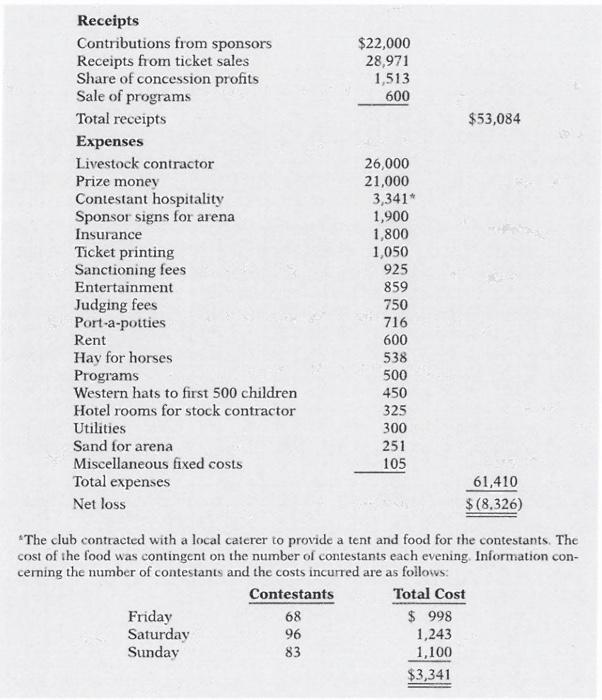
The Business Situation When Shelley Jones became president-elect of the Circular Club of Auburn, Kansas, she was asked to suggest a new fundraising activity for the club. After a considerable amount of research, Shelley proposed that the Circular Club sponsor a professional rodeo. In her presentation to the club, Shelley said that she wanted a fundraiser that would (1) continue to get better each year, (2) give back to the community, and (3) provide the club a presence in the community. Shelley's goal was to have an activity that would become an "annual community event" and that would break even the first year and raise $5,000 the following year. In addition, based on the experience of other communities, Shelley believed that a rodeo could grow in popularity so that the club would eventually earn an average of $20,000 annually. A rodeo committee was formed. Shelley contacted the world's oldest and largest rodeo-sanctioning agency to apply to sponsor a professional rodeo. The sanctioning agency requires a rodeo to consist of the following five events: Bareback Riding, Bronco Riding, Steer Wrestling, Bull Riding, and Calf Roping. Because there were a number of team ropers in the area and because they wanted to include females in the competition, members of the rodeo committee added Team Roping and Women's Barrels. Prize money of $3,000 would be paid to winners in each of the seven events. Members of the rodeo committee contracted with RJ Cattle Company, a livestock contractor on the rodeo circuit, to provide bucking stock, fencing, and chutes. Realizing that costs associated with the rodeo were tremendous and that ticket sales would probably not be sufficient to cover the costs, the rodeo committee sent letters to local businesses soliciting contributions in exchange for various sponsorships. Exhibiting Sponsors would contribute $1,000 to exhibit their products or services, while Major Sponsors would contribute $600. Chute Sponsors would contribute $500 to have the name of their business on one of the six bucking chutes. For a contribution of $100, individuals would be included in a Friends of Rodeo list found in the rodeo programs. At each performance the rodeo announcer would repeatedly mention the names of the businesses and individuals at each level of sponsorship. In addition, large signs and banners with the names of the businesses of the Exhibiting Sponsors, Major Sponsors, and Chute Sponsors were to be displayed prominently in the arena. A local youth group was contacted to provide concessions to the public and divide the profits with the Circular Club. The Auburn Circular Club Pro Rodeo Roundup would be held on June 1, 2, and 3. The cost of an adult ticket was set at $8 in advance or $10 at the gate; the cost of a ticket for a child 12 or younger was set at $6 in advance or $8 at the gate. Tickets were not date-specific. Rather, one ticket would admit an individual to one performance of his or her choiceFriday, Saturday, or Sunday. The rodeo committee was able to secure a location through the county supervisors board at a nominal cost to the Circular Club. The arrangement allowed the use of the county fair grounds and arena for a one-week period. Several months prior to the rodeo, members of the rodeo committee had been assured that bleachers at the arena would hold 2,500 patrons. On Saturday night, paid attendance was 1,663 , but all seats were filled due to poor gate controls. Attendance was 898 Friday and 769 on Sunday. The following revenue and expense figures relate to the first year of the rodeo. "The club contracted with a local caterer to provide a tent and food for the contestants. The cost of the food was contingent on the number of contestants each evening. Information concerning the number of contestants and the costs incurred are as follows: Rather than hire the local catering company to cater the Contestant Hospitality Tent, members of the Circular Club are considering asking Shady's Bar-B-Q to cater the event in exchange for a $600 Major Sponsor spot. In addition, The Fun Shop, a local party supply business, will be asked to donate a tent to use for the event. The Fun Shop will also be given a $600 Major Sponsor spot. Several members of the Club are opposed to this consideration, arguing that the two Major Sponsor spots will take away from the money to be earned through other sponsors. Adrian Stein has explained to the members that the Major Sponsor signs for the arena cost only $48 each. In addition, there is more than enough room to display two additional sponsor signs. What would you encourage the Club to do concerning the Contestant Hospitality Tent? Would your answer be different if the arena were limited in the number of additional signs that could be displayed? What kind of cost would we consider in this situation that would not be found on a financial statement
Step by Step Solution
There are 3 Steps involved in it

Get step-by-step solutions from verified subject matter experts
 Study Help