







Question: Answer the following: 1. Suppose the Fed executes a open market purchases of government bonds in the amount of $85 billion. Before this transaction, all
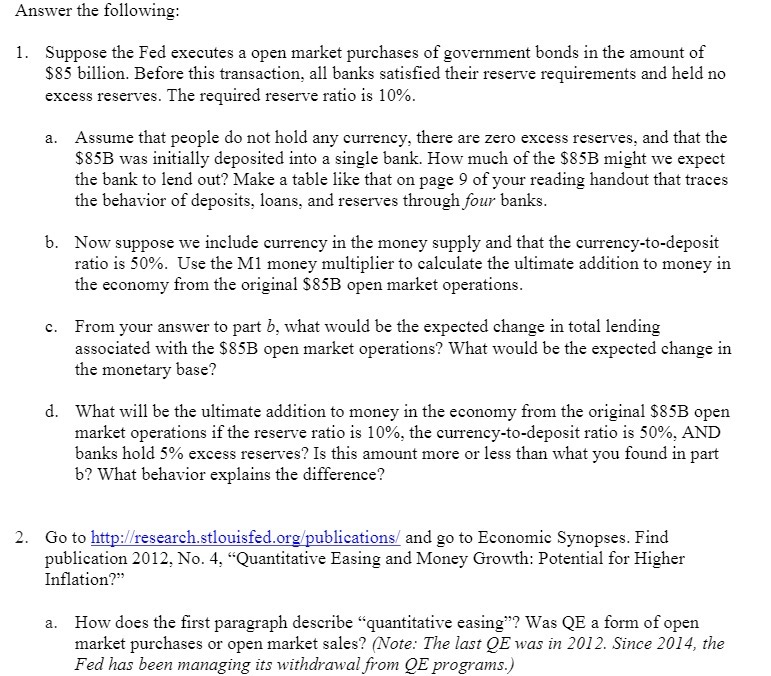
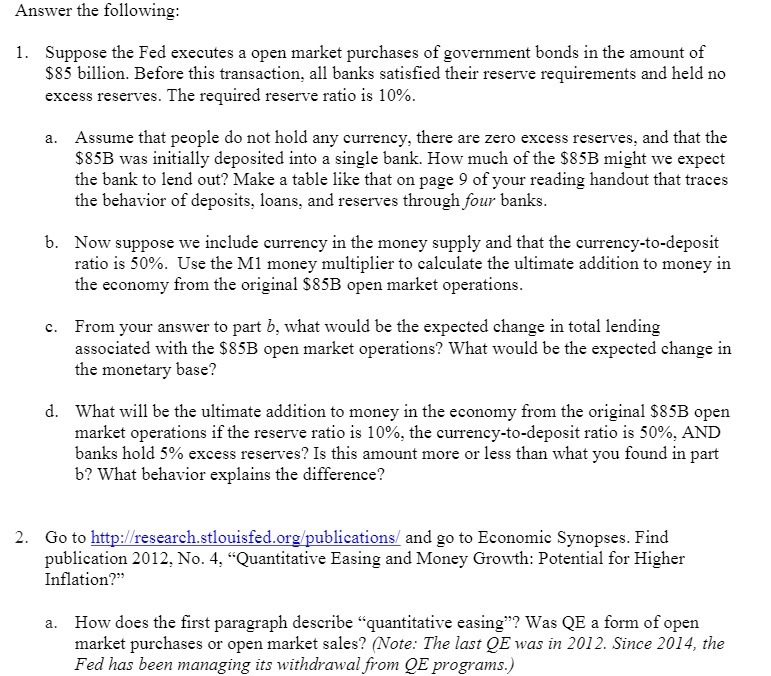
Answer the following: 1. Suppose the Fed executes a open market purchases of government bonds in the amount of $85 billion. Before this transaction, all banks satisfied their reserve requirements and held no excess reserves. The required reserve ratio is 10%. a. Assume that people do not hold any currency, there are zero excess reserves, and that the $85B was initially deposited into a single bank. How much of the $85B might we expect the bank to lend out? Make a table like that on page 9 of your reading handout that traces the behavior of deposits, loans, and reserves through four banks. b. Now suppose we include currency in the money supply and that the currency-to-deposit ratio is 50%. Use the M1 money multiplier to calculate the ultimate addition to money in the economy from the original $85B open market operations. c. From your answer to part b, what would be the expected change in total lending associated with the $85B open market operations? What would be the expected change in the monetary base? d. What will be the ultimate addition to money in the economy from the original $85B open market operations if the reserve ratio is 10%, the currency-to-deposit ratio is 50%, AND banks hold 5% excess reserves? Is this amount more or less than what you found in part b? What behavior explains the difference? 2. Go to http://research.stlouisfed.org/publications/ and go to Economic Synopses. Find publication 2012, No. 4, "Quantitative Easing and Money Growth: Potential for Higher Inflation?" a. How does the first paragraph describe "quantitative easing"? Was QE a form of open market purchases or open market sales? (Note: The last OE was in 2012. Since 2014, the Fed has been managing its withdrawal from QE programs
Step by Step Solution
There are 3 Steps involved in it

Get step-by-step solutions from verified subject matter experts
 Study Help