Question: answer the following However, it was only long after ordered pairs had been used extensively in. mathematics that mathematicians realized that it was possible to
answer the following
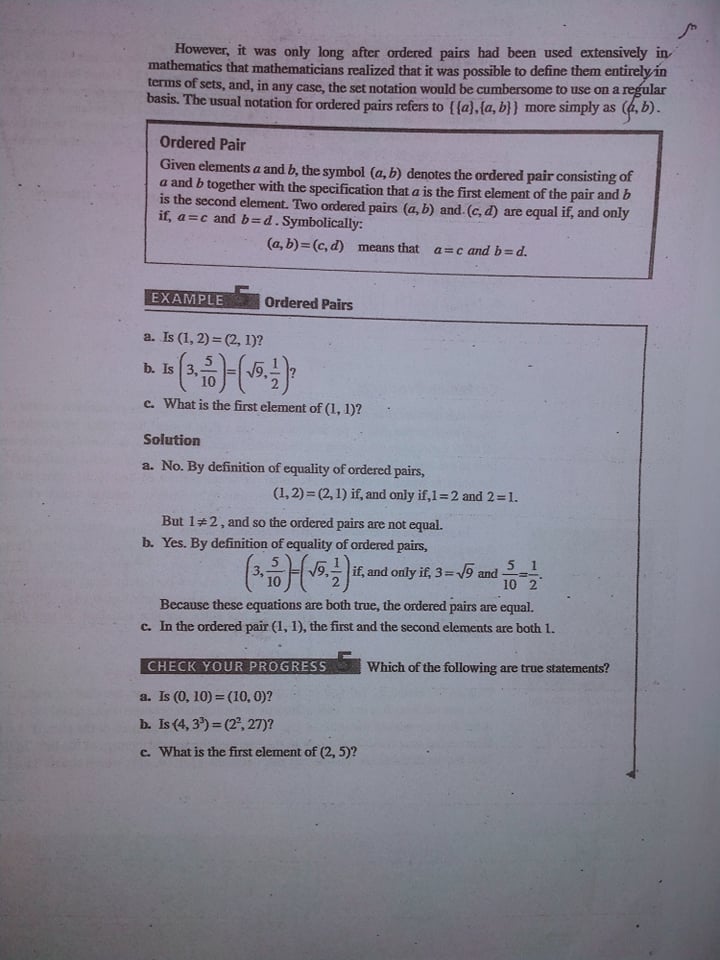
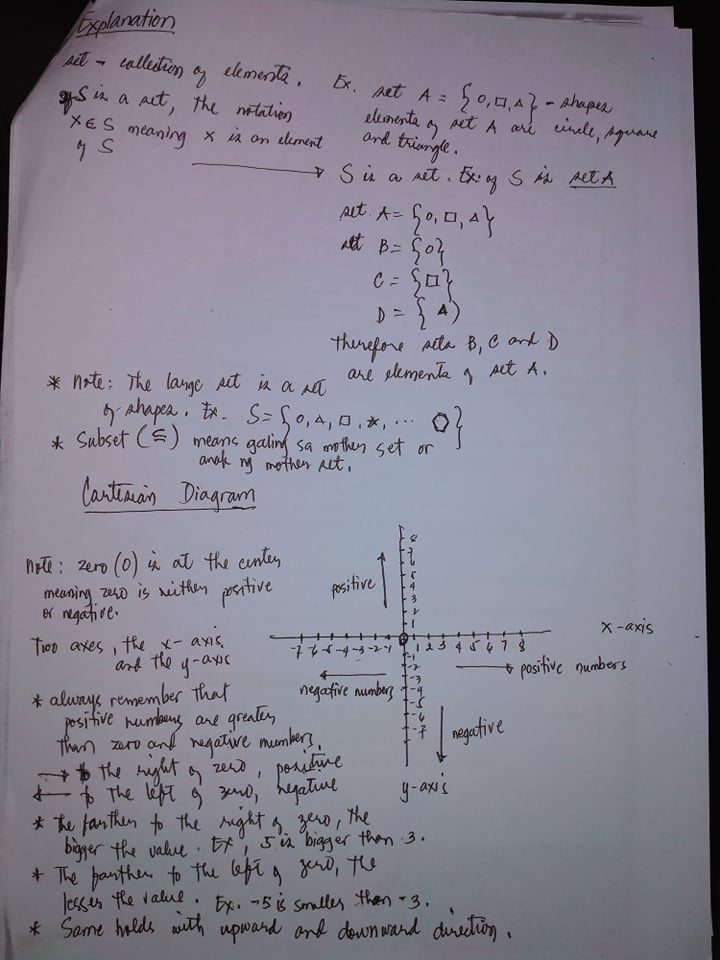
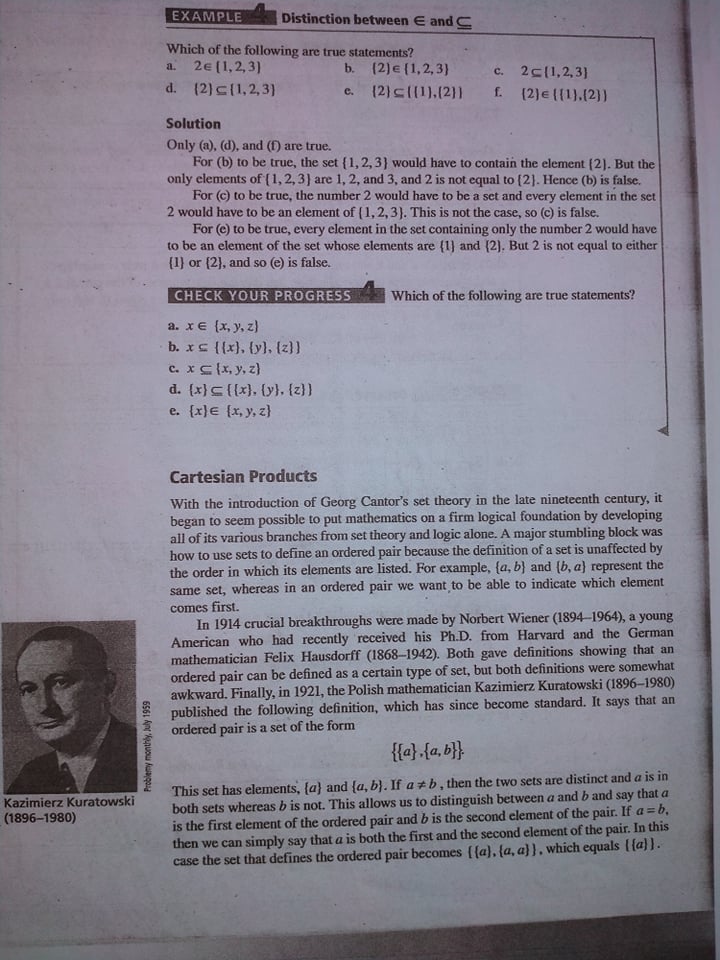
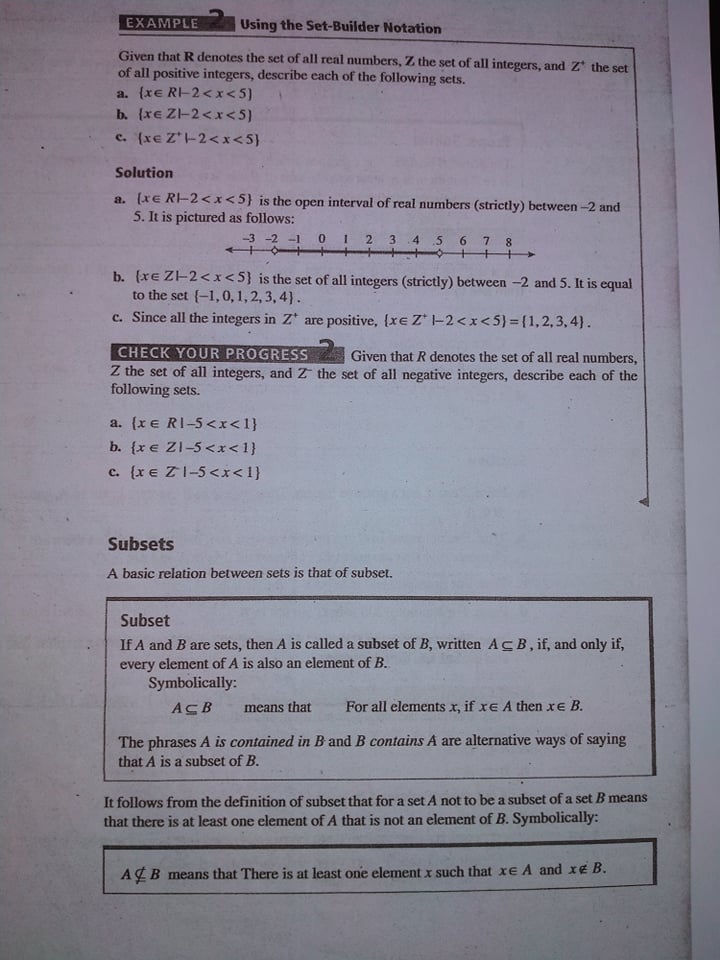
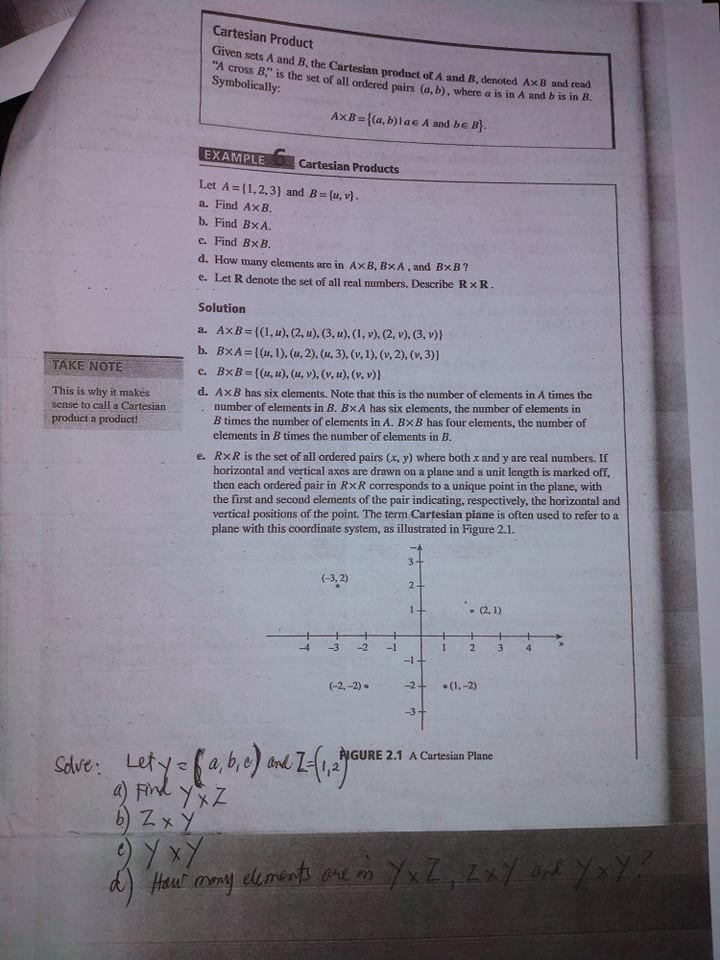
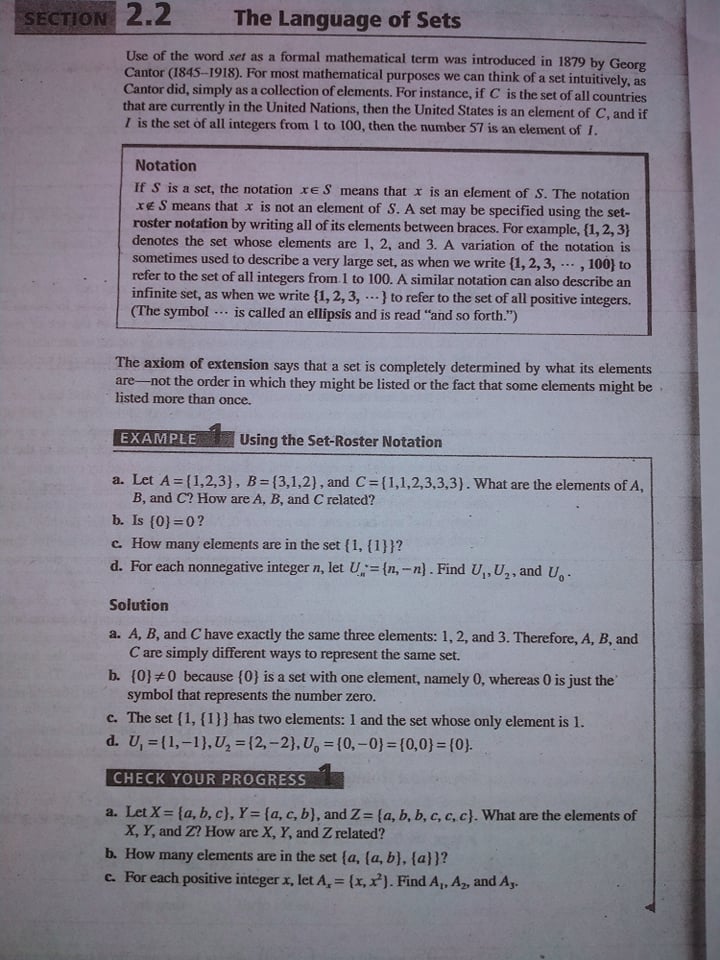
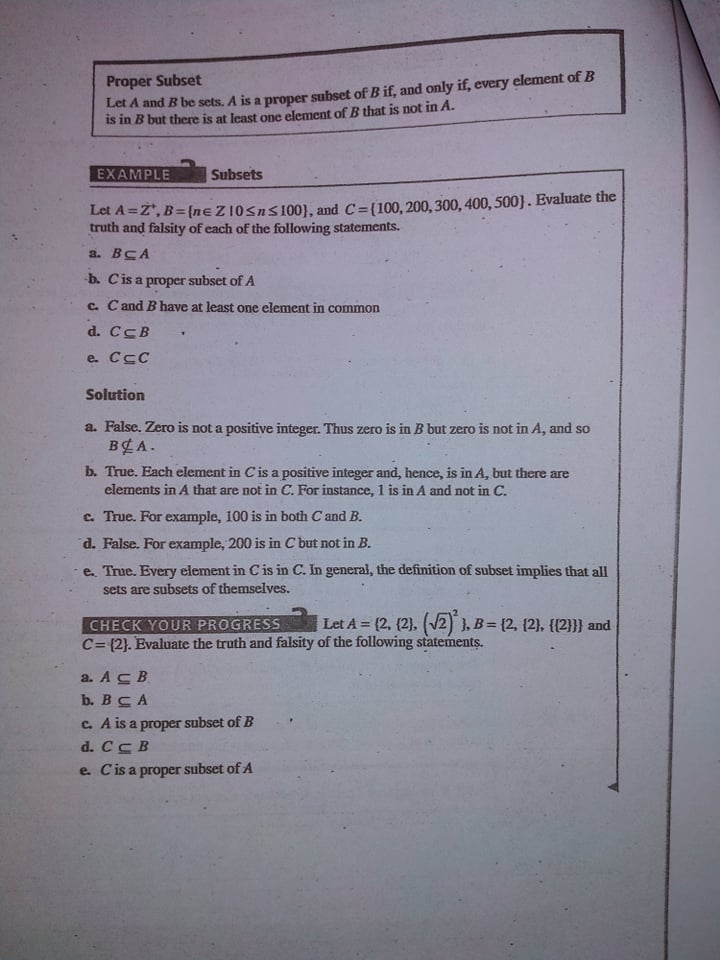
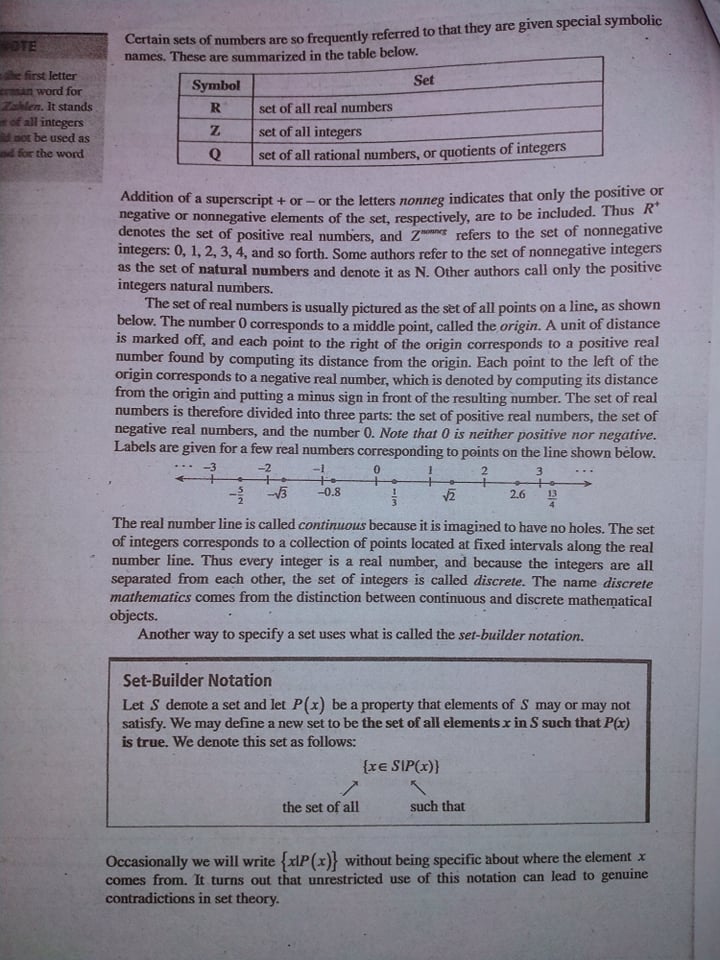
However, it was only long after ordered pairs had been used extensively in. mathematics that mathematicians realized that it was possible to define them entirely in terms of sets, and, in any case, the set notation would be cumbersome to use on a regular basis. The usual notation for ordered pairs refers to {{a], (a, b} } more simply as ((, b). Ordered Pair Given elements a and b, the symbol (a, b) denotes the ordered pair consisting of a and b together with the specification that a is the first element of the pair and b is the second element. Two ordered pairs (a, b) and. (c, d) are equal if, and only if, a =c and b=d . Symbolically: (a, b)= (c, d) means that a = c and b=d. EXAMPLE Ordered Pairs a. Is (1, 2) = (2, 1)? ( 3. 10 ) - ( 15 . ) 2 c. What is the first element of (1, 1)? Solution a. No. By definition of equality of ordered pairs, (1,2) = (2, 1) if, and only if, 1 =2 and 2 =1. But 1=2, and so the ordered pairs are not equal. b. Yes. By definition of equality of ordered pairs, (3. 10 ( 15,2 it,and only if, 3 = 19 and 51 10 2 Because these equations are both true, the ordered pairs are equal. c. In the ordered pair (1, 1), the first and the second elements are both 1. CHECK YOUR PROGRESS Which of the following are true statements? a. Is (0, 10) = (10, 0)? b. Is (4, 3') = (27,27)? c. What is the first element of (2, 5)?Explanation act - collection of elementa, Ex. net A = 50, 1 47 - shaped *s in a pet, the notation YES meaning x in an element elements of set A are circle, square and triangle . Alt. A= 50, 0, AY att B = So C = 50? D = 14) therefore with B, C and D * note: The lange set in a net are elements of set A. of shapes , Ex. S= 50, 4, 0. *... 07 * Subset (S ) means galing sa mother jet or anak my mother ret . Cantemian Diagram note: zero ( 0) in at the center meaning zero is neither positive positive er negative . Two axes, the x-axis. X - axis 1 123 4 5 6 7 8 and the y-axis 74-5- 4-3-27 positive numbers * always remember that negative numbers positive numbers are greater Than zero and negative numbers, negative + to the right of zest, positive * to The left of sand, negative 4 - axis * The farther to the right of zero, the bigger the value. EX, 5 is bigger than .3 . * The farther to the left o jeso, the leases the value . Ex. -5 is smaller than- 3. * Same holds with upward and downward direction.EXAMPLE Distinction between E and C Which of the following are true statements? a. 2c [1,2,3] b. (2)= (1,2,3) c. 2c(1,2,3] d. (2) c (1,2,3] (2) = ((1),(2]] E [2)= ((1).(2) ) Solution Only (a), (d), and (1) are true. For (b) to be true, the set {1, 2, 3) would have to contain the element (2]. But the only elements of [ 1, 2, 3] are 1, 2, and 3, and 2 is not equal to [2]. Hence (b) is false. For (c) to be true, the number 2 would have to be a set and every element in the set 2 would have to be an element of ( 1, 2, 3). This is not the case, so (c) is false. For (e) to be true, every element in the set containing only the number 2 would have to be an element of the set whose elements are (1) and (2). But 2 is not equal to either (1) or (2), and so (e) is false. CHECK YOUR PROGRESS Which of the following are true statements? a. x 6 {x, y, z) b. x = {(x], (yl, (z]] c. x s (x, y, z) d. (x) c {(x). (y), {z]] e. {xle (x, y, z] Cartesian Products With the introduction of Georg Cantor's set theory in the late nineteenth century, it began to seem possible to put mathematics on a firm logical foundation by developing all of its various branches from set theory and logic alone. A major stumbling block was how to use sets to define an ordered pair because the definition of a set is unaffected by the order in which its elements are listed. For example, {a, b} and (b, a} represent the same set, whereas in an ordered pair we want to be able to indicate which element comes first. In 1914 crucial breakthroughs were made by Norbert Wiener (1894-1964), a young American who had recently received his Ph.D. from Harvard and the German mathematician Felix Hausdorff (1868-1942). Both gave definitions showing that an ordered pair can be defined as a certain type of set, but both definitions were somewhat awkward. Finally, in 1921, the Polish mathematician Kazimierz Kuratowski (1896-1980) published the following definition, which has since become standard. It says that an ordered pair is a set of the form Problemy monthly, July 1959 Ha} {a, b}} This set has elements, (a} and (a, b). If a # b , then the two sets are distinct and a is in Kazimierz Kuratowski both sets whereas b is not. This allows us to distinguish between a and b and say that a (1896-1980) is the first element of the ordered pair and b is the second element of the pair. If a = b, then we can simply say that a is both the first and the second element of the pair. In this case the set that defines the ordered pair becomes {{a), (a, a] ]. which equals [a]].EXAMPLE Using the Set-Builder Notation Given that R denotes the set of all real numbers, Z the set of all integers, and Z* the set of all positive integers, describe each of the following sets. a. {xe RI-2
2 or s









 Study Help