







Question: Answer the following question by reading the case study given - P.S. Elaborate it as much as you can. Don't say question incomplete or whatever,
Answer the following question by reading the case study given -
P.S. Elaborate it as much as you can. Don't say question incomplete or whatever, instead don't even answer.
QUES - Given the ability of most managers to "communicate" directly with the HR files, can CPIB use this to its advantage in collecting job analysis information? Explain.
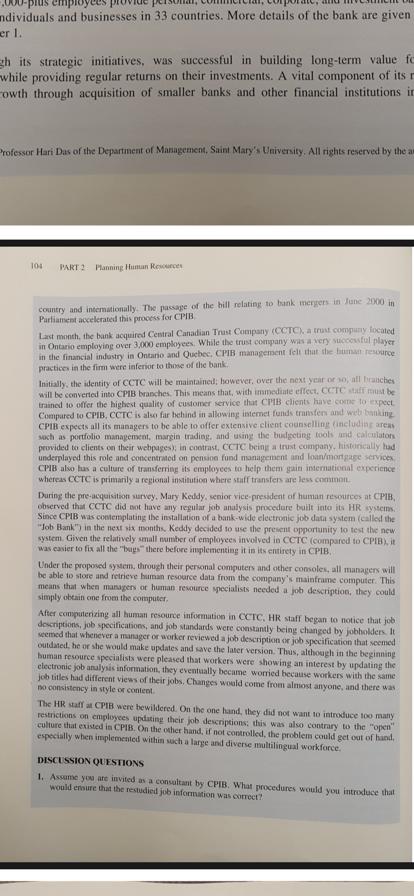
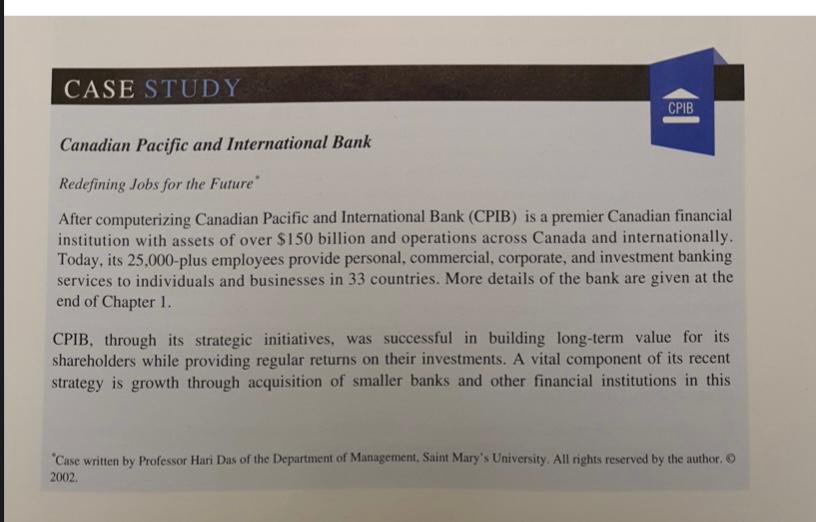
DO-plus employees pray ndividuals and businesses in 33 countries. More details of the bank are given er 1. th its strategic initiatives, was successful in building long-term value fo while providing regular returns on their investments. A vital component of its owth through acquisition of smaller banks and other financial institutions in Professor Hari Das of the Department of Management, Saint Mary's University. All rights reserved by the a 104 PART 3: Planning Human Resources country and internationally. The passage of the bill relating to brink mergers in June 2000 m Parliament accelerated this process for CPIB Last month, the bank acquired Central Canadian Trust Company (CCTCk a fruit company located in Ontario employing over 3.000 employees, While the trust company was a very successful player in the financial industry in Oneano and Quebec, CPIB management felt that the human resource practices in the firm were inferior to those of the bank. Initially, the identity of CCTC will be maintained, however, over the next year or to, all branches will be converted into CPIB branches, This means that, with inamediate effect, CCTC stuff must be trained to offer the highest quality of customer service that CRIB clients have come to expect Compared to CPIB, CCTC is also far behind in allowing internet funds tranfer and web banking CPIB expects all its managers to be able to offer extensive client counselling (including areas such as portfolio management, margin trading. and using the budgeting tools and calculator provided to clients on their webpages); in contrast, CC TC being a trust company, historically had underplayed this role and concentrated on pension fund management and loan mortgage services CPIBl also fun a culture of transferring its employees to help them guin international experience whereas CCTC is primarily a regional institution where staff transfers are less conunon During the pre-acquisition survey. Mary Keddy, senior vice president of human resources at CPIB, observed that CCTC did not have any regular job analysis procedure built into its HR system. Since CPIB was contemplating the installation of a bank-wide electronic job data system (called the "Job Blank") in the next six months, Keddy decided to use the present opportunity to test the new system. Given the relatively small number of employees involved in CCTC (compared to CPIB), it was easier to fix all the "bags"there before implementing it in its entirety in CPIA, Under the proposed system, through their personal computers and other comoles, all managers will be able to store and retrieve human resource data from the company's mainframe computer. This means that when managers or human resource specialists needed a job description, they could simply obtain cine from the computer. After computerizing all human resource information in CCTC, HR staff began to notice that job descriptions, job specifications, and job standards were constantly being changed by jobholders. It seemed that whenever a manager of worker reviewed a job description or job specification that seemed outdated, he or she would make updates and save the later version. Thus, although in the beginning human resource specialists were pleased that workers were showing an interest by updating the electronic job analysis information, they eventually became worried because workers with the same job titles had different views of their jobs, Changes would come from almost anyone, and there was no consistency in style of content. The HR staff al CPIB were bewildered. On the one hand, they did not want to introduce too many restrictions on employees updating their job descriptions: this was also contrary to the "open" culture that existed in CPIB. On the other hand, if not comrolled, the problem could get out of hand, especially when implemented within such a large and diverse multilingual workforce. DISCUSSION QUESTIONS 1, Assame you are invited as a consultant by CPIB. What procedures would you introduce that would ensure that the restudied job information was correct?.CASE STUDY CPIB Canadian Pacific and International Bank Redefining Jobs for the Future" After computerizing Canadian Pacific and International Bank (CPIB) is a premier Canadian financial institution with assets of over $150 billion and operations across Canada and internationally. Today, its 25,000-plus employees provide personal, commercial, corporate, and investment banking services to individuals and businesses in 33 countries. More details of the bank are given at the end of Chapter 1. CPIB, through its strategic initiatives, was successful in building long-term value for its shareholders while providing regular returns on their investments. A vital component of its recent strategy is growth through acquisition of smaller banks and other financial institutions in this "Case written by Professor Hari Das of the Department of Management, Saint Mary's University. All rights reserved by the author. Q 2002
Step by Step Solution
There are 3 Steps involved in it

Get step-by-step solutions from verified subject matter experts
 Study Help