Question: Answer the following question critical thinking questions from chapter 7 (case7.3) of your textbook. 1) Does the Supreme Court's decision in the Riley case protect
Answer the following question critical thinking questions from chapter 7 (case7.3) of your textbook.
1) Does the Supreme Court's decision in the Riley case protect privacy rights?
2) Did the supreme Court justices evidence an understanding of the digital world in their opinion?
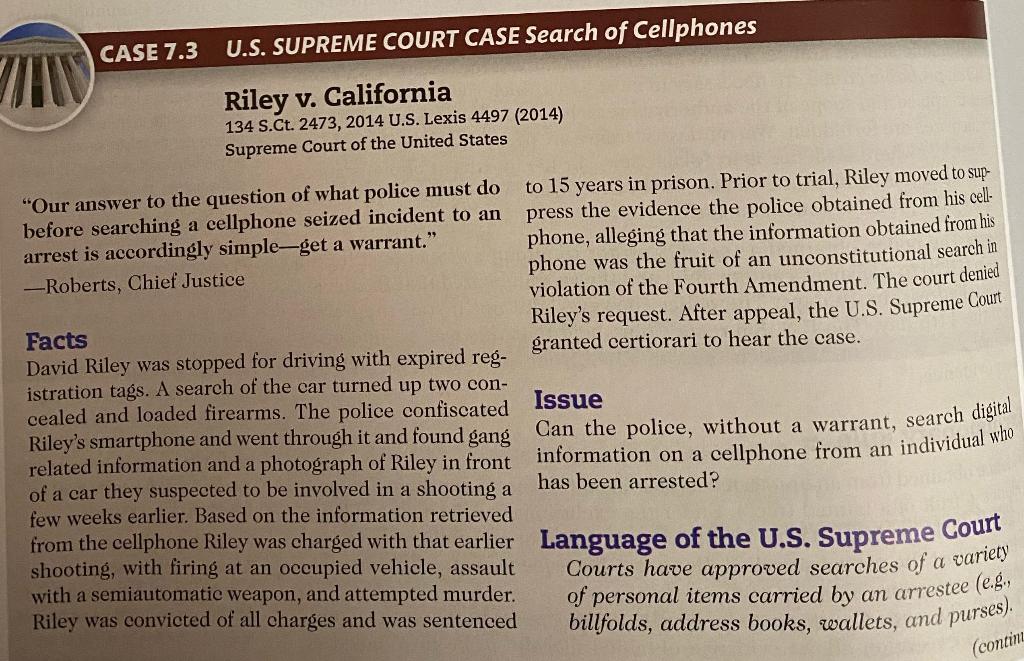
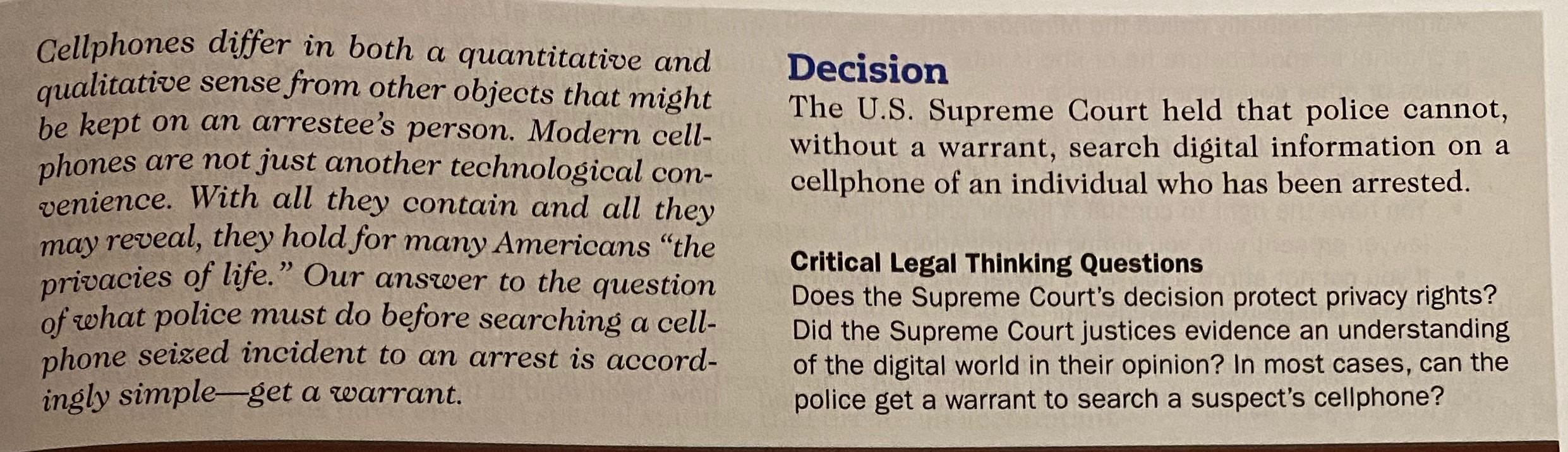
CASE 7.3 U.S. SUPREME COURT CASE Search of Cellphones Riley v. California 134 S.Ct. 2473, 2014 U.S. Lexis 4497 (2014) Supreme Court of the United States "Our answer to the question of what police must do to 15 years in prison. Prior to trial, Riley moved to sup- before searching a cellphone seized incident to an press the evidence the police obtained from his cell- arrest is accordingly simple-get a warrant." phone, alleging that the information obtained from his -Roberts, Chief Justice phone was the fruit of an unconstitutional search in violation of the Fourth Amendment. The court denied Facts Riley's request. After appeal, the U.S. Supreme Court David Riley was stopped for driving with expired reg- granted certiorari to hear the case. istration tags. A search of the car turned up two con- cealed and loaded firearms. The police confiscated Issue Riley's smartphone and went through it and found gang Can the police, without a warrant, search digital related information and a photograph of Riley front information on a cellphone from an individual who of a car they suspected to be involved in a shooting a has been arrested? few weeks earlier. Based on the information retrieved from the cellphone Riley was charged with that earlier Language of the U.S. Supreme Court shooting, with firing at an occupied vehicle, assault with a semiautomatic weapon, and attempted murder. Courts have approved searches of a variety Riley was convicted of all charges and was sentenced of personal items carried by an arrestee (e.g., billfolds, address books, wallets, and purses). (contin Decision The U.S. Supreme Court held that police cannot, without a warrant, search digital information on a cellphone of an individual who has been arrested. Cellphones differ in both a quantitative and qualitative sense from other objects that might be kept on an arrestee's person. Modern cell- phones are not just another technological con- venience. With all they contain and all they may reveal, they hold for many Americans "the privacies of life. Our answer to the question of what police must do before searching a cell- phone seized incident to an arrest is accord- ingly simple-get a warrant. Critical Legal Thinking Questions Does the Supreme Court's decision protect privacy rights? Did the Supreme Court justices evidence an understanding of the digital world in their opinion? In most cases, can the police get a warrant to search a suspect's cellphone









 Study Help