







Question: Answer the following Question from the case: WHAT SPECIFIC TACTICS WOULD YOU PROPOSE TO RAISE ADDITIONAL FUNDS? Nebraska State Historical Society Foundation: the Nebraska Marker
Answer the following Question from the case:
WHAT SPECIFIC TACTICS WOULD YOU PROPOSE TO RAISE ADDITIONAL FUNDS?
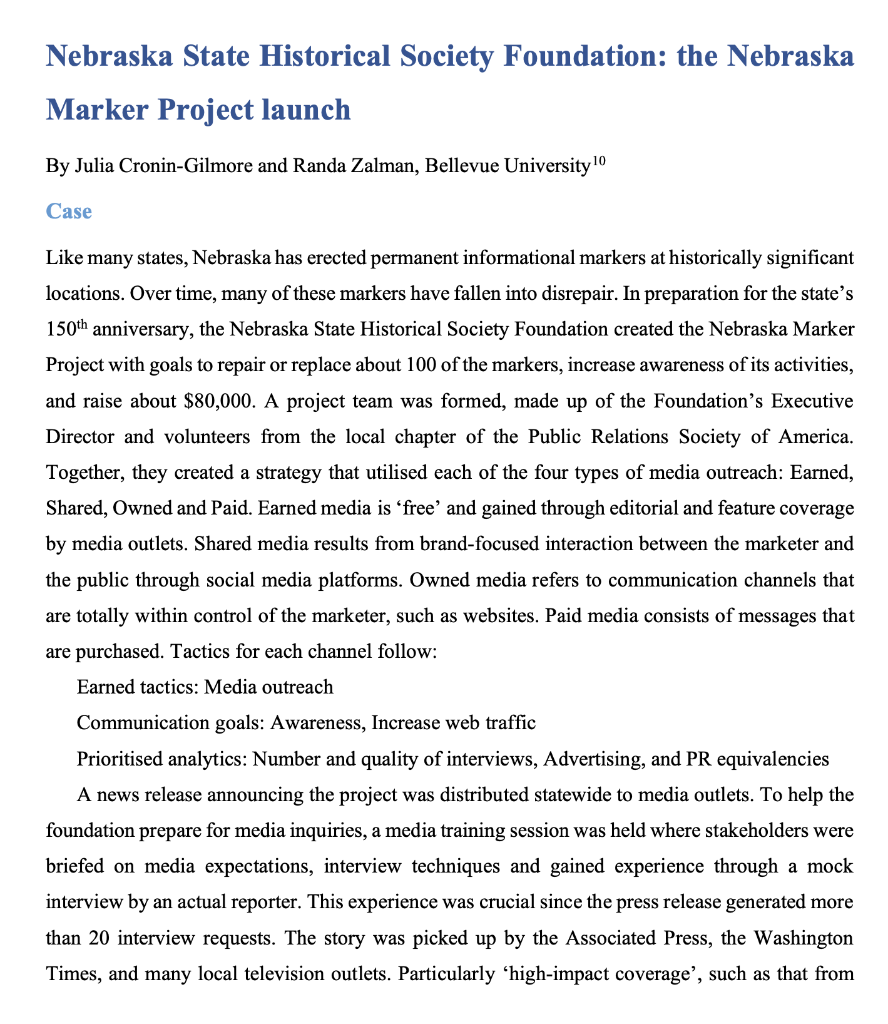
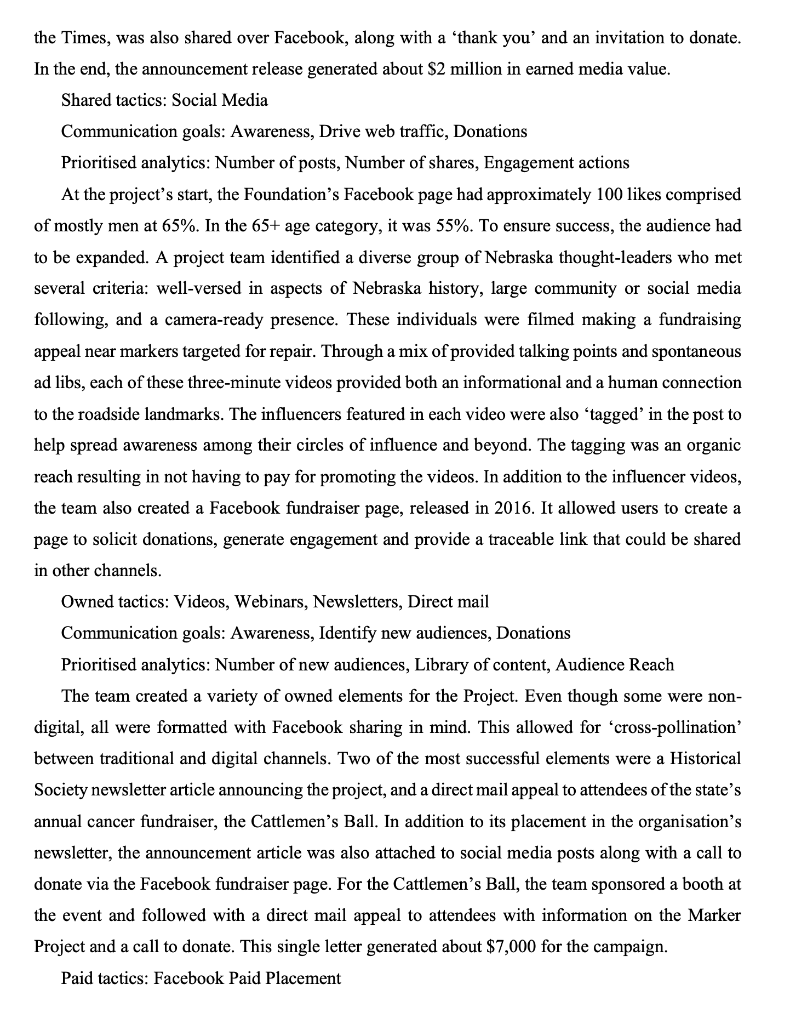
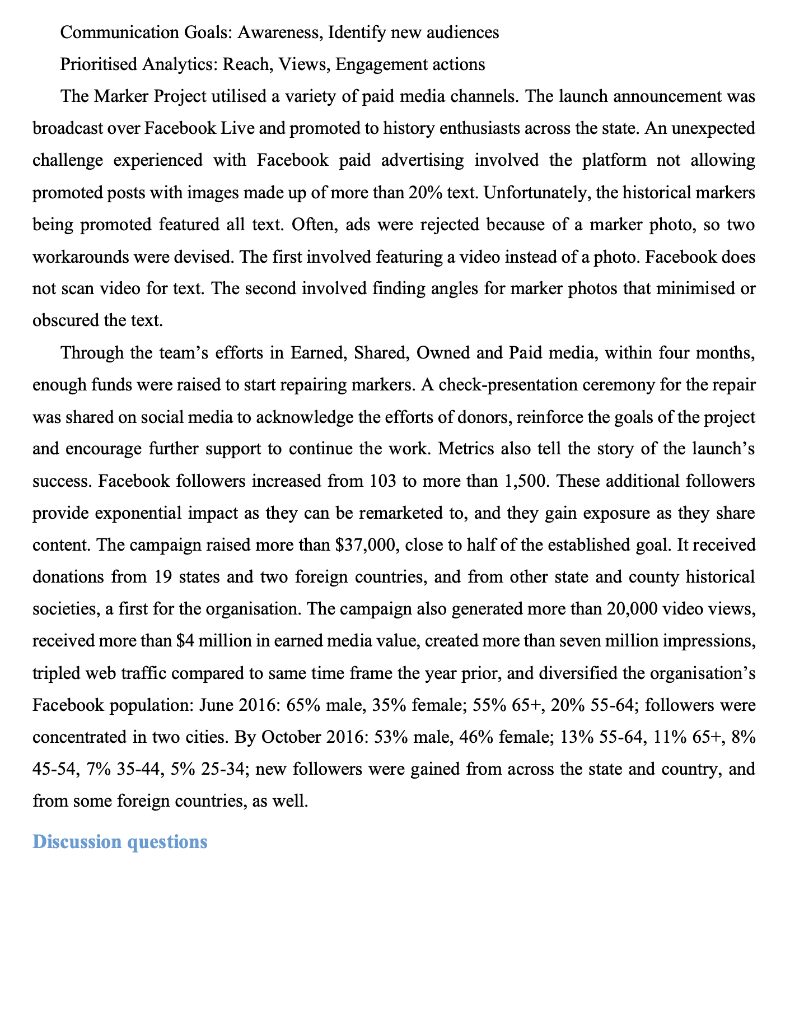
Nebraska State Historical Society Foundation: the Nebraska Marker Project launch By Julia Cronin-Gilmore and Randa Zalman, Bellevue University Case Like many states, Nebraska has erected permanent informational markers at historically significant locations. Over time, many of these markers have fallen into disrepair. In preparation for the state's 150th anniversary, the Nebraska State Historical Society Foundation created the Nebraska Marker Project with goals to repair or replace about 100 of the markers, increase awareness of its activities, and raise about $80,000. A project team was formed, made up of the Foundations Executive Director and volunteers from the local chapter of the Public Relations Society of America. Together, they created a strategy that utilised each of the four types of media outreach: Earned, Shared, Owned and Paid. Earned media is 'free' and gained through editorial and feature coverage by media outlets. Shared media results from brand-focused interaction between the marketer and the public through social media platforms. Owned media refers to communication channels that are totally within control of the marketer, such as websites. Paid media consists of messages that are purchased. Tactics for each channel follow: Earned tactics: Media outreach Communication goals: Awareness, Increase web traffic Prioritised analytics: Number and quality of interviews, Advertising, and PR equivalencies A news release announcing the project was distributed statewide to media outlets. To help the foundation prepare for media inquiries, a media training session was held where stakeholders were briefed on media expectations, interview techniques and gained experience through a mock interview by an actual reporter. This experience was crucial since the press release generated more than 20 interview requests. The story was picked up by the Associated Press, the Washington Times, and many local television outlets. Particularly 'high-impact coverage', such as that from the Times, was also shared over Facebook, along with a 'thank you' and an invitation to donate. In the end, the announcement release generated about $2 million in earned media value. Shared tactics: Social Media Communication goals: Awareness, Drive web traffic, Donations Prioritised analytics: Number of posts, Number of shares, Engagement actions At the project's start, the Foundation's Facebook page had approximately 100 likes comprised of mostly men at 65%. In the 65+ age category, it was 55%. To ensure success, the audience had to be expanded. A project team identified a diverse group of Nebraska thought-leaders who met several criteria: well-versed in aspects of Nebraska history, large community or social media following, and a camera-ready presence. These individuals were filmed making a fundraising appeal near markers targeted for repair. Through a mix of provided talking points and spontaneous ad libs, each of these three-minute videos provided both an informational and a human connection to the roadside landmarks. The influencers featured in each video were also 'tagged' in the post to help spread awareness among their circles of influence and beyond. The tagging was an organic reach resulting in not having to pay for promoting the videos. In addition to the influencer videos, the team also created a Facebook fundraiser page, released in 2016. It allowed users to create a page to solicit donations, generate engagement and provide a traceable link that could be shared in other channels. Owned tactics: Videos, Webinars, Newsletters, Direct mail Communication goals: Awareness, Identify new audiences, Donations Prioritised analytics: Number of new audiences, Library of content, Audience Reach The team created a variety of owned elements for the Project. Even though some were non- digital, all were formatted with Facebook sharing in mind. This allowed for 'cross-pollination' between traditional and digital channels. Two of the most successful elements were a Historical Society newsletter article announcing the project, and a direct mail appeal to attendees of the state's annual cancer fundraiser, the Cattlemen's Ball. In addition to its placement in the organisation's newsletter, the announcement article was also attached to social media posts along with a call to donate via the Facebook fundraiser page. For the Cattlemen's Ball, the team sponsored a booth at the event and followed with a direct mail appeal to attendees with information on the Marker Project and a call to donate. This single letter generated about $7,000 for the campaign. Paid tactics: Facebook Paid Placement Communication Goals: Awareness, Identify new audiences Prioritised Analytics: Reach, Views, Engagement actions The Marker Project utilised a variety of paid media channels. The launch announcement was broadcast over Facebook Live and promoted to history enthusiasts across the state. An unexpected challenge experienced with Facebook paid advertising involved the platform not allowing promoted posts with images made up of more than 20% text. Unfortunately, the historical markers being promoted featured all text. Often, ads were rejected because of a marker photo, so two workarounds were devised. The first involved featuring a video instead of a photo. Facebook does not scan video for text. The second involved finding angles for marker photos that minimised or obscured the text. Through the team's efforts in Earned, Shared, Owned and Paid media, within four months, enough funds were raised to start repairing markers. A check-presentation ceremony for the repair was shared on social media to acknowledge the efforts of donors, reinforce the goals of the project and encourage further support to continue the work. Metrics also tell the story of the launch's success. Facebook followers increased from 103 to more than 1,500. These additional followers provide exponential impact as they can be remarketed to, and they gain exposure as they share content. The campaign raised more than $37,000, close to half of the established goal. It received donations from 19 states and two foreign countries, and from other state and county historical societies, a first for the organisation. The campaign also generated more than 20,000 video views, received more than $4 million in earned media value, created more than seven million impressions, tripled web traffic compared to same time frame the year prior, and diversified the organisation's Facebook population: June 2016: 65% male, 35% female; 55% 65+, 20% 55-64; followers were concentrated in two cities. By October 2016: 53% male, 46% female; 13% 55-64, 11% 65+, 8% 45-54, 7% 35-44, 5% 25-34; new followers were gained from across the state and country, and from some foreign countries, as well. Discussion questionsStep by Step Solution
There are 3 Steps involved in it
1 Expert Approved Answer
Step: 1 Unlock

Question Has Been Solved by an Expert!
Get step-by-step solutions from verified subject matter experts
Step: 2 Unlock
Step: 3 Unlock
 Study Help