







Question: ANSWER THE FOLLOWING QUESTION THIS IS ONE PROBLEM ANSWER THE FOLLOWING - You have saved $5,000 for a down payment on a new car. The
ANSWER THE FOLLOWING QUESTION THIS IS ONE PROBLEM
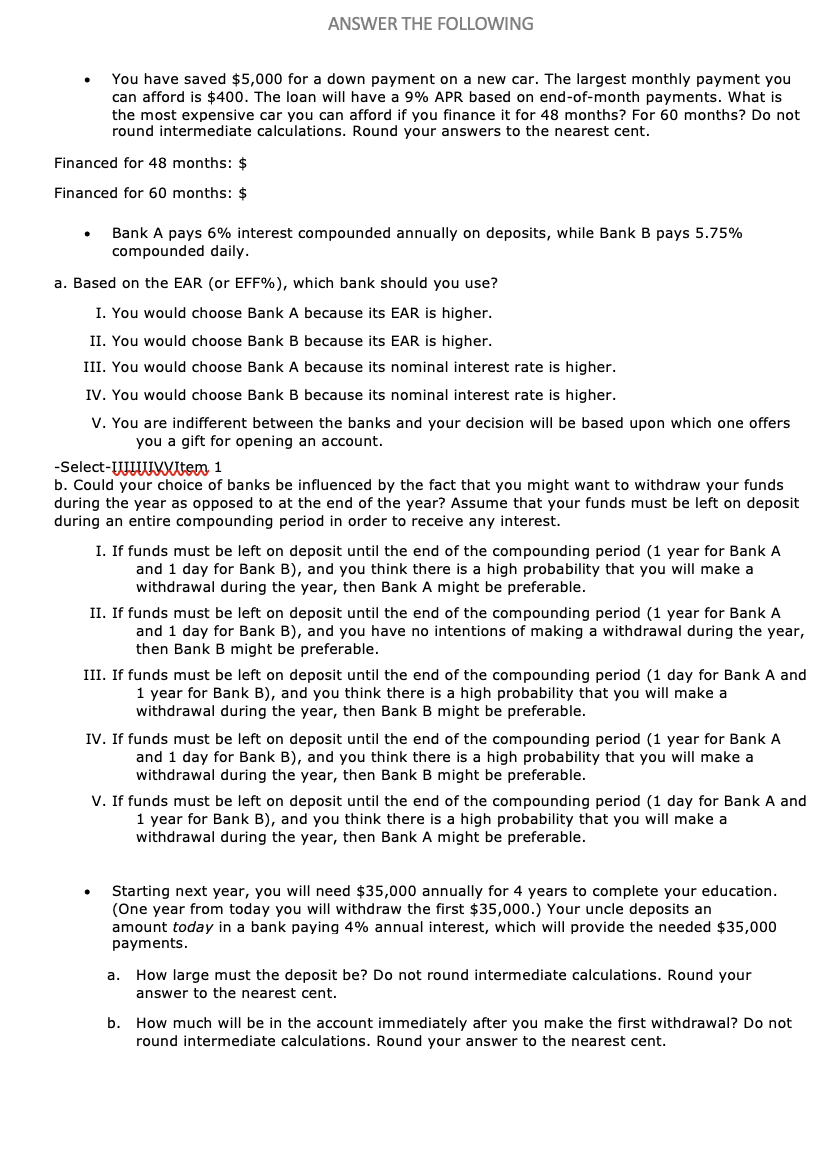
ANSWER THE FOLLOWING - You have saved $5,000 for a down payment on a new car. The largest monthly payment you can afford is $400. The loan will have a 9% APR based on end-of-month payments. What is the most expensive car you can afford if you finance it for 48 months? For 60 months? Do not round intermediate calculations. Round your answers to the nearest cent. Financed for 48 months: \$ Financed for 60 months: \$ - Bank A pays 6% interest compounded annually on deposits, while Bank B pays 5.75% compounded daily. a. Based on the EAR (or EFF\%), which bank should you use? I. You would choose Bank A because its EAR is higher. II. You would choose Bank B because its EAR is higher. III. You would choose Bank A because its nominal interest rate is higher. IV. You would choose Bank B because its nominal interest rate is higher. V. You are indifferent between the banks and your decision will be based upon which one offers you a gift for opening an account. -Select-ULuLutem 1 b. Could your choice of banks be influenced by the fact that you might want to withdraw your funds during the year as opposed to at the end of the year? Assume that your funds must be left on deposit during an entire compounding period in order to receive any interest. I. If funds must be left on deposit until the end of the compounding period (1 year for Bank A and 1 day for Bank B), and you think there is a high probability that you will make a withdrawal during the year, then Bank A might be preferable. II. If funds must be left on deposit until the end of the compounding period (1 year for Bank A and 1 day for Bank B), and you have no intentions of making a withdrawal during the year, then Bank B might be preferable. III. If funds must be left on deposit until the end of the compounding period (1 day for Bank A and 1 year for Bank B), and you think there is a high probability that you will make a withdrawal during the year, then Bank B might be preferable. IV. If funds must be left on deposit until the end of the compounding period (1 year for Bank A and 1 day for Bank B), and you think there is a high probability that you will make a withdrawal during the year, then Bank B might be preferable. V. If funds must be left on deposit until the end of the compounding period (1 day for Bank A and 1 year for Bank B), and you think there is a high probability that you will make a withdrawal during the year, then Bank A might be preferable. - Starting next year, you will need $35,000 annually for 4 years to complete your education. (One year from today you will withdraw the first $35,000.) Your uncle deposits an amount today in a bank paying 4% annual interest, which will provide the needed $35,000 payments. a. How large must the deposit be? Do not round intermediate calculations. Round your answer to the nearest cent. b. How much will be in the account immediately after you make the first withdrawal? Do not round intermediate calculations. Round your answer to the nearest cent
Step by Step Solution
There are 3 Steps involved in it

Get step-by-step solutions from verified subject matter experts
 Study Help