







Question: Answer the following question : What is the policy underlying the Equal Protection Clause? How did it apply in this case? How important is the
Answer the following question :
- What is the policy underlying the Equal Protection Clause?
- How did it apply in this case?
- How important is the Supreme Court's decision?
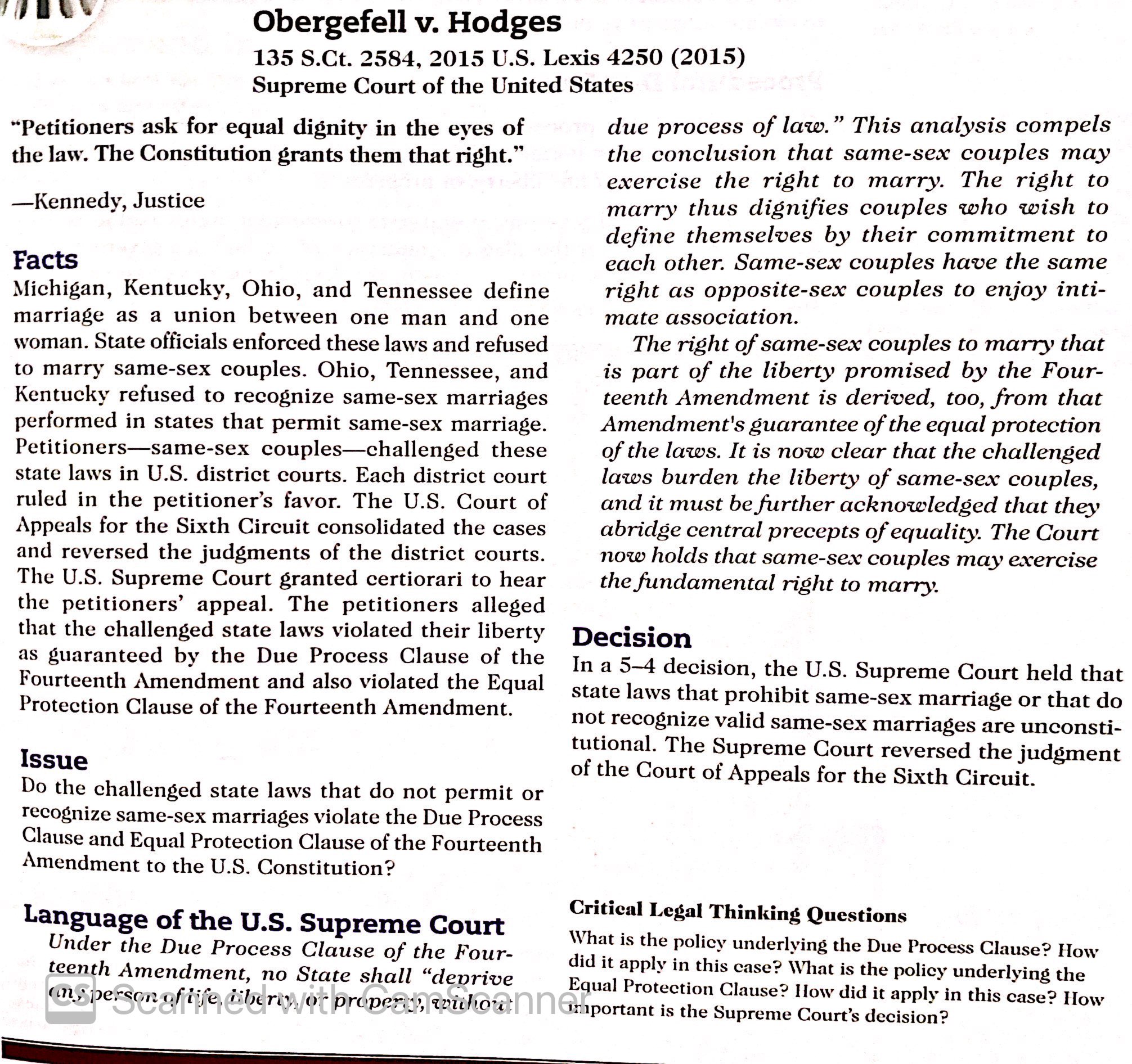
valuir / Obergefell v. Hodges 135 S.Ct. 2584, 2015 U.S. Lexis 4250 (2015) Supreme Court of the United States \"Petitioners ask for equal dignity in the eyes of the law. The Constitution grants them that right." Kennedy, Justice Facts Michigan, Kentucky, Ohio, and Tennessee define marriage as a union between one man and one woman. State ofcials enforced these laws and refused to marry same-sex couples. Ohio, Tennessee, and Kentucky refused to recognize same-sex marriages performed in states that permit same-sex marriage. Petitionerssame-sex coupleschallenged these state laws in U.S. district courts. Each district court ruled in the petitioner's favor. The U.S. Court of Appeals for the Sixth Circuit consolidated the cases and reversed the judgments of the district courts. The U.S. Supreme Court granted certiorari to hear the petitioners' appeal. The petitioners alleged that the challenged state laws violated their liberty as guaranteed by the Due Process Clause of the Fourteenth Amendment and also violated the Equal Protection Clause of the Fourteenth Amendment. Issue D0 the challenged state laws that do not permit or recognize same-sex marriages violate the Due Process Clause and Equal Protection Clause of the Fourteenth Amendment to the U.S. Constitution? Language of the U.S. Supreme Court Under the Due Process Clause of the Four- :.t.h Amendment, no State shll \"d- 1' egmt'tirw'ii due process of law.\" This analysis compels the conclusion that same-sex couples may exercise the right to marry. The right to marry thus dignifies couples who wish to define themselves by their commitment to each other. Same-sex couples have the same right as opposite-sex couples to enjoy inti- mate association. The right of same-sex couples to many that is part of the liberty promised by the Four- teenth Amendment is derived, too, from that Amendment's guarantee of the equal protection of the laws. It is now clear that the challenged laws burden the liberty of same-sex couples, and it must be further acknowledged that they abridge central precepts of equality. The Court now holds that same-sex couples may exercise the fundamental right to many. Decision In a 54 decision, the U.S. Supreme Court held that state laws that prohibit same-sex marriage or that do not recognize valid samesex marriages are unconsti- tutional. The Supreme Court reversed the judgment of the Court of Appeals for the Sixth Circuit. Critical Legal Thinking Questions What is the policy underlying the Due Process Clause? How did it apply in this case? What is the policy underlying the E ual Protection Clause? How did it apply in this case? How agponant is the Supreme Court's decision
Step by Step Solution
There are 3 Steps involved in it

Get step-by-step solutions from verified subject matter experts
 Study Help