



Question: Answer the following questions ffChapter 23 Review A. Select the one best answer for each of the following. 1. When using the transfer (gait) belt
Answer the following questions

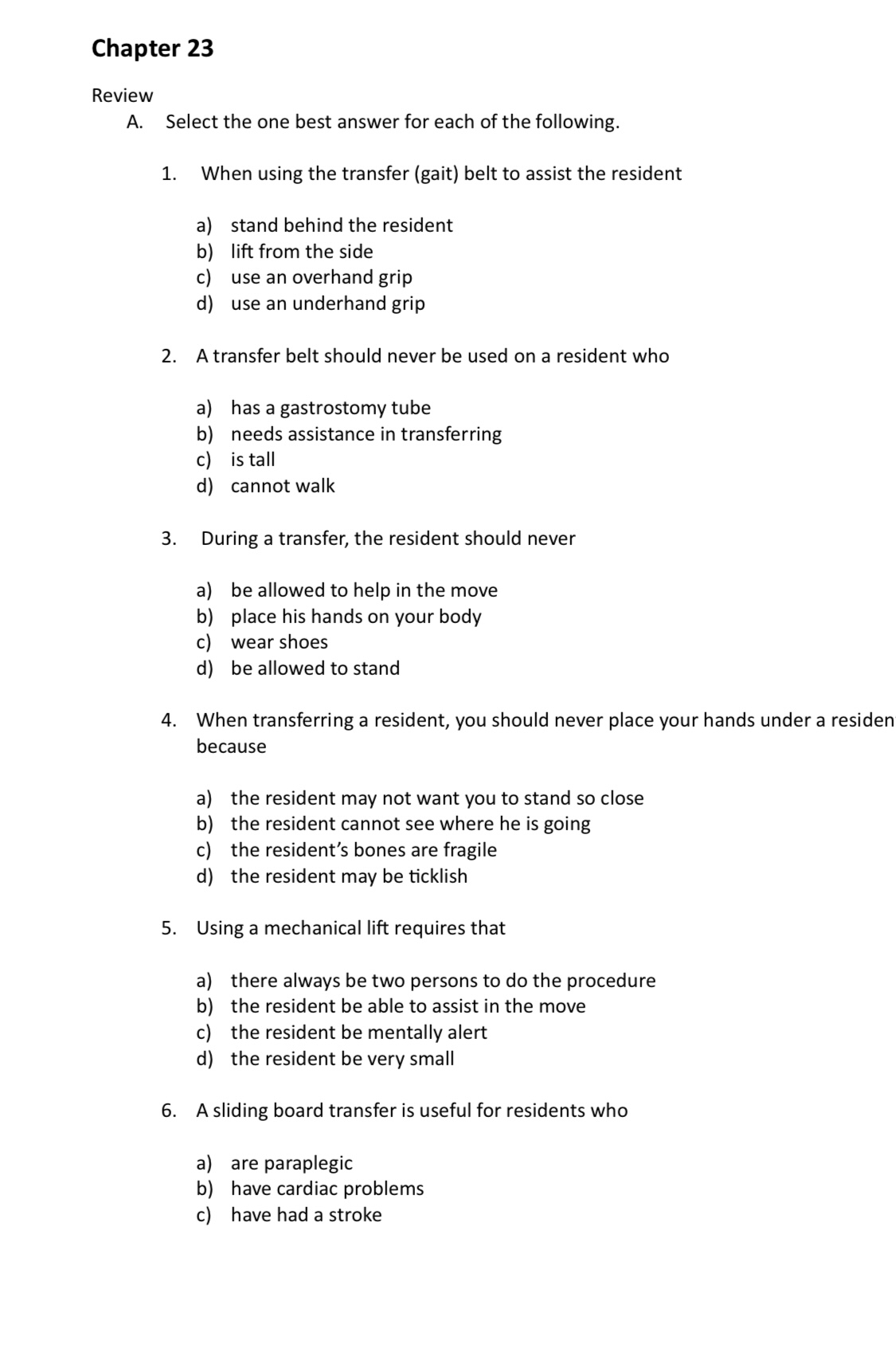
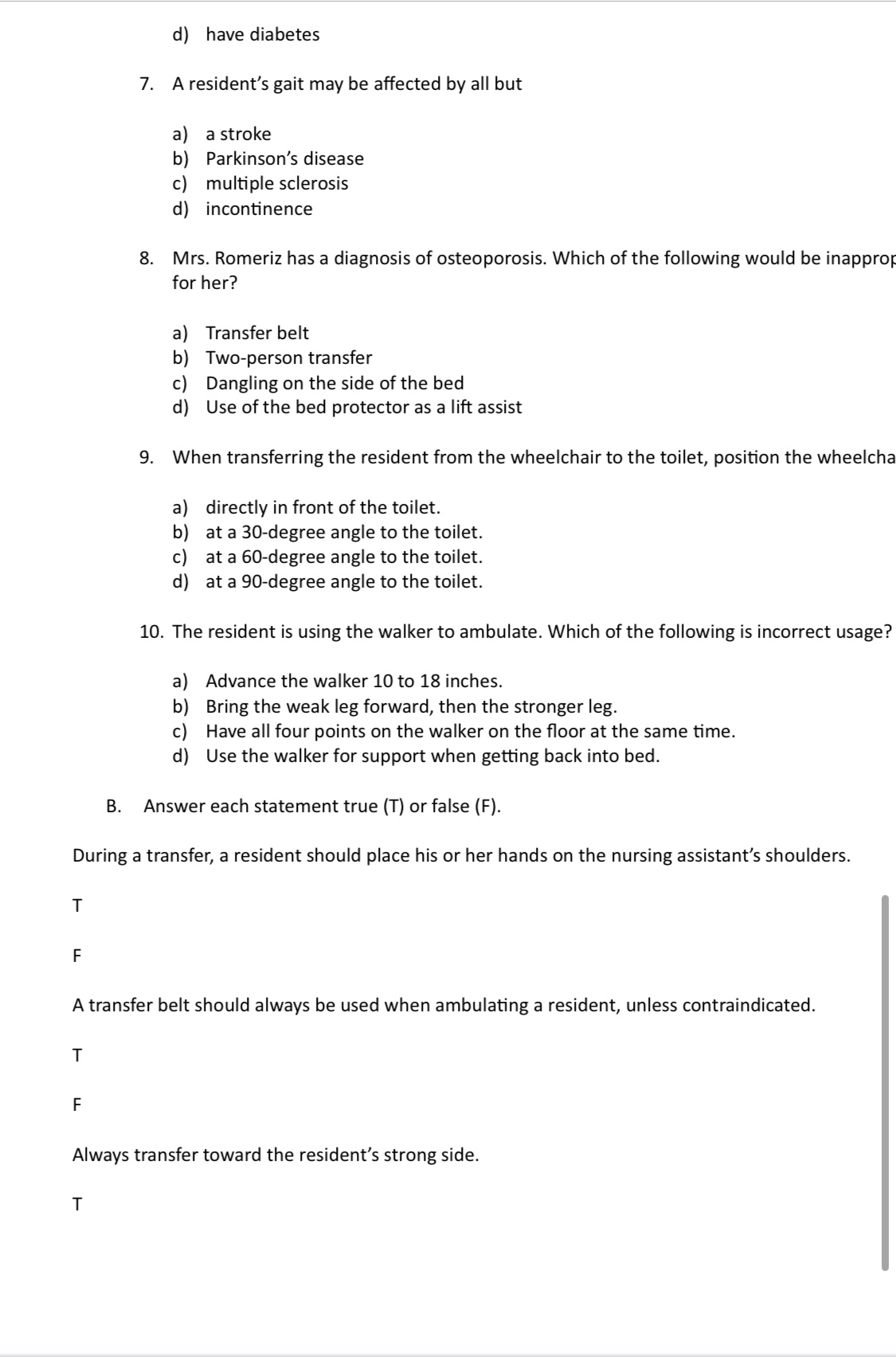

\f\fChapter 23 Review A. Select the one best answer for each of the following. 1. When using the transfer (gait) belt to assist the resident a) stand behind the resident b) lift from the side c) use an overhand grip d) use an underhand grip A transfer belt should never be used on a resident who a) has a gastrostomy tube b) needs assistance in transferring c) is tall d) cannot walk During a transfer, the resident should never a) be allowed to help in the move b) place his hands on your body c) wear shoes d) be allowed to stand When transferring a resident, you should never place your hands under a residen because a) the resident may not want you to stand so close b) the resident cannot see where he is going c) the resident's bones are fragile d) the resident may be ticklish Using a mechanical lift requires that a) there always be two persons to do the procedure b) the resident be able to assist in the move c) the resident be mentally alert d) the resident be very small A sliding board transfer is useful for residents who a) are paraplegic b) have cardiac problems c) have had a stroke d) have diabetes 7. A resident's gait may be affected by all but a) a stroke b) Parkinson's disease c) multiple sclerosis d) incontinence 3. Mrs. Romeriz has a diagnosis of osteoporosis. Which of the following would be inappro; for her? a) Transfer belt b) Two-person transfer c) Dangling on the side of the bed d) Use of the bed protector as a lift assist 9. When transferring the resident from the wheelchair to the toilet, position the wheelcha a) directly in front of the toilet. b) at a 30-degree angle to the toilet. c) at a SCI-degree angle to the toilet. d) at a 90-degree angle to the toilet. 10. The resident is using the walker to ambulate. Which of the following is incorrect usage? a) Advance the walker 10 to 18 inches. b) Bring the weak leg forward, then the stronger leg. c) Have all four points on the walker on the floor at the same time. d) Use the walker for support when getting back into bed. B. Answer each statement true (T) or false (F). During a transfer, a resident should place his or her hands on the nursing assistant's shoulders. T A transfer belt should always be used when ambulating a resident, unless contraindicated. T Always transfer toward the resident's strong side. T When pushing the wheelchair you should go forward over thresholds or uneven surfaces. T Always explain what the assistant is doing and what the resident can do to help. T Towel bars are not safe to use as grab bars. T Always hold a cane on the weak side. T When using a walker, the front two tips of the walker should strike the oor rst and then the back 1 tips should strike the oor. T
Step by Step Solution
There are 3 Steps involved in it

Get step-by-step solutions from verified subject matter experts