







Question: Answer the following questions. Include all graphs. Typed work. '. r QUESTION FIVE (a) In a perfectly oompetitive market, a firm's average revenue and cost
Answer the following questions. Include all graphs. Typed work.
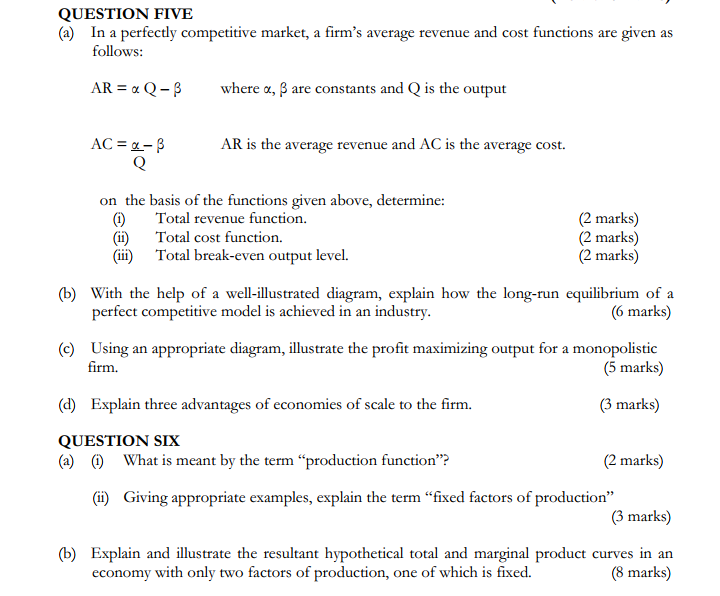
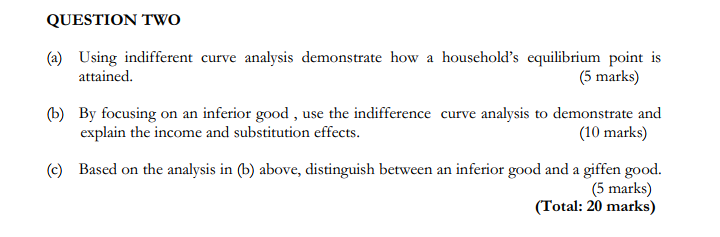
'\\. r QUESTION FIVE (a) In a perfectly oompetitive market, a firm's average revenue and cost functions are given as follows: AR = tit Q f3 where at, :3 are constants and Q is the output AC = tx_ 13 AR is the average revenue and AC is the average cost. Q on the basis of the functions given above, determine: (i) Total revenue function. (2 marks) (ii) Total cost function. (2 marks) (iii) Total break-even output level. (2 marks) {In} lWith the help of a well~illustrated diagram, explain how the longvrun equilibrium of a perfect competitive model is achieved in an industry. {15 marks} (c) Using an appropriate diagram, illustrate the prot maximizing output for a monopolistic rm. (5 marks) {d} Explain three advantages of economies of scale to the rm. (3 marks) QUESTION SDI (a) (i) What is meant by the term \"production function\"? (2 marks) (ii) Giving appropriate examples, explain the term \"xed factors of production" (3 marks) (In) Explain and illustrate the resultant hypothetical total and marginal product curves in an economy with only two factors of production, one of which is xed. (8 marl-rs) QUESTION TWO (a) Using indifferent curve analysis demonstrate how a household's equilibrium point is attained. (5 marks) (b) By focusing on an inferior good , use the indifference curve analysis to demonstrate and explain the income and substitution effects. (10 marks) (c) Based on the analysis in (b) above, distinguish between an inferior good and a giffen good. (5 marks) (Total: 20 marks)
Step by Step Solution
There are 3 Steps involved in it

Get step-by-step solutions from verified subject matter experts
 Study Help