



Question: Answer the following questions, no work is absolutely needed- just brief explanations. On October 21, 2001, Ian Ashpole of the United Kingdom achieved a record
Answer the following questions, no work is absolutely needed- just brief explanations.
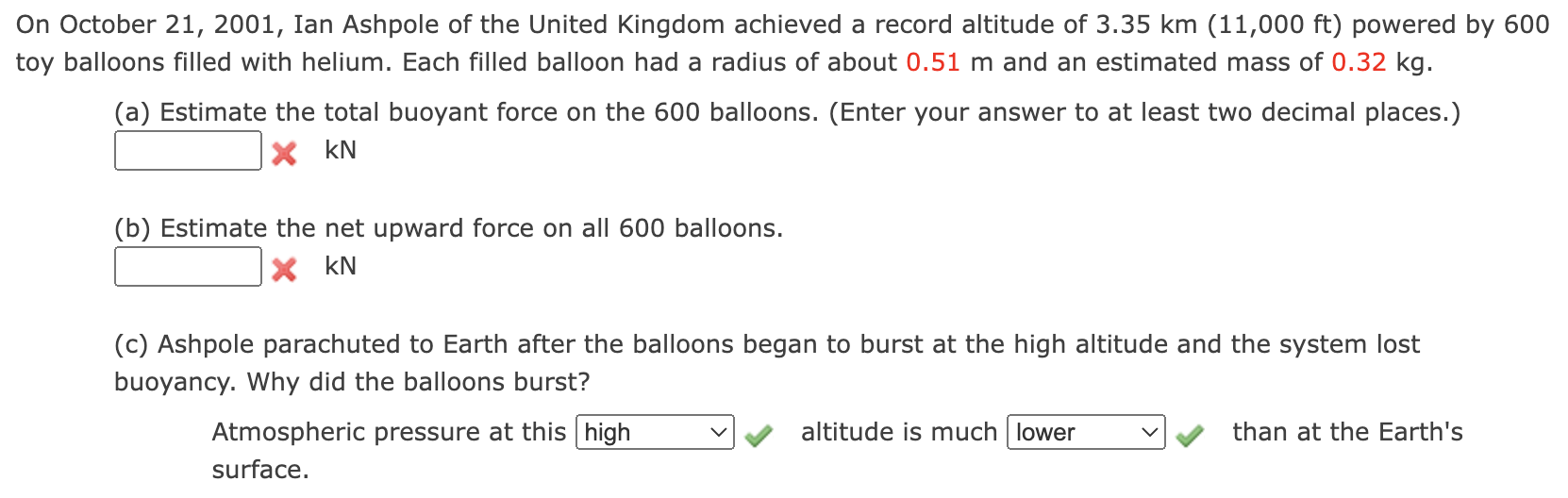
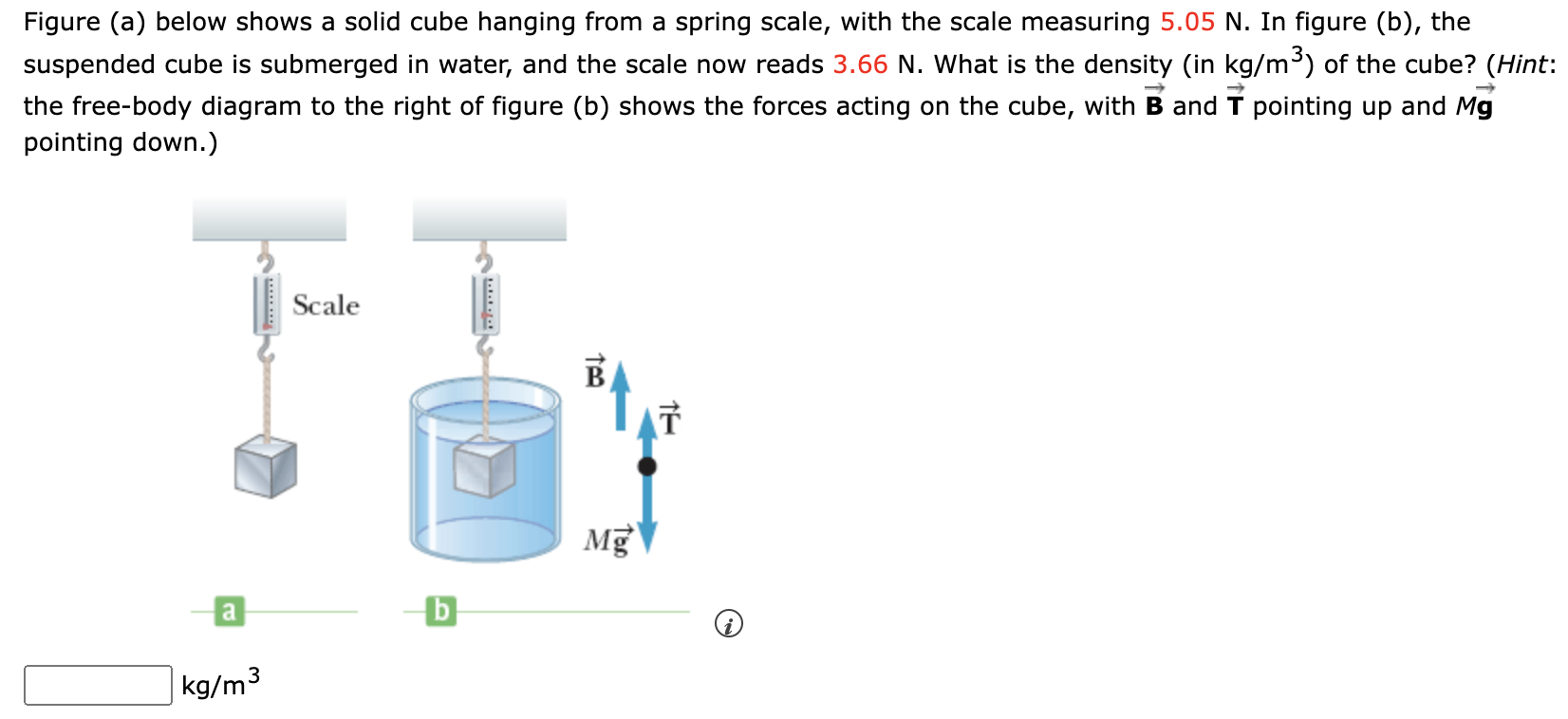
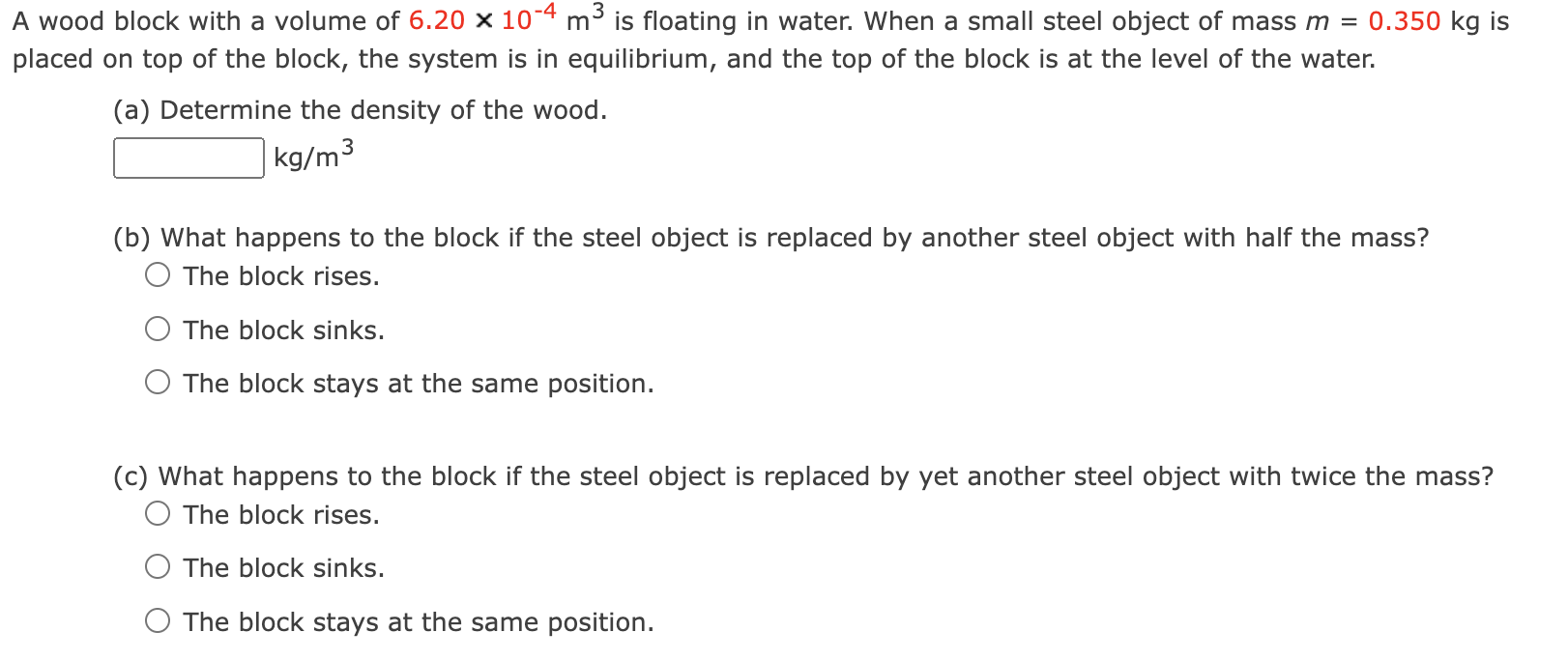
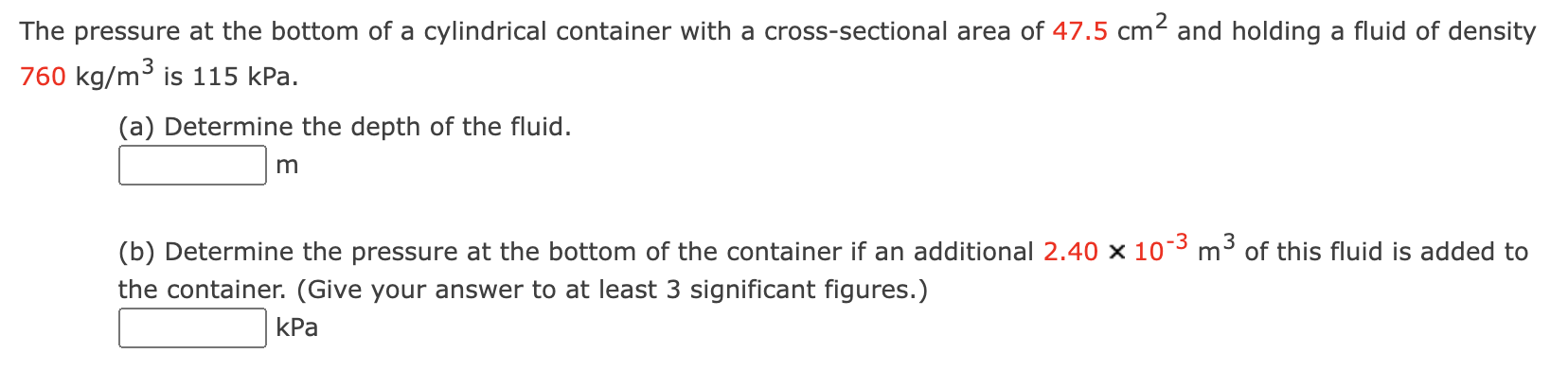
On October 21, 2001, Ian Ashpole of the United Kingdom achieved a record altitude of 3.35 km (11,000 ft) powered by 600 toy balloons filled with helium. Each filled balloon had a radius of about 0.51 m and an estimated mass of 0.32 kg. (a) Estimate the total buoyant force on the 600 balloons. (Enter your answer to at least two decimal places.) :lx m (b) Estimate the net upward force on all 600 balloons. :lx m (c) Ashpole parachuted to Earth after the balloons began to burst at the high altitude and the system lost buoyancy. Why did the balloons burst? Atmospheric pressure at this J altitude is much than at the Earth's surface. Figure (a) below shows a solid cube hanging from a spring scale, with the scale measuring 5.05 N. In figure (b), the suspended cube is submerged in water, and the scale now reads 3.66 N. What is the density (in kg/m3) of the cube? (Hint: the free-body diagram to the right of gure (b) shows the forces acting on the cube, with E and i" pointing up and M3 pointing down.) '5. Scale 5 A wood block with a volume of 6.20 x 10'4 m3 is floating in water. When a small steel object of mass m = 0.350 kg is placed on top of the block, the system is in equilibrium, and the top of the block is at the level of the water. (a) Determine the density of the wood. |:]kg/m3 (b) What happens to the block if the steel object is replaced by another steel object with half the mass? 0 The block rises. O The block sinks. O The block stays at the same position. (c) What happens to the block if the steel object is replaced by yet another steel object with twice the mass? 0 The block rises. O The block sinks. O The block stays at the same position. The pressure at the bottom of a cylindrical container with a cross-sectional area of 47.5 cm2 and holding a fluid of density 760 kg/m3 is 115 kPa. (a) Determine the depth of the fluid. :lm (b) Determine the pressure at the bottom of the container if an additional 2.40 x 10'3 m3 of this fluid is added to the container. (Give your answer to at least 3 signicant figures.)
Step by Step Solution
There are 3 Steps involved in it

Get step-by-step solutions from verified subject matter experts