







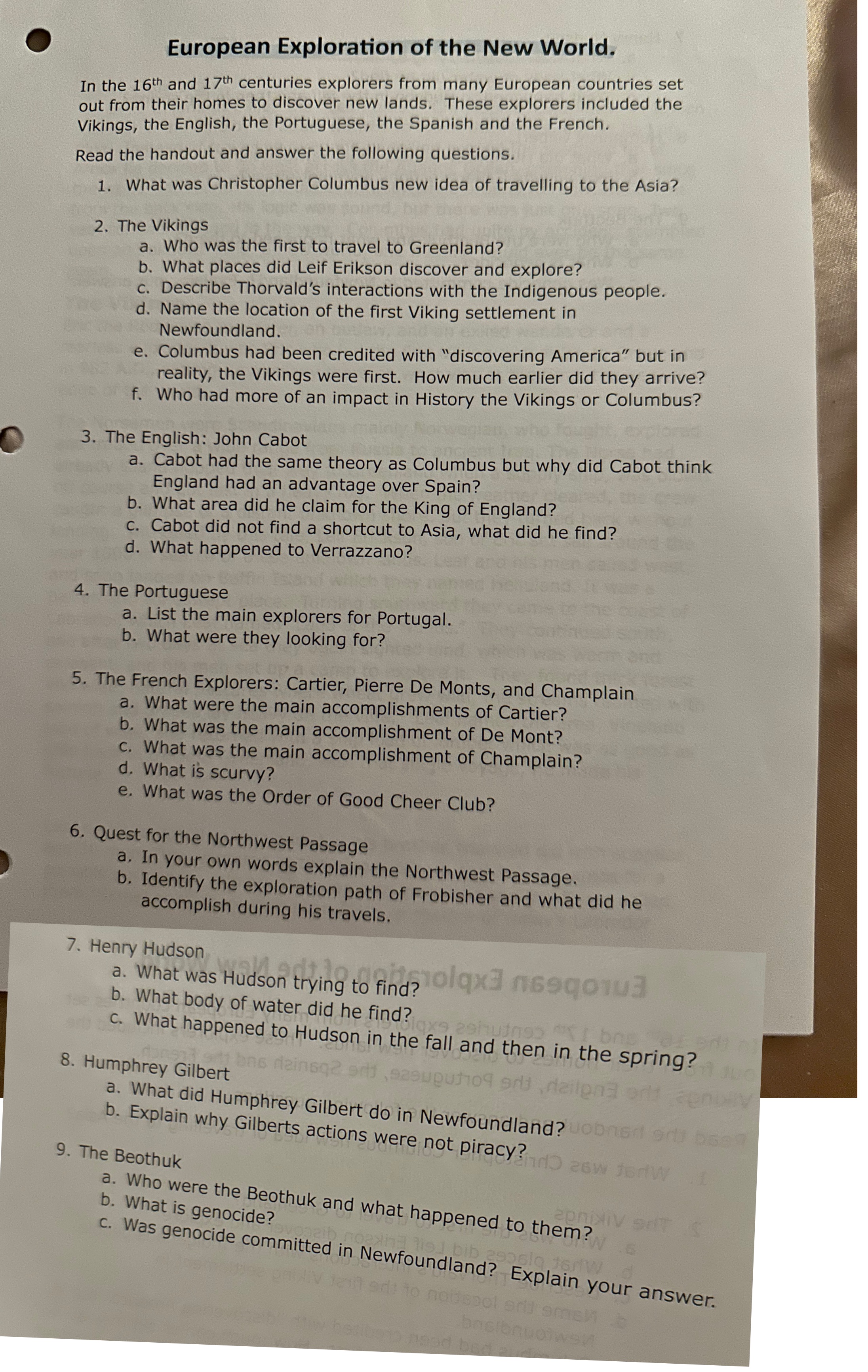
Question: *Answer the following questions that are in the attachment** Using what the information below to answer the questions. The European Explorers;First Contact:In 1492 Columbus sailed
*Answer the following questions that are in the attachment** Using what the information below to answer the questions. The European Explorers;First Contact:"In 1492 Columbus sailed the ocean blue..." Christopher Columbus, an Italian mariner in the employ of Spain wanted to reach the Indies, but he had an idea. Instead of travelling overland or sailing around the southern tip of Africa he decided to go west across the Atlantic Ocean, reasoning that since the world was round, he would eventually circle around to reach the orient from the back side. His logic was sound, but there was just one snag. Two vast continents stood in the way. Columbus had quite by accident, stumbled upon an unknown land, a new world, and nothing would ever be the same again.The Vikings:Eric the Red was a murderer, an outlaw, and an exiled wanderer and a fearless explorer. It was Eric who led the first Viking expedition to Greenland in 982 A.D., setting up a colony there on what was at the time, the very edge of the world.The Norsemen were Scandinavians mainly Norwegian, who fought, explored and traded over a wide range from Russia to ancient Iraq. The Norse had already island hopped their way to Greenland when a supply ship, was blown off course and got lost in a heavy fog. When the weather cleared, the crew caught a glimpse of a distant unknown shore, but they turned back without landing. Intrigued by this tale, Leif Erickson, son of Eric set sail around the year 1000 in search of these unknown lands. Leaf and his men sailed west, and soon landed on Baffin Island which they named Helluland. It was a barren and windswept place. Turning southward they came to the coast of Labrador, which Leaf named "Land of the Woods." They continued south, and after two days at sea they again sighted land, which was warm and pleasant, and his men set up a camp to explore it. They found thick forest and wide, natural pastures where wheat grew wild, the streams teamed with salmon and grapes lay heavy on the vine. Leaf named the area, Vineland land of wine, and returned with a ship load of lumber which was as good as gold back in treeless Greenland, with that single voyage, he made his fortune.Leaf never returned to Vineland, but his brother Thorvald did with supplies and 30 men. They wintered at temporary camps and scouted areas for a possible permanent colony. They ran into the locals and the Norse called them "Skraeling's", they were most likely ancestors of today's Labrador Indigenous people or perhaps the Beothuk. It was Thorvald, who first encountered them. It happened during his explorations along the Labrador coast when his men came upon nine indigenous, people asleep. The Norsemen attacked killing all but one who managed to escape. The Indigenous people then returned in full force and a major battle ensued. Thorvald was hit by an arrow and died soon after. This was the first recorded contact between European and Indigenous people.Around 1012 A.D. A major expedition was launched, three ships with 160 settlers and assorted livestock cows, pigs, goats, etc. They settled in Newfoundland and the following year a baby boy was born named Snorri. He was the first European child born in the New World.The Norse settlers traded with the Indigenous groups in the area, but the relationship was strained, and often turned into violence. Bad weather, and the constant threat of Skraeling attacks took their toll, as did the physical and psychological isolation. The Vikings eventually abandoned their Vinland colonies, though they did continue to make occasional village visits to North America for hundreds of years. As noted, the contact with Indigenous people was not always hostile. There are records of renewed trade between the two and Viking material has been found in several northern Inuit communities.Historians agree that a Viking settlement was built near L'Anse aux Meadows on the northern tip of Newfoundland. It wasn't until the 1960s that a team of Norwegian archeologists confirmed this to be true. Almost 50 years later, the remains of the Norse settlement were unearthed. The site contained homes, workshops, a bathhouse, a kiln, and a blacksmith forge marking the first time that iron was smelted in the New World. Archeologists also uncovered a wool spinning tool, which is especially important, because it gives clear evidence that the Vikings had brought their wives with them, and they intended to stay. But what the site didn't contain was just as significant. There were no large or extensive garbage piles suggesting that the community itself was short-lived, lasting perhaps only a few years. It is a remarkable site, nonetheless. In 1978, L'Anse aux Meadows was declared a United Nations world heritage site.The Vikings were here 500 years before Columbus. Even today, evidence continues to be discovered. Norse spinning yarn thought to be 800 years old was discovered on Baffin Island in 1984 and Norse artifacts, woven cloth, iron fragments, ship rivets, a carpenter's plane and even chain mail has been discovered as far north, as Ellesmere Island, well above the Arctic Circle. In 2000 Newfoundland celebrated the 1000th anniversary of the arrival of the Vikings. An event that included a replica Norse ship built and captained by a descendant of Leif Erickson.Still, it is important, not to overstate the significance of the early Viking expeditions to the world. The Vikings are really just a footnote in Canadian history. A fascinating footnote to be sure, but still just a footnote. The voyages of Christopher Columbus on the other hand had a huge impact.Columbus changed the course of human history forever. The Vikings did not they came they saw, and then they went home.John Cabot:John Cabot was a contemporary of Christopher Columbus, and, like Columbus he was born in the Italian seaport of Genoa and raised in Venice.There is a distinct possibility that the two explorers had known each other in their youth. Certainly, John Cabot had independently come to the same conclusion that the world was round and that by sailing west across the Atlantic, you would eventually circle around and reach Asia from the other side. It was a simple but brilliant idea. Cabot was in Spain when the news broke that Columbus had reached the Indies by just such a route. Cabot tried to get backing for a similar expedition, but failed so he went to England instead to look for financial support from the wealthy spice merchants of Bristol. Why, England? Two reasons, first Spain had already claimed the middle latitudes, but just as importantly Cabot reasoned that if the world was indeed a globe the distance would become narrower the farther north you went. England thus would be closer to Asia than Spain. Cabots logic was correct. There was just one problem. An entire continent blocked way.The English King Henry VII, still kicking himself for having passed on the chance to sponsor Columbus's original expedition was told of Cabots plans, and he quickly gave his Royal approval. No money, just approval. Cabot was only able to outfit a single ship, the Matthew, with a small crew of 18 men because of the lack of money. In May 1497, just five years after Columbus's first voyage, Cabot sailed from Bristol, his destination the distant isles of the Orient - surprise surprise he got as far as Newfoundland or maybe Cape Breton Island. No one is sure exactly where he landed. Cabot made quick work of it anyway, he erected a large cross and laid claim to the "New Founde Land" in the name of the King of England. He never did find a route to China, but he did find some thing just as valuable: fish. Lots of fish. The seas off the Grand Banks were swarming with cod. Was Cabot really the first? There is some indication that the Grand Banks were well known to Bristol fisherman long before John Cabot set sail, and that he merely broke a trade secret. Either way with Cabots discovery the word was out. A new continent had been discovered. The strange disappearance of John Cabot:No gold, but lots of fish, Henry VII awarded Cabot for his discoveries with an annual pension and granted him permission for another voyage. In 1498John Cabot set out on a second expedition again in search of the Northwest Passage to the Orient. This time however, he had a crew of 300 men and a fleet of five ships. It was all hoopla and excitement heading out, but there are no records of Cabot ever returning. Because of this, most historians assume the Cabot must have perished on route and he did not ever reach China.From Cabot to Cartier:After John Cabots discovery, they were soon hundreds of ships prowling the waters off the Grand Banks. They came from England, Spain, France and Portugal, but no one seemed interested in setting up a long-term permanent settlement in the new world. The Basques (people from the southern area of Spain and France) maintained a whaling station in Newfoundland for more than 50 years but it was not a long-term settlement.It wasn't until 1524 that France got around to sending an official expedition to the area. The King of France authorized Italian explorer Giovanni da Verrazano to look for a short northern route to the Orient, although Verrazano didn't find any such passage. He did establish a French claim on the eastern seaboard of North America. Sadly, Verrazano himself was later captured and eaten by cannibals in the Caribbean. It was a tough life being an explorer!The Portuguese:???Gaspar Cort-Real, a Portuguese nobleman, skirted the shores of Newfoundland as early as the year 1500. The following year he returned with his brother Miguel and a fleet of three ships. The brothers captured and took as many as 50 indigenous people as slaves. He sent the prisoners back to Portugal, and then steered his own ship towards the Canadian mainland.He vanished without a trace. When Gaspard failed to return, his brother Miguel set off with three ships to find him. He never came back either, so a third brother got ready to search for Miguel, who was searching for Gaspar, but the Portuguese King intervened and refused to let the third brother go.The French: In 1534 Jacques Cartier, sailed out of the French port of St. Malo with two ships and a crew of 61 men. His mission, to discover certain isles and countries where it is said that there must be great quantities of gold and other riches. Unlike Cabot, Cartier knew exactly where he was going. He had probably accompanied Verrazano on an earlier, failed quest for the passage to the Orient and he certainly had been to the cod fisheries of Newfoundland at some point.Cartier made one important discovery right at the start. By sailing through the narrow northern strait, he proved that Newfoundland was in fact, an island. Next, he sailed up the coast of what is now, New Brunswick where he met enthusiastically with the band of Micmac, who are well-versed in trade, and eager to acquire European goods.Cartier followed the coastline north to the Gaspe Peninsula where he made contact with a group of Iroquois people who were on a seasonal fishing expedition. In the presence of their Chief Donnacona, the French explorer erected, a large wooden crossed that claimed the land for the King of France. Donnacona was understandably upset at this and despite the language barrier, the chief knew full well, that Cartier was up to no good, and he angrily denounced the explorers' actions. This early confrontation between European imperial claims and indigenous ancestral rights is an important moment in Canadian history. To sooth the irate Chief, Cartier told him that the cross was merely a navigational marker and not a claim of ownership. Cartier plied Donnacona with gifts, hoping to win him over and then as a show of good faith, he kidnapped two of Donnacona's two sons, and headed back to France.The two young men that Cartier kidnapped were taken back to France and given language lessons so they could act as interpreters on later voyages.History tells us very little of the terrifying culture shock they must have experienced - it would be like being whisked away to another planet, on board a UFO. They did lead Cartier back to their home village the following year. In 1535, spurned on by the rumours of a magical kingdom the indigenous people called Saguenay. Cartier left St. Malo with three ships and the crew of 110 men, guided by his two captives. Cartier sailed into the mouth of the St. Lawrence River to the site a present-day Quebec City. Chief Donnacona was there to meet them and was overjoyed seeing his sons again, but he treated Cartier coldly. Later, Cartier expressed an interest in sailing farther upriver, where he soon came upon an even larger village, present-day Montreal. The village was impressive, 50 long houses, open fields, and Palisade walls. More than 1000 people came out to greet Cartier and he was led on a royal procession through the village. Cartier climbed a nearby hill, which he named Mount Royal and planted yet another cross in the name of France (Mount Royal, which would later become pronounced Montreal).Cartier and his men suffered through a harrowing winter. Scurvy, a crippling disease caused by a simple vitamin C deficiency ravaged his crew killing 25 men. Concerned, the Indigenous people provided Cartier with a cure of boiled Cedar, and in exchange, Cartier introduced several new infectious diseases to their community. Bad deal for the Indigenous people!Cartier then upped the ante, taking Chief Donnacona prisoner, along with four others. As Cartier prepared to sail back to France the Indigenous people tried to barter for the Chiefs life offering Cartier five other prisoners as gifts instead. Cartier took them as well. He left for home in the spring of 1536 with a total of 10 prisoners! He was a very talented kidnapper.Donnacona never made it home again. He died in France far from his family. Only one of Cartier's captives survived and she remained in France. When Cartier finally returned more than five years after he kidnapped their Chief, he found that their mood had soured considerably. Hmmm, I wonder why?Cartier attempted to establish a French colony along the St. Lawrence, but violence stood in his way. Thirty-five colonists had been reported killed in conflict with the local Iroquois. Cartier had enough and he left for France with a handful of gold, and some Canadian diamonds he had manage to excavate. In the end, the gold was iron pyrite "fools gold", and the diamonds were mere quartz. Cartier had achieved a lot, even though he did not find any great wealth. He discovered and charted one of the worlds greatest rivers, the St. Lawrence and he had given France a claim on the mainland.Champlain to the rescue!: Samuel de Champlain managed to establish and maintain a permanent French colony on the mainland of North America. This marked an important shift in Canadian History, from exploration the settlement. Fur trade and the French desire to send missionaries to spread Christianity now pushed France to explore.St. Croix island. In 1604 not a single European settlement existed north of Florida. A few fishing stations had been built on Newfoundland and along the shores of the St. Lawrence but nothing permanent had taken root.The adventurous French trader Pierre de Monts decided to change that once, and for all. With a young Champlain, tagging along as a sort of unofficial navigator/mapmaker, de Monts set sail from France, with a group of nobleman, craftsmen, and Swiss mercenaries. De Monts arrived in the Bay of Fundy, and following the shore, eventually entered a river, he named Saint Croix for its cross like formation. There, on a small island in the middle of the river, de Monts build a settlement that included a grand residence for himself and rough barracks for the men, as well as a communal kitchen, a blacksmith stand, and even a small chapel. Most of the buildings were behind protective walls, with cannons at either end for defense. De Monts was fearful of an attack from the local indigenous people. He shouldn't have worried. It appears that the Indigenous people were more concerned for the French settler's survival. They wondered... didn't the French know that the river could get blocked with ice during the winter? Apparently not. The island, de Monts thought was roughly in line with the south of France on the globe so how cold can it possibly get?That year snow began falling on October 6 by early December there were ice flows in the river, and it would turn out to be one of the bitterest winters in 100 years. De Monts and his men suffered terribly. Stricken with scurvy, their gums bled and turn black, their teeth became loose and fell out, their arms and legs became swollen, and a terrible pain convulsed through their stomachs and bowels. Trapped on the island for weeks on end, terrified of an impending indigenous attack they began to die one by one. The bodies piled up and by spring 36 of the original 80 colonists were dead.Port Royale - De Monts attempt at establishing a beachhead on Saint Croix Island was near disaster. But rather than give up, he moved the settlement across the Bay of Fundy to a cove he called Port Royale on the inner shore of what is now in Nova Scotia. This area would soon become the colony of Acadia. Port Royale was the first successful European presence on the mainland of Canada. At Port Royale, de Monts built a single interconnected habitation, with Palisade walls, a central courtyard and cannons for protection. He also planted a garden, something that history books call a first, even though several first nation groups had been farming extensively for hundreds of years in the area.The Order of Good Cheer Social Club was founded by Champlain as a way of maintaining morale among the scurvy ridden Port Royale colonists over the winter. Members of the Order took turns arranging entertainment and festive meals for the others.Quebec City - De Monts left Port Royale and returned to France in 1607 in a bit of a huff after the French crown cancelled his trade monopoly.Although he never returned to the New World, DeMont still remain active in pursuing trade and encouraging settlement. In 1608, Samuel de Champlain sailed up the St. Lawrence River with a small band of colonists. Where the river narrows a great natural rock formation rises. It was there at the base of these cliffs that Champlain built his habitation, a cluster of connected buildings modelled on Port Royale. Samuel de Champlain had a tough assignment. That first winter scurvy again took a deadly toll, 20 of Champlain's 28 men died, a terrible death rate, but those eight survivors proved it could be done and a new colony was born. No one is exactly sure what happened to the St. Lawrence Iroquois during the 70 years between Cartier's visit and Champlain, but European disease appears to have played a major role in their disappearance.Quest for the Northwest Passage:It was driving the Europeans crazy, at every turn Columbus 's shortcut idea to the Orient was blocked by a vast land. Other explorers sailing north had demonstrated that the coast was continuous from Florida all the way to the Bay of Fundy and Cartier had dashed any hope that the St. Lawrence might be the passage to the Indies. Because England was the northern most of the newly emerging imperial powers. It was only natural that it would turn its gaze to the cold mysterious Arctic Ocean. Queen Elizabeth I was determined to have a trade route of her own, far from the Spaniards and across the shortest possible distance from England. The first great champion of the Northwest Passage concept was an explorer named Humphrey Gilbert.Gilbert thought that if ships could somehow manage to thread their way through the treacherous waters of the high Arctic, they would eventually reach the other side. So began the quest for the Northwest passage, one that would last more than 300 years and cost hundreds of lives and millions of dollars to achieve very little. The men who went in search of the Northwest passage took an enormous risk. They were sailing off the map into darkness.The Voyages of Martin Frobisher:In 1576, Martin Frobisher sailed into the Arctic Ocean on board his tiny ship the Gabriel. At the southern tip of Baffin Island, he entered the bay that now bears his name. What he had hoped, was a passage to China, turned out to be a fjord like dead end. Frobisher grew impatient. These were unknown lands and dangerous waters. He made tentative contact with the Inuit in the area and even took one on board to act as a pilot. But when 5 of Frobisher's men returned the pilot to shore, they were taken captive.Frobisher was livid, and in response, he took an Inuit hunter hostage. He had hoped to barter the hunter for his own men, but the tactic failed. Frobisher was forced to raise anchor and return to Europe without the missing sailors. The Inuit captive was taken back to England where he died soon after from the common cold. Frobisher's journey wasn't a total failure.As a gift for Queen Elizabeth, he brought back the horn of a strange sea, (Narwhal) and a small sample of rock that he thought might contain coal.Soon after he returned home a shifty assayer pronounced the rock had gold in it! Gold rush fever gripped the merchants and investors of London.Shares for the next journey sold at inflated prices and in the following year Frobisher set sail back to Baffin Island with three ships in tow. The focus now shifted from finding the Northwest Passage to discovering gold. After claiming the land in the name of Queen Elizabeth I, he began mining the black ore.Relations with the Inuit began to worsen, and hostility soon escalated into open conflict. In a barrage of arrows from the Inuit, Frobisher himself was hit in the buttocks, but he survived. Throughout the summer, Frobisher continued to search for the crew men who have been taken prisoner on the previous expedition. Sadly, although Frobisher came across traces of them.The men themselves were never seen again.First contact between the European and Indigenous people was going from bad to worse. Frobisher kidnapped a man, a woman and a small child and took them back to England and put on display.Frobisher brought back 160 tons of ore and Elizabeth was overjoyed. But before the ore was tested, Frobisher headed off again on the third voyage with an entire fleet of ships and some 400 men. His goal in 1578 was to mine the land and to set up in Northern English colony. After several mishaps on the ice flows, the fleet finally landed in Baffin Island, and immediately began chewing up the landscape. The idea of a Northern colony was quickly abandoned. Frobisher returned loaded down with more than 1200 tons of rock, he was convinced it was worth a fortune. But there was no gold in the ore, or at least very little. The load of rock was worthless.Much of it dumped overboard, the rest of it used in construction to repair manor walls. It was a scandal that ruined several of Frobisher's backers, and to this day the culprit behind fraud has never been determined.Frobisher himself appears to have been innocent. He remained in Elizabeths good books and was later Knighted for his role in defending the English from an invasion force from Spain. With the dream of arctic wealth gone, the north was once again perceived, as being not a destination, but an obstacle.Something to be conquered, something to be travelled through and a riddle to be solved.Henry Hudson:In 1610, Henry Hudson set sail in search of the Northwest Passage with a crew of 22 onboard his ship the Discovery. Hudson became the first person to navigate the treacherous straight that separates northern Quebec and Baffin Island, a bottleneck of arctic currents and unpredictable ice flows.Eventually he entered the bay that now bears his name, Hudson Bay. He was convinced that he had "won the passage" to the Orient and he set course due south for warmer weather but at the bottom of James Bay he ran into a dead end.Hudson and his men spent the rest of summer and then into autumn sailing back and forth trying to find a way through. It was no use, there was no way out and now winter had arrived. Hudson was forced to beach his ship and hunker down for the winter. Within 10 days the bay was completely frozen, and they were stuck. Hudson had not come prepared to winter in North America and his provisions were running dangerously low. The crew was put on starvation rations and was soon reduced to eating moss to survive. Henry Hudson was a bold navigator, but he was a poor leader. In today's terms he lacked people skills. In the spring it became clear to the crew that Hudson was planning to continue the search for the Northwest Passage - the crew rebelled in mutiny. Hudson, his son, and a few supporters (some loyal, some ill and some just plain unpopular) were set adrift on a small boat and never seen again.The mutineers considered becoming pirates and plundering the shore off the coast of Newfoundland but in the end, they decided to return home. On a small island off the coast of Northern Quebec the crew stopped to kill seas birds for food when they were ambushed by a group of Inuit hunters. Two crew died and two more were injured before they left for Europe. The ringleaders of the mutiny by this time had died.Sadly, for Hudson the English courts were more concerned with the Northwest Passage than punishing the mutineers. It is shameful how little concern Hudson's backers showed for him. In fact, they even sent one of the mutineers back to North America on Hudson's ship to continue the search for the passage and maybe look for Henry if there was time. Not a single mutineer was convicted for the crimes they committed.The drama of mutiny has long overshadowed Henry Hudson's very real accomplishments. He discovered the second great sea route into the Canadian interior: Hudson Bay. The St. Lawrence River belonged to the French; Hudson Bay now belonged to the English.The mystery of Henry Hudson:What happened to Henry Hudson and his small group set adrift in James Bay? Were they adopted by local indigenous people? Or killed out right? Did they even make it to shore?There are legends among the Inuit of a boat found a drift, filled with dead white men, and a single, shivering boy perhaps Henry's son? Other theories suggest that Hudson and the others were taken captive, and then sold into slavery to the indigenous people in northern Ontario, where a rock was reportedly found with the haunting inscription "H.H. 1612 captive" unfortunately, the rock can't be located and only a photograph of it remains.Another theory suggests that Hudson and the others somehow managed to navigate their way out of the Bay and across the Arctic Circle to the Norwegian island of Spitsbergen wear a grave marked Hudson was discovered in 1823. Fascinating but unlikely. A more plausible landing is that they took shelter on nearby Danby Island where a row of wooden stakes were discovered 20 years later. Were these the remnants of a makeshift shelter built by the outcasts? No one knows for sure. The fate of Henry Hudson remains shrouded in mystery.Don't be Salty:European Cod fishermen desperately wanted to fish off the Grand Banks. Demand was high because the Catholic nations of Europe were strictly meatless on Fridays, but how do you get the fish back home before they spoil? Salt!Salt comes from two places. It can be mined from underground, but that salt is too course to pack fish. The other option is "solar salt" Salt water taken from the sea and dried in the sun. Unfortunately, England's climate isn't suited for this because of its damp and foggy weather. The English developed a new method to preserve fish - drying. Fish would be brought to shore and dried. Then it was given a light dusting of salt and hauled back to England.England wanted to control the coast of Newfoundland to the Grand Banks. Humphrey Gilbert played a crucial role in England's move to take control Gilbert sailed into St. John's Harbour in the summer of 1583. Gilbert was actually on his way to establish a colony somewhere else, but he stopped in at Newfoundland and claimed it as well for good measure. Some 36 different ships - from Spain, Portugal, France, and England were in harbour at the time, but that didn't deter Gilbert. Waiving a Royal Charter, he announced that he was taking possession of Newfoundland in the name of Elizabeth I Queen of England. He then began confiscating supplies from the various ships and demanding tax payments. This might have looked like piracy but since he claimed the island first it was not theft it was taxation! He also proclaimed that the Church of England was now the official religion and that anyone making dishonourable remarks about Queen Elizabeth would have their ears cut off!Most historians consider Gilberts proclamation of August 5, 1583, as the true beginning of the British Empire with Newfoundland as its first colony.Gilberts time on this earth ended in an unheroic way. On his way back to England Gilberts flagship the heroically named "Squirrel" ran into a storm and went down with all hands.The Beothuk:The Beothuk hunted seals offshore and caught salmon in the rivers that emptied into the sea, Caribou herds long extinct once migrated down the interior Newfoundland, every autumn and the Beothuk moved inland to intercept them building elaborate fence pounds to corral them in.The Beothuk were wary of whites and the first settlers, who came to their shores, gave them reason to be. The Irish and English fisherman, who moved into the coves, seasonally at first and later year-round, cut off to the Beothuk's access to both the sea, and the shore. These settlers - these trespassers - ignorant of the salmons' lifecycle began stringing nets across the rivers, disrupting the migration upstream and squeezing out the Beothuk's food supply. In retaliation the Beothuk began cutting nets and pilfering supplies from the settlers. And in turn the settlers, began shooting the Beothuk on sight. Tensions escalated. The killings lasted for more than 200 years, from 1613 to 1823 and ended only because by that point there were very few Beothuk left to shoot.If it was a war, it was a very lopsided one. The Beothuk never organized attacks, never launched indiscriminate massacres, and never killed a single woman or child. The white settlers did all the above. For more than 50 years it was perfectly legal to kill Beothuk and even after a proclamation was issued in 1769 making it a crime the killings continued anyway, an entire people were starved, hounded, and hunted into oblivion and not a single white settler was ever brought to any kind of real justice.In 1823 three Beothuk women - a mother and two daughters surrendered to white settlers. They were starving and were perhaps the last of their people.The mother, and one of the daughters soon died, leaving only one left. The last Beothuk died from tuberculosis. The Beothuk were gone forever an entire nation of people destroyed.Was this genocide? Local Newfoundland historians get quite upset when the extinction of the Beothuk people is referred to as a genocide. They insist that such charges are slander on the early settlers, that portrays them as vindictive and uncaring. Others believe the declining factor in the destruction of the Beothuk was the brutality of the early English settlers, who showed a total disregard for the humanity of the native population.nCalling it a genocide, makes some people queasy because the word conjures up Nazi death camps.The 1948 United Nations genocide convention states that genocide weather committed in time of peace, or in time of war, is punishable under international law.Genocide means any of the following acts committed with intent to destroy in whole, or in part, a national ethnic racial or religious group.A. killing members of the groupB. causing serious, bodily or mentor mental harm to members of the groupC. deliberately inflicting on the group conditions of life calculated to bring about its physical destruction in whole or in part.D. imposing measures intended to prevent births within the group and eat.E. forcibly, transferring children of the group to another group.By current war tribunal standards, the settlers in Newfoundland, who took part in the ongoing harassment and violence would have been indicted.The Beothuk were eliminated. Cut off from the coast and pushed back into the interior, they were starved out, hunted down, and persecuted.If it wasn't genocide, what was it?
Step by Step Solution
There are 3 Steps involved in it

Get step-by-step solutions from verified subject matter experts
 Study Help