







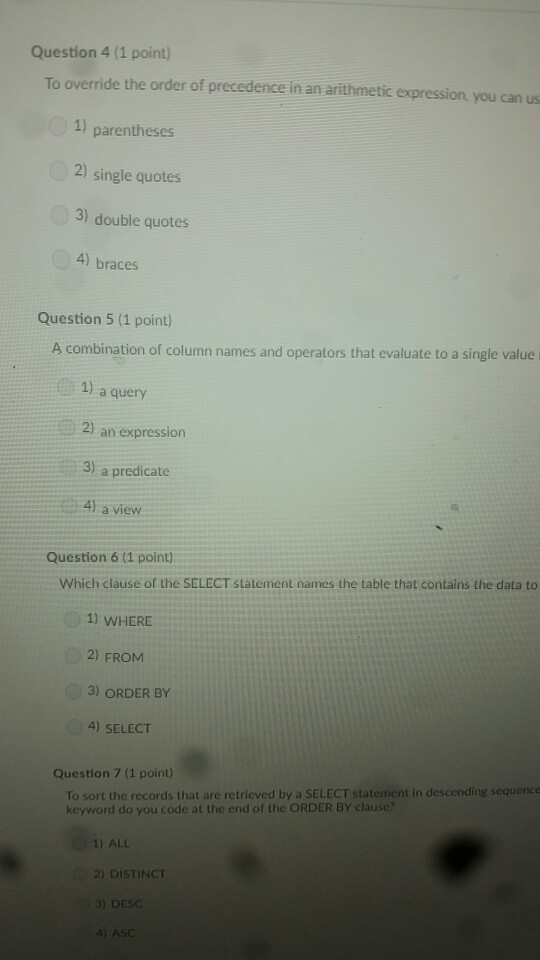
Question: answer the following seven SQL practice questions Question 4 (1 point) To override the order of precedence in an arithmetic expression, you can us 1)
answer the following seven SQL practice questions
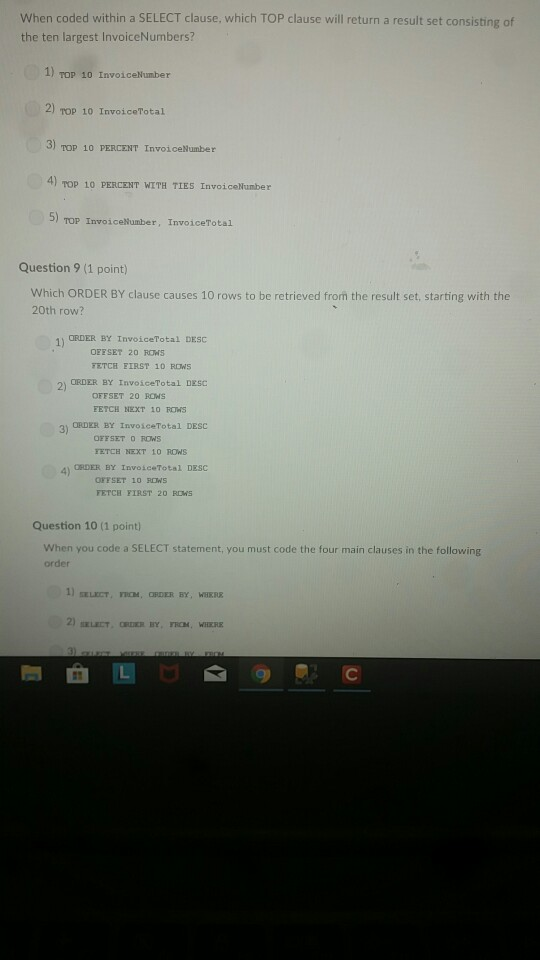
Question 4 (1 point) To override the order of precedence in an arithmetic expression, you can us 1) parentheses 2) single quotes 3) double quotes 4) braces Question 5 (1 point) A combination of column names and operators that evaluate to a single value 1) a query 2) an expression 3) a predicate 4) a view Question 6 (1 point) Which clause of the SELECT statement names the table that contains the data to 1) WHERE 2) FROM 3) ORDER BY 4) SELECT Question 7 (1 point) To sort the records that are retrieved by a SELECT statement in descending sequence keyword do you code at the end of the ORDER BY clause? 1) ALL 2) DISTINCT 3) DESC 4) ASC When coded within a SELECT clause, which TOP clause will return a result set consisting of the ten largest InvoiceNumbers? 1) LI TOP 10 InvoiceNumber 2) TOP 10 InvoiceTotal 3) TOP 10 PERCENT InvoiceNumber 4) TOP 10 PERCENT WIETH TIES Invoiceumber TOP InvoiceNumber, InvoiceTotal Question 9 (1 point) Which ORDER BY clause causes 10 rows to be retrieved from the result set, starting with the 20th row? 1)ORDER BY InvoiceTotal DEsc OFESET 20 ROWS FETCH EIRST 10 ROWS 2 ORDER BY InvoiceTotal DESC OFFSET 20 RONS FETCH NEXT 10 ROWS 3) ORDER BY IavoiceTotal DESC ETCH NEXT 10 ROWS 4) ORDER BY Invos ceTotal DESC OFFSET 10 ROWS FETCH FIRST 20 RKS Question 10 (1 point) When you code a SELECT statement, you must code the four main clauses in the following order 1) SELECT, ndM ORDER BY , WHERE KLECT ORDER BY, nad . WHERE
Step by Step Solution
There are 3 Steps involved in it

Get step-by-step solutions from verified subject matter experts
 Study Help