





Question: Answer the following theories with solution MULTIPLE CHOICE 1. In a process costing system that assumes that normal spoilage occurs at the end of a

Answer the following theories with solution
Answer the following theories with solution
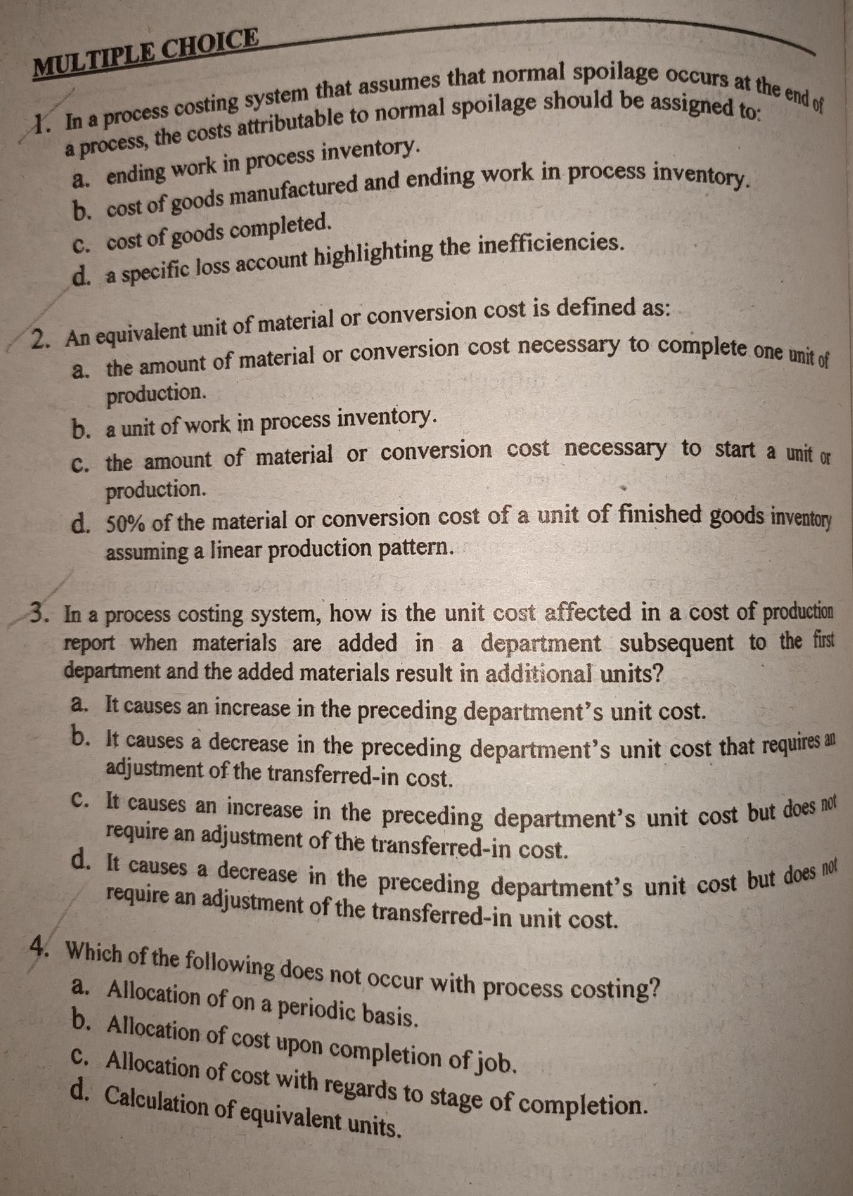
MULTIPLE CHOICE 1. In a process costing system that assumes that normal spoilage occurs at the end of a process, the costs attributable to normal spoilage should be assigned to: a. ending work in process inventory. b. cost of goods manufactured and ending work in process inventory. C. cost of goods completed. d. a specific loss account highlighting the inefficiencies. 2. An equivalent unit of material or conversion cost is defined as: a. the amount of material or conversion cost necessary to complete one unit of production. b. a unit of work in process inventory. C. the amount of material or conversion cost necessary to start a unit or production. d. 50% of the material or conversion cost of a unit of finished goods inventory assuming a linear production pattern. 3. In a process costing system, how is the unit cost affected in a cost of production report when materials are added in a department subsequent to the first department and the added materials result in additional units? a. It causes an increase in the preceding department's unit cost. b. It causes a decrease in the preceding department's unit cost that requires an adjustment of the transferred-in cost. C. It causes an increase in the preceding department's unit cost but does not require an adjustment of the transferred-in cost. d. It causes a decrease in the preceding department's unit cost but does not require an adjustment of the transferred-in unit cost. 4. Which of the following does not occur with process costing? a. Allocation of on a periodic basis. b. Allocation of cost upon completion of job. C. Allocation of cost with regards to stage of completion. d. Calculation of equivalent units

Step by Step Solution

There are 3 Steps involved in it

1 Expert Approved Answer
Step: 1 Unlock blur-text-image

Question Has Been Solved by an Expert!

Get step-by-step solutions from verified subject matter experts

Step: 2 Unlock
Step: 3 Unlock

Students Have Also Explored These Related Accounting Questions!