







Question: Answer the following Transformation questions, please include steps. 9} The graph of y = f (I) is reected in the x-axis, stretched vertically about the
Answer the following Transformation questions, please include steps.
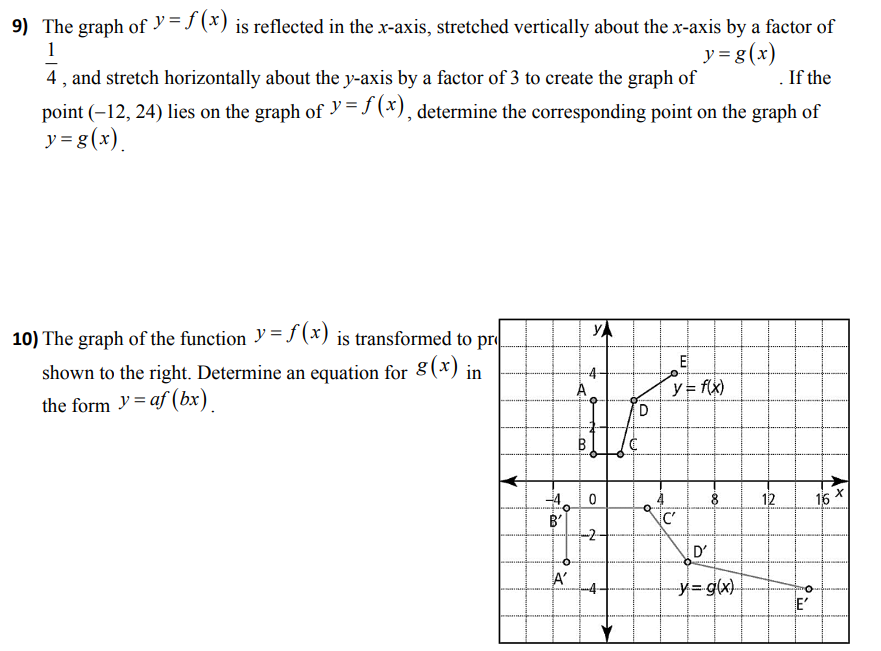
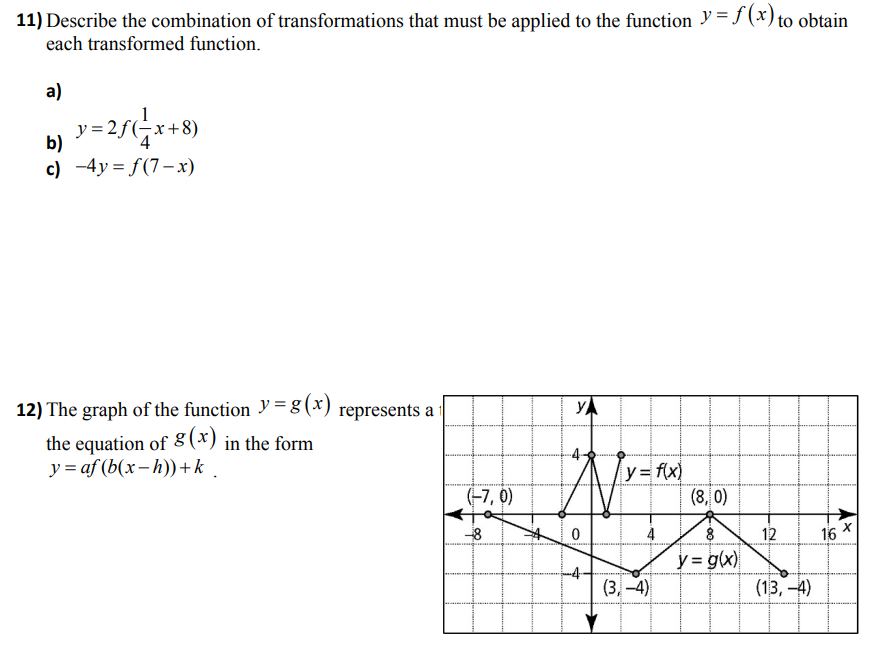
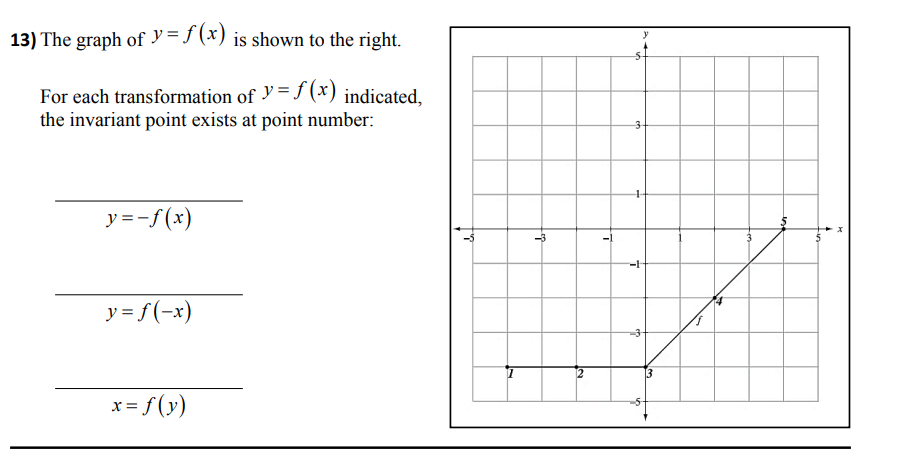
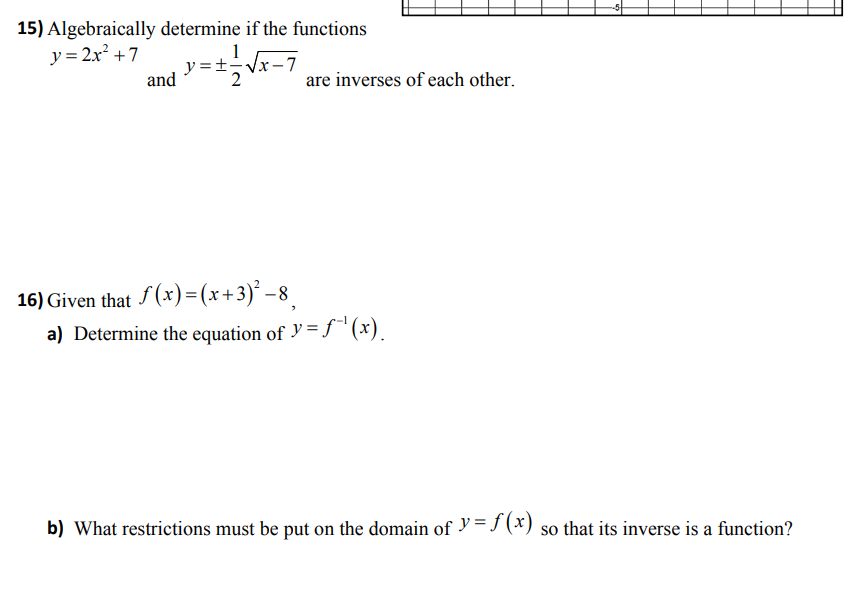
9} The graph of y = f (I) is reected in the x-axis, stretched vertically about the x-axis by a factor of l y=gU) E, and stretch horizontally about the y-axis by a factor of 3 to create the graph of . If the point (12, 24} lies on the graph of y = f (I) , determine the corresponding point on the graph of y=gUl 10} The graph of the function J' =f(x} is tansfomed to pr: . . . shown to the right. Determine an equation for g (x) in the form J' = 0\"\"), Mr..." awnI T"T"""T""'"':""'"=T"'\"% """"" 11) Describe the combination of transformations that must be applied to the function ) = f (x) to obtain each transformed function. a) b) y = 2f (x+8) c) - 4y = f(7-x) 12) The graph of the function ) = 8 (x) represents a YA the equation of 8 (*) in the form y = af (b(x - h)) +k . y =f(x) (-7, 0) (8, 0) -18 0 4 8 16 * y = g() (3. -4) (13, -4)13) The graph of y= f(x} is shown to the right. For each transfonnation of y = f (x) indicated, the invariant point exists at point number: 15) Algebraically determine if the functions y = 2x- +7 Vx- 7 and are inverses of each other. 16) Given that f (x) = (x+3) -8 a) Determine the equation of ) = f (x). b) What restrictions must be put on the domain of ) = J (*) so that its inverse is a function
Step by Step Solution
There are 3 Steps involved in it

Get step-by-step solutions from verified subject matter experts
 Study Help